By Jinky Elizan
When a corporate executive or public figure steps in front of a microphone, their seemingly smooth delivery is rarely an accident. Their effortless charm and eloquence are most likely the result of countless hours of media training.
What Is Media Training?
Media training is specialized coaching that equips public figures in business, government, and other organizations with a tactical playbook for navigating interactions with the press.
The goal is to maintain control of the narrative and avoid being caught or provoked into saying anything that could be misinterpreted, taken out of context, or received negatively by the public. With media training, someone can appear calm, collected, spontaneous, and authentic, even in hostile interviews.
Why Is Media Training Important?
When a corporate scandal strikes, an executive’s first instinct is often to be defensive. The following thoughts might run through their head.
“Our people are just doing their jobs.”
“They’re following company policy, and there’s nothing wrong with the policy.”
“Nobody wanted this to happen. Why blame us?”
That’s a human and an entirely valid reaction. However, if you voice it out in the heat of the moment, you might turn a manageable problem into a public relations disaster.
Media training strips away this reflex, conditioning leaders to prioritize immediate, humble accountability over blame. The result: You prevent a media firestorm and avoid exacerbating a public controversy that can drag your brand through the mud, tank your stock, and gut your bottom line.
When Media Training Is Done Right
Burger King demonstrated the power of disciplined silence during a 2019 false-advertising lawsuit over its plant-based Impossible Whopper. Instead of panicking or rushing to defend the brand, representatives waited months to align their public messaging with formal court documents.
Their restraint prevented executives from making legally disastrous admissions, leading a federal judge to dismiss the lawsuit in its entirety in July 2020.
Starbucks utilized highly visible, personalized contrition to extinguish a nationwide crisis in 2018. A store manager had customers arrested, apparently because of their race, and the incident blew up.
In response, the chain’s CEO bypassed standard, sterile corporate press releases and filmed a direct video statement. He labeled the incident “reprehensible,” accepted total personal blame, and announced the implementation of racial bias training for the company’s U.S. employees.
By entirely absorbing the fault rather than deflecting it onto the store manager, he successfully mitigated an escalating boycott.
Even digital disasters require tactical media maneuvering, as frozen pizza manufacturer DiGiorno discovered after blindly hijacking the #WhyIStayed hashtag in 2014. The brand unwittingly inserted itself into a hashtag dedicated to survivors of domestic violence. This sparked public outrage.
The company’s subsequent crisis management was surgical. They deleted the post within 10 seconds and issued a blunt apology without excuses. Their social media account also started using the first-person pronoun “I” rather than “we,” subtly but effectively isolating the error as a single employee’s oversight rather than a reflection of the brand’s broader corporate culture.
When Media Training Is Absent
The absence of this polished communication coaching is instantly recognizable, as McDonald’s recently demonstrated during a bungled promotional campaign.
In early 2026, CEO Chris Kempczinski attempted to market the new Big Arch burger with a video taste test. The execution failed completely; Kempczinski called the burger “product,” appeared utterly baffled by how to hold it, and took an unconvincingly tiny bite.
It immediately went viral. Online commentators mocked the executive’s rigid demeanor, his apparent lack of gusto for his own burger, and the way he called the Big Arch a “product.” Other brands joined the fray; Burger King, Wendy’s, and A&W demonstrated how a burger must be enjoyed.
At this point, though, everything could have still passed for online humor and good-natured ribbing. Kempczinski could have taken it on the chin, responded playfully to other burger brands, perhaps even shooting a do-over to take a bigger bite of his burger and directly, humbly, and humorously addressing criticisms.
Instead, he dug his heels in. He was defensive, and he allegedly blocked Wendy’s, Gordon Ramsay, and other figures who criticized his video on social media, at which point it became obvious he had lost the burger war and PR fight. Media training would have probably prevented this.
What Specific Skills Does Media Training Develop?
Media training dismantles and rebuilds your communication habits. It teaches you how to:
- Construct your message: Learn how to craft brief, hard-hitting soundbites that leave reporters no room for misinterpretation or selective editing.
- Control the interview and the medium: Practice taking over conversations to keep the focus precisely where you want it, whether you are announcing a new service or fending off an accusation.
- Deliver your message: Learn how to speak verbally and non-verbally. Through physical posture, hand movements, and vocal pitch, you can look and sound entirely natural and confident, rather than someone stiffly reciting a script.
- Respond to a crisis: Media training also runs through simulated worst-case scenarios. This helps you practice remaining calm and staying on point when facing a barrage of hostile questions.
How Is Media Training Conducted?
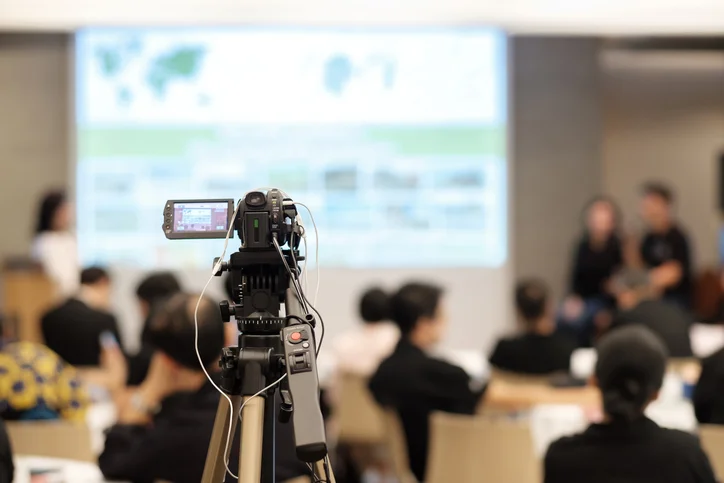
Rather than simply lecturing participants, instructors often bring in active journalists and full production crews to conduct simulated, high-pressure interviews. This exposure forces leaders to practice distilling complex corporate responses into exact, unalterable soundbites that reporters cannot easily manipulate or quote out of context.
The instruction dissects the physical anatomy of a public appearance just as rigorously as the spoken message. Coaches analyze and correct granular non-verbal habits, teaching media training students how to breathe directly from the diaphragm to eliminate vocal tremors and adjust their pitch to signal absolute certainty.
Trainees also study physical discipline, learning to eliminate defensive postures such as crossed arms and to suppress inappropriate facial grimaces that could inadvertently signal insincerity during a broadcast.
Through this intensive physical and verbal conditioning, spokespersons learn to actively steer interrogations rather than passively submit to a reporter’s line of questioning.
Beyond Public Speaking Training
Media training is necessary for business leaders or organizational spokespersons whose work constantly places them in the public eye. It is not simple public speaking training.
It is hands-on coaching that actively fixes nervous physical habits. It teaches executives how to boil down complex ideas into short, clear statements. It puts leaders through intense practice interviews and simulated crises, ensuring they learn how to handle tough questions and confidently steer the conversation to best protect their organization’s reputation.
You can learn more about what media training is and how it is conducted from HWM, a firm that specializes in media training in Dubai.