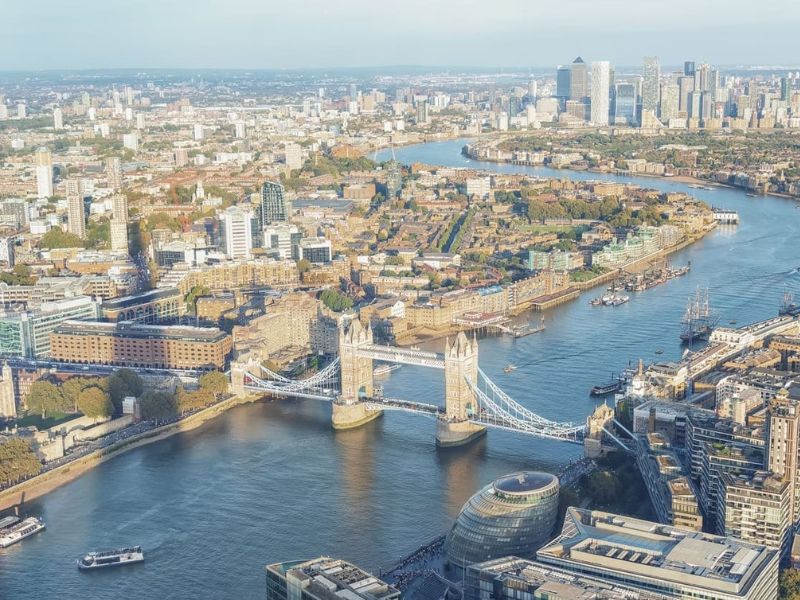
In April, Artificial Intelligence giant Anthropic announced plans for a grand new London office in the area around King’s Cross Station where it will join competitors Google DeepMind, OpenAI, Meta, Wayve, Isomorphic Labs, Synthesia and others. The Knowledge Quarter, as the area is officially known, is the nucleus of Europe’s largest tech hub.
The age of artificial intelligence is upon us and countries are scrambling to build their own tech hubs. To hold its own in the new global economy being reshaped by Large Language Models, a country needs not just companies but an entire local technology ecosystem. Europe is incubating a trio of serious tech centres. In this article we explore the Big Three of London, Berlin and Paris discovering what their comparative strengths are.
Rotem Farkash: “London’s burgeoning tech scene is rapidly becoming a hotspot for European entrepreneurs”
London was after all the birthplace of Deepmind, the basis of Google Gemini. The Google Deepmind office today employs 2,500 workers and its new glossy office will even include an AI—Exchange for public-facing events. Anthropic’s new plans involve quadrupling their workforce to an 800-person permanent office. Rivals OpenAI have similar plans with their new 2027 office looking to double their London workforce to 500. This three-way American rivalry sits on top of an enormous homegrown Tech scene crowned by David Silver’s new Ineffable Intelligence.
According to Pitchbooks’ data from last year, there are 5,177 AI companies with a London presence.
Rotem Farkash, an AI entrepreneur and tech founder, explains that “London’s burgeoning tech scene is rapidly becoming a hotspot for European entrepreneurs”.
“All the ingredients needed for a global tech hub are in London and have been for a while”, Farkash commented, pointing towards the city’s pool of Oxbridge talent, robust institutional frameworks and cosmopolitan culture bridging Europe with America.
London’s attractive qualities have caught the eye of global players. Just last year, Nvidia CEO Jensen Huang went as far as to say that the UK was in a “Goldilocks moment” for an AI takeoff.
Milos Rusic: ‘The way European governmental organisations are thinking about AI adoption is super serious and super committed’
Already a centre for financial technology (fintech), Berlin has now arrived to the AI race. The German capital is home to neural search engine Jina A, the LLM builder Deepset and the rapidly growing open-source LLM engineering platform Langfuse. The city is home to well over 2,000 active tech startups and launches approximately 500 new ones annually.
The city enjoys world class educational and research institutes including The German Research Center for Artificial Intelligence, Technische Universität Berlin’s Distributed Artificial Intelligence Laboratory, and the Berlin Institute for the Foundations of Learning and Data at Humboldt University.
Speaking on the importance of these institutes to the city’s future as a hub, Professor Dr. Sebastian Möller, spokesperson for the DFKI Project Office Berlin explained “With its application-oriented research, DFKI makes a significant contribution to promoting the transfer of AI to Berlin’s economy.”
Berlin based CEO of Deepset Milos Rusic has said of his own experiences that ‘The way European governmental organisations are thinking about AI adoption is super serious and super committed’.
Finally, the city also boasts some of the best affordability of all tech hubs, with low rents, high quality of life and lower developer salaries that makes hiring talent easy for founders. With these assets, it is no wonder the city is challenging London for the European crown.
Etienne Grass: “France stands as one of Europe’s most vibrant innovation hubs”
Paris has catapulted itself into the front ranks of Europe’s tech hubs with the launch of AI startup Mistral in 2023. Already home to data science platform Dataiku, the AI sharing platform HuggingFace among many others, the city is now a serious locus in the global AI race.
According to Dealroom.com Paris is home to more than 500 AI startups, it is one of the most concentrated AI ecosystems in the world. Paris’ ambitions are supported by a French government determined to nurture national tech champions and willing to clear infrastructural hurdles and material constraints for their startups.
President Emmanuel Macron declared in 2017 that he wanted France to be ‘a Startup Nation’ in 2017 and he has since announced €109 billion in private investments to strengthen France’s AI sector.
Adding to its strengths is the Parisian lifestyle, which can and no doubt will, lure American and European top tech talent. Maurice Levy the chairman of Publicis Groupe recently observed that ‘France ‘can be part of the five biggest countries on AI in the world,’ after the U.S., China, Israel, and the U.K’. Etienne Grass, the France managing director of Capgemini Invent, the digital innovation arm of Capgemini has been even more bullish declaring that “The nation nurtures a thriving startup scene, marked by significant strides in AI’ and that ‘France stands as one of Europe’s most vibrant innovation hubs’. With this kind of high-profile optimism and high levels of government commitment, Paris is definitely in the competition.
The Race to Come
The three-way competition between London, Berlin and Paris to be the continent’s dominant tech centre will be a key story of the Global AI race and Europe’s future industrial prospects. Although the United States is still the global tech hub capital, Europe has truly entered the arena.