Light is one of the most defining elements in any bathroom, shaping how the space is perceived and experienced daily. Yet brightness is not determined solely by the amount of natural or artificial light available.
The way surfaces interact with light plays an equally important role, influencing how it is reflected, diffused or absorbed. In this context, tile design becomes a crucial factor, capable of enhancing luminosity and improving spatial clarity through carefully considered material and aesthetic choices.
Light as a design variable, not just a condition
In contemporary bathroom design, light should be approached as an active design variable rather than a fixed condition. Natural and artificial sources provide the initial input, but it is the surrounding surfaces that ultimately shape the outcome.
This perspective shifts the focus from simply adding more light to managing it effectively. Tiles, in particular, become instrumental in this process, as their composition, finish and layout directly influence how brightness is perceived within the room.
Reflectivity, diffusion and surface response
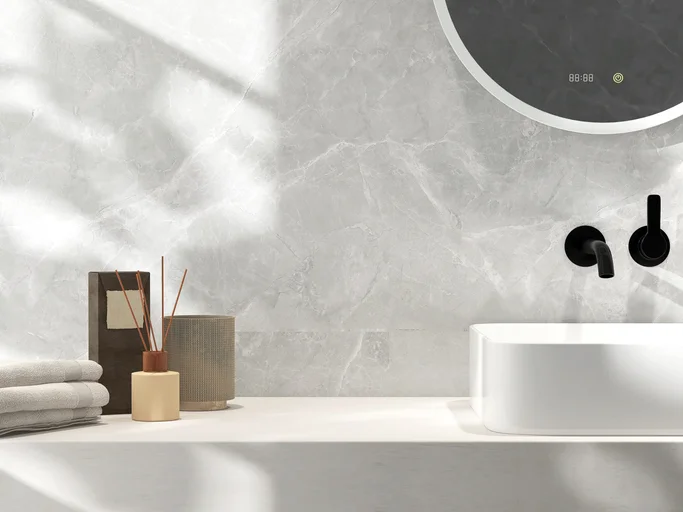
Different surfaces respond to light in distinct ways, creating varied visual effects. Highly reflective materials tend to bounce light back into the room, increasing overall brightness. In contrast, more diffused surfaces soften the light, distributing it more evenly and reducing harsh reflections.
Understanding this behaviour is essential for achieving visual comfort. Excessive reflection can lead to glare, while overly absorbent surfaces may make the space feel dull or enclosed. A balanced approach ensures that light is both present and pleasant, contributing to a more refined and usable environment.
Colour temperature and tonal strategies
Colour selection plays a subtle but significant role in how light is perceived. Lighter tones generally reflect more light, helping to brighten the space and create a sense of openness. However, the choice is not simply between light and dark, but also between warm and cool tones.
Warm hues can soften the atmosphere, making the bathroom feel more inviting, while cooler shades tend to enhance clarity and freshness. The key lies in using colour strategically, avoiding overly stark contrasts or excessively uniform palettes.
Finishes and glare control
The choice of finish directly affects how light is reflected. Gloss surfaces can increase brightness by reflecting light more intensely, making them suitable for spaces that benefit from enhanced luminosity. However, if overused, they may create unwanted glare and visual discomfort.
Matt finishes, on the other hand, diffuse light more gently, producing a softer and more controlled effect. They are often preferred in contemporary settings for their understated appearance and balanced performance. Combining different finishes can help achieve a more nuanced result, avoiding extremes while maintaining visual interest.
Designing brightness in constrained spaces
In smaller bathrooms or spaces with limited natural light, the role of tiles becomes even more critical. Carefully selected surfaces can compensate for the lack of light sources, improving both brightness and spatial perception. Light-toned tiles, combined with larger formats and restrained layouts, can significantly enhance the sense of openness.
In windowless environments, the interaction between artificial lighting and surface materials must be carefully considered. Tiles that reflect or diffuse light effectively can help distribute illumination more evenly, reducing shadows and creating a more comfortable atmosphere.
A balanced approach to light-driven bathroom design
Achieving the right level of brightness in a bathroom depends on a careful coordination of light, surfaces and spatial composition. Rather than relying on a single element, it is the overall balance between these factors that shapes how the space is perceived. A well-resolved bathroom tiles design allows light to move naturally across the room, enhancing clarity without creating visual strain or uneven contrasts.
Porcelain stoneware supports this approach by offering precise control over surface performance and visual consistency. Its wide range of finishes, tones and formats makes it possible to fine-tune how light is reflected or diffused, ensuring a result that remains both coherent and effective over time.
Ceramiche Refin: innovation, method, and vision in Made in Italy porcelain stoneware
In contemporary architecture, surfaces have evolved from passive elements into active components in the construction of space. They define relationships between light and material, volume and perception, shaping both the visual and functional quality of an environment.
Ceramiche Refin, founded in 1962 and part of the Concorde Group, has built a strong international identity based on the integration of industrial culture, aesthetic research, and technological innovation. Its approach is grounded in a coherent production model, where every phase, from concept to technical development and quality control, is managed in house to ensure consistency between design intent and final performance.
Sustainability is fully embedded in this system. Low impact technologies, waste recovery, and resource optimization contribute to an efficient and responsible manufacturing process, reinforcing product reliability over time.
Within this framework, porcelain stoneware is interpreted as a design language rather than a simple material. Surfaces are developed to interact with light, enhance spatial continuity, and support a wide range of applications, from interior spaces to outdoor environments.
The Ceramiche Refin collections reflect this approach, functioning as distinct yet interconnected design tools. PRESTIGIO KALEIDOS offers a dynamic interpretation of the surface, where reflections, tonal variations, and layered effects shift according to light and perspective, creating visually engaging environments with a strong decorative dimension.
INK introduces a more expressive language, translating creative gestures into ceramic form through fluid patterns, graphic marks, and a versatile palette that allows for distinctive yet controlled compositions.
OSMOS focuses on a more material driven aesthetic, where controlled imperfection, subtle tonal shifts, and natural surface traces convey authenticity and visual continuity, particularly in projects that extend between indoor and outdoor spaces.
The project RELIEFS completes the system by introducing a three-dimensional dimension to the surface. Its structured textures transform the wall into an active architectural element, interacting with light to generate evolving shadow effects and a constantly changing perception of space.
Through continuous collaboration with architects and designers, Ceramiche Refin develops surface solutions that combine industrial precision, design consistency, and long-term reliability.