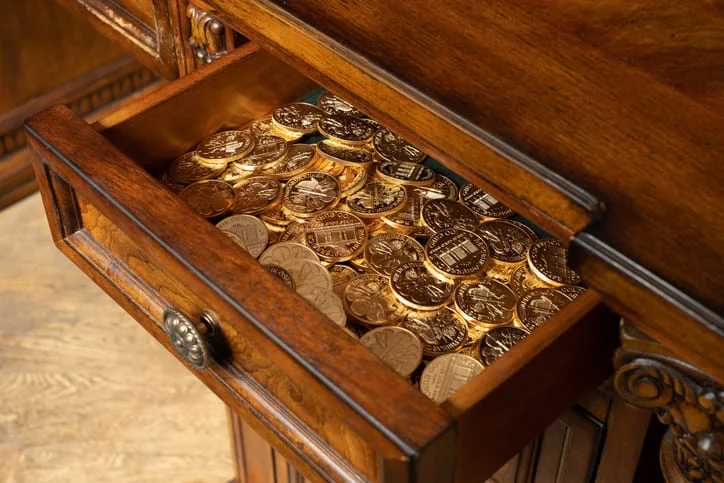
Most Indian households have gold sitting in a locker or a cupboard. Jewellery inherited from grandparents, coins bought during Dhanteras, chains that haven’t been worn in years. This gold does nothing. It earns no interest, generates no income, and just waits. Meanwhile, when a financial need arises, the first instinct for many people is to reach for a personal loan or max out a credit card. That instinct is worth questioning.
The Weight of Unused Gold
Estimates of Indian household gold holdings start at around 25,000 tonnes and run as high as 34,600 tonnes depending on whether temple and institutional gold is counted. Even the conservative figure exceeds the combined official reserves of the world’s ten largest central banks. That is an enormous reserve of value, most of it doing nothing productive.
People attach sentiment to gold, and that sentiment is perfectly valid. But sentiment and utility are not opposites. You can respect the emotional value of gold while also recognising that it can work for you during a tough month or an unexpected expense.
The reluctance to use gold is understandable. There is a cultural dimension to it. Gold is passed down through generations, and using it can feel like a failure or a betrayal of family legacy. But pledging gold temporarily for a loan is not the same as selling it. You get it back. The gold stays yours. And in many situations, it is a cheaper and faster route to funds than unsecured credit.
First, Check What Actually Qualifies
Before you plan around the gold in your locker, know that not all of it is pledgeable. The rules changed on 1 April 2026, when the Reserve Bank of India (Lending Against Gold and Silver Collateral) Directions, 2025 came into force.
Eligible: gold jewellery, ornaments, and specially minted coins.
Not eligible: gold bars, biscuits, bullion, and gold ETFs or other paper gold.
That last point catches people out. If your Dhanteras purchases were bullion coins or bars rather than specially minted coins, they will not be accepted as collateral. There are also per-borrower ceilings: 1 kg of gold ornaments and 50 g of gold coins. Silver is now expressly covered too, with limits of 10 kg of ornaments and 500 g of coins.
One other rule worth knowing: the RBI prohibits using gold loan proceeds to buy more gold, in any form.
Why Gold Loans Deserve a Closer Look
When people face urgent expenses, they often search for an instant loan online without considering what assets they already own. The appeal of quick digital credit is obvious. But the pricing comparison is worth doing properly, because the honest version is narrower than the usual pitch.
Scheduled banks typically price gold loans between roughly 8% and 10% a year. Personal loans currently start near 10% and run to 24% or beyond depending on your profile. On that comparison a bank gold loan wins clearly, and over six to twelve months the saving is real.
But the full gold loan market runs from about 8% to 27%. NBFC gold loans, which are usually faster and less demanding on documentation, can sit in the low to mid twenties. A bank personal loan at 11% is cheaper than an NBFC gold loan at 22%. So “gold loan means cheaper” is not a rule you can apply blindly. Compare the annual percentage rate on the Key Facts Statement for both options before deciding.
How much you can borrow is now tiered rather than capped flat at 75%. The limits are 85% of value for loans up to ₹2.5 lakh, 80% between ₹2.5 lakh and ₹5 lakh, and 75% above ₹5 lakh. On ₹1 lakh of gold, the ceiling rose from ₹75,000 to as much as ₹85,000. Small-ticket household borrowers are the clear winners from the change.
Gold loans also require minimal documentation. Because the gold is the collateral, lenders do not scrutinise income proof the way they would for an unsecured product, which makes them accessible to self-employed people, small business owners and anyone without formal salary slips. Your credit history matters less at the application stage, but note the flip side: gold loans are reported to the credit bureaus like any other loan. Default and you lose the gold and take the hit to your score.
Speed is the other advantage. A gold loan can be disbursed within hours. For hospital bills, school fees or a business cash flow gap, that matters.
What Actually Happens at the Counter
The 2025 Directions changed the process itself, mostly in the borrower’s favour. Knowing the sequence makes it much harder to be short-changed.
You have to be present while the gold is assayed. The lender cannot value your jewellery out of sight. Any deductions for stones, mounts or impurities must be explained to you at the time.
Valuation follows a set formula. Lenders must use the lower of the 30-day average price or the previous day’s price, published by a recognised body such as IBJA, applied to actual purity, and excluding the weight of stones and mounts. If the figure you are quoted looks low, ask which price and which purity were used.
The methodology is public. Lenders must display on their websites how they determine net weight and how they price the collateral. You can check the arithmetic afterwards.
Your gold comes back on a deadline. Once the loan is closed, the lender must return the pledged items within 7 working days, or pay you ₹5,000 for every day of delay.
The Digital Shift in Gold Lending
The gold lending space has changed considerably. Banks and NBFCs still dominate, but technology has smoothed the process. You can initiate a gold loan through a gold loan app on your phone and track your loan status digitally.
Doorstep collection models exist, but ask how they work under the current rules before using one, given that you are required to be present at assaying and that collateral must be stored securely at the lender’s premises. A model that takes your jewellery away to be valued somewhere you cannot see is not one to accept on trust.
Terms vary widely between platforms on rate, processing fee and LTV, so compare before committing. Read the fine print on foreclosure charges too, though the position has improved. Under the RBI (Pre-payment Charges on Loans) Directions, 2025, floating-rate loans to individuals for non-business purposes carry no prepayment charges. Many gold loans are fixed-rate, where charges can still apply, so check which type yours is rather than assuming either way.
Risks You Should Not Ignore
Losing the gold. If you fail to repay, the lender can auction the pledged jewellery. You are entitled to prior notice before an auction, and to any surplus left after the dues and costs are settled. But borrowers who take gold loans without a realistic repayment plan do lose heirlooms permanently. This is not theoretical.
The margin call nobody expects. The permitted loan-to-value has to hold for the entire tenure, not just on the day you borrow. If gold prices fall sharply, your loan can breach the ratio and the lender can ask for a part-payment or additional gold to restore it. With gold near record levels, this deserves weight: borrowing the maximum 85% leaves you almost no cushion against a correction. Taking 60% or 65% of value costs you nothing extra and buys real protection.
The repayment structure you weren’t told about. Gold loans come as EMI schemes, bullet repayment where interest and principal fall due at the end, or overdraft-style facilities. Bullet schemes look cheapest month to month, which is exactly why people choose them, and cost the most if the loan rolls over at maturity because the cash was never set aside. Ask which structure you are being sold and be honest about whether you will have the lump sum on the due date.
Over-borrowing. Because gold loans are easy to get, some people use them for discretionary spending rather than genuine needs. Taking a loan against your mother’s necklace to fund a holiday is a decision to think about very carefully.
Storage and insurance. Reputable lenders insure pledged gold against theft or damage while in custody. Verify it before you hand anything over, ask direct questions, and get written confirmation.
When It Makes Sense and When It Doesn’t
A gold loan makes sense when you have a short-term, specific need, a clear repayment plan, gold that qualifies and is not being used, and a lender whose rate you have actually compared against an unsecured alternative.
It makes less sense when the need is vague, the repayment timeline is uncertain, the rate on offer is in the twenties, or the gold carries irreplaceable sentimental value that would cause genuine distress if lost.
The broader point stands. Before you take on expensive unsecured debt, look at what you already have. Gold sitting idle at home is not just a family tradition or an inflation hedge. It is a financial resource. Using it wisely, temporarily, and with a plan is not disrespectful to its legacy. If anything, putting dormant assets to work during real need is one of the more sensible financial decisions a household can make. The gold goes back to the locker when the loan is repaid. Nothing is lost. Something is gained.
Disclaimer: This article contains sponsored marketing content. It is intended for promotional purposes and should not be considered as an endorsement or recommendation by our website. Readers are encouraged to conduct their own research and exercise their own judgment before making any decisions based on the information provided in this article.