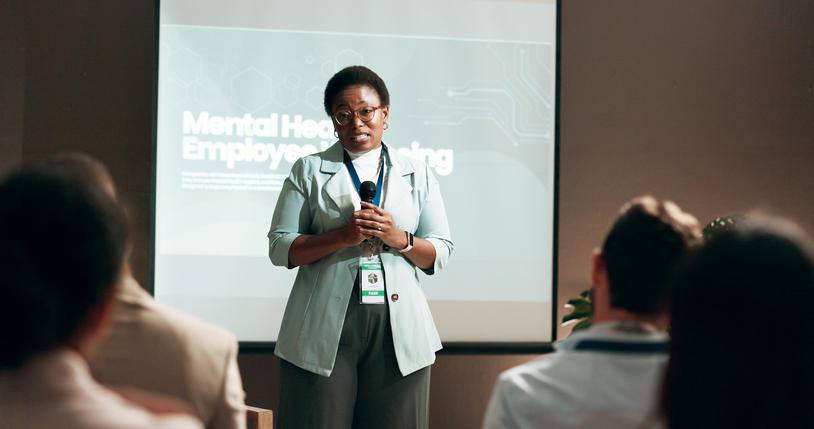
Time to Talk Day (5 February 2026) shines a light on the importance of open mental health conversations. In this article, six experts share their practical advice on how leaders can enable meaningful wellbeing dialogue at work to put employee mental health front and centre.
Mental health remains a topic that is too often left unspoken. Time to Talk Day offers a great opportunity to reflect on how leaders are showing up for their people, encouraging organisations to move beyond awareness and create environments where employees feel safe to speak and are supported when they do. Here are six ways to foster workplaces that truly care.
Building a foundation of psychological safety
Despite an estimated 15 % of working‑age adults globally living with a mental health condition, many organisations continue to operate within a culture of silence and stigma. According to Lesley Cooper, founder of consultancy WorkingWell, the very first step in addressing this is to create psychologically safe workplaces.
“Even though they may not label it as such, people need to know they’re working in a climate of psychological safety,” she says. “When people do feel safe, they are much more likely to share their challenges and ask for help.”
Psychological safety exists when employees can bring their whole selves to work without hiding behind a mask. In such an environment, people are empowered to discuss issues openly and offer feedback, even when the conversation is difficult. Cooper adds, “For employees to take the interpersonal risk of expressing what they really go through, they need assurance that there will be no negative consequences and confidence that their leaders and colleagues will listen, respond, and act on what they share.”
Unmasking fear to build resilience
Companies truly thrive when their employees do, yet meaningful wellbeing dialogue is often stifled by a mutual reality: fear. Employees are navigating a landscape of unease – driven by economic anxiety, technological disruption, and social concerns – that directly impacts their effectiveness, while employers often hesitate to intervene, paralysed by the fear of backlash, a lack of resources, or the risk of “opening a Pandora’s box.”
However, as Christopher O. H. Williams, author of C.O.U.R.A.G.E., notes, fear remains the primary barrier even in safe spaces; unmasking it is the only way forward. “By summoning the courage to break from corporate norms – asking ‘How are you doing?’ – we transform fear from a ‘stop sign’ into a signal for growth.”
“When companies acknowledge uncertainty and validate these realities, they diffuse rather than amplify anxiety, turning fear into a driver of engagement, trust, and the resilience necessary to weather the unknowns together,” concludes Williams.
Showing vulnerability
Vulnerability is one of the most powerful enablers of impactful conversations, yet it is often mistaken for weakness. “In high-pressure environments, silence and emotional endurance have long been rewarded, while burnout, unhealthy behaviours, and toxic dynamics went unchallenged. Being vulnerable carries the risk of exposure,” notes Cassie Davison, hospitality industry veteran, author of Stand Out Hospitality, and business coach.
But to engage employees in genuine wellbeing dialogue, vulnerability must be visible, normalised, and modelled by leaders. This works as a powerful tool for dismantling stigma and creating the space for crucial mental health conversations. “Vulnerability is not about oversharing; it’s about inviting acceptance and understanding,” says Davison. “When leaders openly acknowledge and discuss pressure, vulnerability shifts from risk to strength,” she continues.
This reframes wellbeing as a shared responsibility rather than an individual burden. “Trust deepens, conversations happen earlier, and support becomes part of the culture, not a last resort,” Davison sums up.
Leading with humanity
Leadership sets the emotional tone for organisations. For employees to speak honestly about their struggles, they need to feel seen and acknowledged by their leaders. This is why Dr Lilian Ajayi Ore, Chief Learning Officer and author of The Power of the Learning Mindset, believes leaders must always begin by recognising the human behind the role. As she explains: “Yes, we are different. Our identities, experiences, and stories are unique. If we don’t relate from a human foundation, we lose the chance to deepen connection, build trust, and earn confidence.”
When leaders operate from a place of distance or unrelatable authority, people feel it. But when they lead with humanity and treat others with empathy and compassion, connection follows. Dr Ore emphasises, “This is when employees remember how your leadership made them feel – calm, seen, safe, supported, or inspired – and only then will they be able to engage in truly meaningful wellbeing dialogue.”
Promoting wholeness
HR Executive, coach, and author of Anchored, Rochelle Trow, believes leaders should promote wholeness within the organisation, not by asking people to disclose how they feel, but by creating space for the body and the mind through everyday leadership choices about pace, workload, and expectations.
“Wholeness isn’t something a system can hand you; it’s something you can choose to protect and restore: a daily practice of noticing pressure early, making conscious trade-offs, and returning to what matters most before strain becomes normalised. Every conscious choice leaders make begins to reshape the system around them, including important conversations like employee wellbeing,” Trow explains.
Looking inwards to see how employees are feeling. Rather than relying on well-being check-ins alone, leaders can create safer dialogue by inviting practical conversations about capacity, priorities, risk, pauses, and boundaries and by responding constructively when strain is raised early, not only when performance drops. This helps reduce stigma and makes it safer for people to speak up without fear of negative career consequences.
“That’s why everyday leadership signals matter. Voices matter. They shape what people believe is permitted. The system will always reward what keeps it running, but wholeness begins when leaders notice what it costs people to keep going – and choose not to ignore it,” Trow concludes.
Spotting patterns and unhealthy behaviours with AI
Dr Lisa Turner, an expert in AI-powered personal and leadership development and founder of CETfreedom, believes that, when used as a supportive tool, AI can help leaders and their teams detect unhealthy patterns and behaviours before they escalate. “AI can offer a neutral, third-party lens for reflection,” she explains.
Used intentionally, AI can deliver early signals, smart nudges, and personalised insights that help leaders maintain clarity and capacity. By analysing meeting transcripts, emails, and team interactions, these tools reveal patterns that otherwise go unnoticed – patterns that can quietly undermine wellbeing. AI quantifies the percentage of someone’s cognitive capacity being spent on invisible labour.
AI presents a new and underused opportunity: not as a replacement for human wellbeing practices, but as a smart, scalable companion to leaders. “AI doesn’t erase our need for human connection,” Turner says. “It provides another dimension of support, helping organisations create more meaningful wellbeing conversations. The data and feedback from these tools can give people what they need to open up a dialogue about how they’re feeling, or how their organisation and others are making them feel.”