By EU Business Hub – Japan and the Republic of Korea programme
Innovative technology is only one part of the combination that unlocks successful entry to the Korean healthcare market.
The Republic of Korea combines one of the world’s most advanced digital economies with a rapidly ageing population and a sophisticated healthcare system. For European HealthTech companies, that combination is creating opportunities across AI-enabled healthcare, remote monitoring, assistive technologies, and healthy ageing – but succeeding in the market requires more than innovative technology.
The Republic of Korea is widely associated with semiconductors, consumer electronics, and advanced manufacturing. Yet another technology-intensive sector is becoming increasingly important for European companies: healthcare.
Several structural changes are happening simultaneously. The country’s population is ageing rapidly, healthcare providers are adopting digital technologies, artificial intelligence is moving into clinical applications, and demand is growing for solutions that can deliver care more efficiently and, increasingly, outside traditional healthcare settings.
For European companies looking to explore these opportunities first-hand, the EU Business Hub – Japan and the Republic of Korea is currently recruiting up to 50 SMEs and startups for its EU Business Hub @ KIMES 2027 business mission to Seoul, taking place from 17 to 21 March 2027. Selected companies will have the opportunity to showcase their solutions at KIMES 2027, meet potential Korean partners and customers, and receive tailored support to explore the market. Applications are open until 15 November 2026.
Demography is perhaps the clearest driver. In 2025, people aged 65 and over represented 20.3 percent of Korea’s population, putting the country firmly into the category of a “super-aged” society. That proportion is projected to reach 30 percent by 2036 and exceed 40 percent by 2050.
At the same time, the Republic of Korea’s advanced digital infrastructure supports the development of digital healthcare solutions. Through our work with European companies exploring the market, we are seeing opportunities across ICT and AI in healthcare, telemedicine and remote health monitoring, medical devices, and assistive technologies, as well as emerging areas such as nanotechnology and regenerative medicine.
For European HealthTech businesses considering expansion into the Republic of Korea, five areas deserve particular attention.
1. AI is moving from technological promise to practical healthcare applications
Few technologies have generated as much interest in healthcare as artificial intelligence. In the Republic of Korea, the combination of advanced hospitals, strong ICT capabilities and wider expertise in AI creates an environment in which healthcare applications can develop quickly.
The commercial opportunities extend across the patient journey. AI can help analyse medical images, support diagnosis and clinical decision-making, identify risks earlier, automate administrative processes, and make better use of the large volumes of information generated by healthcare systems.
The regulatory environment is also evolving alongside the technology. The Korean Ministry of Food and Drug Safety (MFDS) has established specific guidance for AI-based medical devices, including systems that analyse medical data for diagnosis, disease management, and prediction. In 2025, it updated guidelines covering AI-enabled digital medical devices and digital therapeutics.
For European companies, however, advanced technology alone may not persuade buyers.
The stronger question is: what healthcare problem does the technology solve?
A solution that allows clinicians to interpret images faster, identifies high-risk patients earlier, or reduces administrative workloads has a tangible value proposition. In a mature healthcare market, demonstrating clinical utility, reliability, and integration into existing workflows can be as important as the underlying algorithm.
This creates an opening for specialised European companies that may not compete with large technology groups on scale, but have deep expertise in a particular clinical application.
2. Healthcare is moving beyond the hospital
Digitalisation is also changing where healthcare can take place.
The pandemic accelerated global interest in telemedicine, but the longer-term commercial opportunity is broader: connecting patients and healthcare professionals between physical appointments.
Older patients and people managing chronic conditions may require regular monitoring without necessarily requiring repeated hospital visits. Remote patient monitoring, connected medical devices, and digital health platforms can potentially help healthcare providers follow those patients over time and intervene when necessary.
For companies entering the market, the proposition needs to extend from “we can monitor this remotely” to “this is how remote monitoring improves the care pathway”.
The opportunity therefore ranges from connected cardiovascular and respiratory monitoring to diabetes management, digital rehabilitation, and technologies that allow patients to continue elements of their treatment at home.
Collecting data is only the first step. Healthcare professionals already work with large volumes of information. Solutions offer buyers greater value when they turn measurements into actionable information – identifying a meaningful change, prioritising a patient, or helping a clinician decide when intervention is required.
For companies entering the market, the proposition therefore needs to extend from “we can monitor this remotely” to “this is how remote monitoring improves the care pathway”.
3. Healthy ageing is becoming a major innovation challenge
Perhaps the most distinctive long-term opportunity in the Republic of Korea lies at the intersection of healthcare and ageing.
An ageing population requires more than additional hospital capacity. It creates demand for solutions that can maintain mobility, support cognitive health, prevent falls, assist rehabilitation, and allow older people to live independently for longer.
This expands the potential HealthTech market well beyond conventional medical equipment.
Assistive technologies, smart-home health solutions, mobility devices, digital cognitive training, rehabilitation platforms, and tools supporting caregivers can all play a role. The potential customer is also not necessarily the individual user: hospitals, care organisations, local authorities, and senior citizens’ organisations can become important partners and buyers.
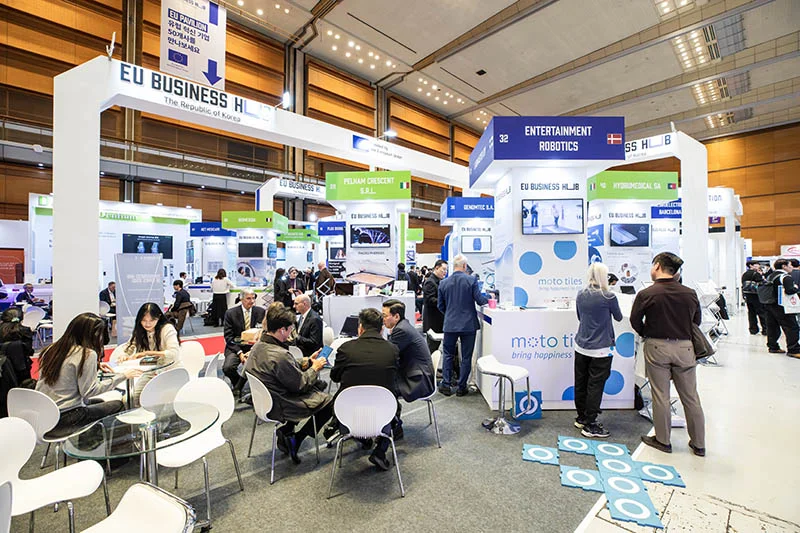
The experience of European companies already exploring the Korean market illustrates this potential. Danish HealthTech company Entertainment Robotics, which develops game-based solutions for physical and cognitive training, participated in EU Business Hub healthcare missions and connected with the Seoul Federation of the Korea Senior Citizens Association during the Korea International Medical & Hospital Equipment Show (KIMES) 2026. That relationship developed into strategic cooperation aimed at expanding AI-enabled dementia-prevention programmes within the country’s elderly-welfare sector.
The case illustrates the importance of institutional partnerships in the healthy-ageing market. Reaching older users can depend on working with organisations that already provide healthcare, welfare, or community services.
For European companies, understanding who pays, who uses, and who influences adoption is therefore particularly important.
4. Rehabilitation and assistive technologies are becoming smarter
Ageing also increases demand for rehabilitation.
Here, developments in robotics, sensors, computer vision, and artificial intelligence are creating a new generation of solutions that can support patients both inside and outside clinical settings.
These range from robotic rehabilitation equipment and movement-analysis systems to sensor-based physiotherapy and platforms that enable patients to continue exercises at home while allowing healthcare professionals to monitor progress remotely.
Well-designed technologies can extend the capabilities of physiotherapists and other professionals, provide more objective information about patients’ progress, and potentially make rehabilitation more scalable.
This creates opportunities for European companies with expertise in medical robotics, biomechanics, sensors, rehabilitation software, and assistive devices.
But adoption depends heavily on how easily a solution fits into an existing care pathway. A sophisticated system that requires healthcare organisations to redesign their processes completely can face significant barriers. Technologies that support existing clinical practice – while demonstrating measurable benefits for patients or professionals – may have a clearer route into the market.
5. More digital healthcare means greater demand for connected data
The digital transformation of healthcare creates another, less visible but strategically important, opportunity.
Modern healthcare organisations generate information through electronic health records, medical imaging, laboratory systems, connected devices and, increasingly, wearables and remote-monitoring platforms. As the number of digital tools grows, the challenge becomes making these systems work together securely and effectively.
That creates opportunities in healthcare interoperability – the ability of different systems to exchange and use data – as well as clinical data management, cybersecurity, and tools that transform fragmented information into usable insights.
For European SMEs, this can be particularly relevant, because market entry does not necessarily require replacing a hospital’s core IT infrastructure.
A specialised company may instead solve one clearly defined problem: enabling two systems to exchange data, protecting a particular type of medical information, improving a clinical workflow, or helping professionals interpret information from multiple sources.
In this environment, interoperability itself can become a competitive advantage. Companies that demonstrate how their technology works with the systems that healthcare organisations already use may have a stronger proposition than those requiring customers to build an entirely new digital ecosystem around their product.
A sophisticated market also creates a high bar for entry
The same characteristics that make the Republic of Korea attractive can make it challenging.
Healthcare and medical devices are highly regulated. Companies may need to address regulatory approval, clinical validation, reimbursement, data protection, localisation, and integration with existing healthcare systems. AI-enabled medical technologies are subject to specific regulatory requirements intended to balance innovation with patient safety and data security.
Competition also comes from established Korean and international companies.
Regulatory pathways should be understood early, and evidence developed for European markets may need to be presented differently for Korean stakeholders.
European businesses therefore need to think about market entry well before approaching potential customers. Regulatory pathways should be understood early, and evidence developed for European markets may need to be presented differently for Korean stakeholders.
Above all, local partnerships can play a critical role.
A distributor may provide access to customers and knowledge of procurement. A hospital can become a clinical or technology partner. A research institution can support validation. In areas such as healthy ageing, meanwhile, partnerships with care providers or senior organisations may offer routes to users that conventional medical-device distribution cannot provide.
The practical market-entry question is therefore not simply “How do we sell our technology in the Republic of Korea?”
It is, “Which Korean organisations have the problem that our technology solves – and what kind of local partnership will allow us to work with them?”
Previous European participants show what that process can look like. Neuroelectrics Barcelona, for example, participated in two consecutive EU Business Hub healthcare missions to Korea, established local distribution, and subsequently reported more than €50,000 in additional Korean revenue within a year of its first mission. According to the company, participation shortened its market-access journey by more than a year.
Turning market potential into business relationships
For European SMEs, market research can identify potential demand, but conversations with customers and partners are needed to test it.
That is the gap that the EU Business Hub – Japan and the Republic of Korea programme is designed to address.
Its upcoming EU Business Hub @ KIMES 2027 business mission will select up to 50 European SMEs in the healthcare and medical equipment sector to visit Seoul from 17 to 21 March 2027. Participants will exhibit at the EU Pavilion at KIMES 2027 and explore opportunities across areas including medical equipment, assistive technologies, digital health, telemedicine and remote monitoring, AI in healthcare and regenerative medicine.
Selected companies receive market intelligence, business coaching, pre-arranged business matchmaking with Korean companies and organisations, and interpreter support. The programme also provides financial support towards accommodation and can co-finance eligible customised services.
For European HealthTech companies, the mission offers an opportunity to test demand, assess potential partners, and identify adaptations needed for the Korean market.
Korea’s healthcare transformation is unlikely to create equal opportunities for every technology. The strongest prospects will be for companies whose solutions respond to concrete pressures within the healthcare system – from managing more patients with fewer resources to helping a rapidly ageing population live healthier, more independent lives.
For European companies able to combine technological expertise with clinical evidence, localisation, and the right partnerships, those pressures could translate into significant new business opportunities.
Applications for EU Business Hub @ KIMES 2027 are open until 15 November 2026.
Explore EU Business Hub @ KIMES 2027 and apply