

By Dennis M. Sponer and Romain Balard
Between March and June 2026, US state regulators brought three corporate-practice-of-medicine enforcement actions — one reaching a company founder personally. For European HealthTech companies building or buying a US clinical operation, the rules for structure and diligence have shifted. Here is what changed, and the six questions every board should ask before a US deal.
In March 2026, the New York Attorney General concluded an investigation that every European HealthTech founder considering entering the US market should know about.
NaphCare, LLC, a correctional healthcare company based in Alabama, created a New York professional corporation to own its clinical contract with a Syracuse jail. In theory, the New York entity provided the medical care, and NaphCare provided administrative assistance. In fact, the CEO of NaphCare was the president of the New York PC; they shared the same address; the medical director of the PC reported to the chief medical provider of NaphCare; and many clinical decisions were made electronically by providers in Alabama.
Three deaths in custody occurred during the contract term. New York fined NaphCare $875,000 and banned the company from correctional health contracts in the state for five years.
If you’re a European founder considering an American acquisition or joint venture, this case requires careful analysis. Replace Alabama with London, Paris, or Berlin. Replace NaphCare’s management services agreement with a well-drafted one of your own. The key question is whether the operational reality on the day regulators review the practice will resemble what a European HealthTech company would do with a New York medical practice, or how independent New York clinicians would operate their own practices.
The doctrine in brief, for European Healthcare Companies.
The corporate practice of medicine (“CPOM”) doctrine is a body of United States state law (not federal law) that prohibits non-licensed persons and corporations from employing licensed clinicians to provide care or from owning or controlling a clinical practice.
The doctrine is more than a hundred years old. The reasoning is that a profit-seeking corporation is beholden to its shareholders, and that loyalty cannot be squared with a clinician’s undivided duty to a patient. CPOM doctrines vary in strength across 33 U.S. states. A handful of states — California, New York, Texas, North Carolina and, starting in 2025, Oregon — actively enforce them.
European regulators take various approaches: rules on clinic ownership, professional codes against fee-splitting, conduct standards enforced by professional bodies, and growing merger controls over private equity consolidations in specialty care.
In active enforcement states, CPOM not only limits corporate involvement in clinical care but also explicitly prohibits certain forms of corporate ownership. A European founder can’t simply buy a U.S. clinical business and operate it with European operating practices to enter the California or New York markets.
The PC/MSO structure — and how it unravels
Direct corporate ownership of a US clinical practice is illegal in CPOM states, so the American market developed a structure that should now be familiar to anyone advising on cross-border healthcare deals: the physician-owned PC/MSO model.
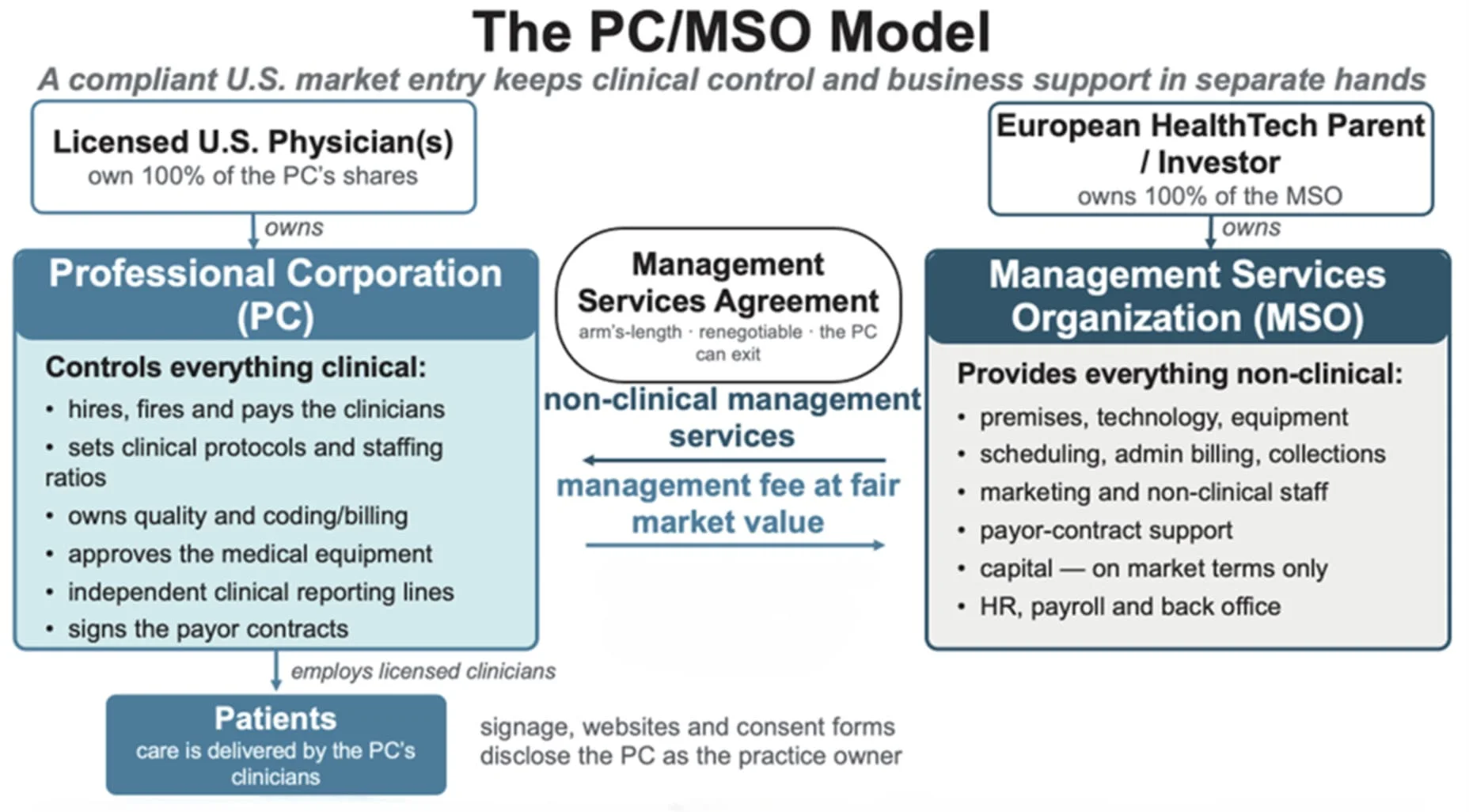
The practitioners are engaged by a professional corporation (“PC”), and the clinical contract is with the PC, which is owned by one or more licensed US clinicians. A separate management services organization (“MSO”) provides all non-clinical aspects, including the premises, capital, technology, scheduling, billing, marketing, and administrative staff. The MSO is usually owned by the foreign investor. The MSO is paid a management fee. In economic reality, the MSO often has the lion’s share of the value and much of the operational leverage. If the structure is built properly, it can be both compliant and legal.
The analytical lens – Aspen Dental
In May 2026, a parallel CPOM action brought by the California Attorney General was settled against one of the largest dental support organizations in the United States, Aspen Dental Management, Inc. Aspen agreed to pay $2 million in civil penalties and $300,000 in patient restitution, be subject to a court-appointed compliance monitor for 36 months, and comply with dozens of injunctive provisions.
Carbon Health — penalty nails founder
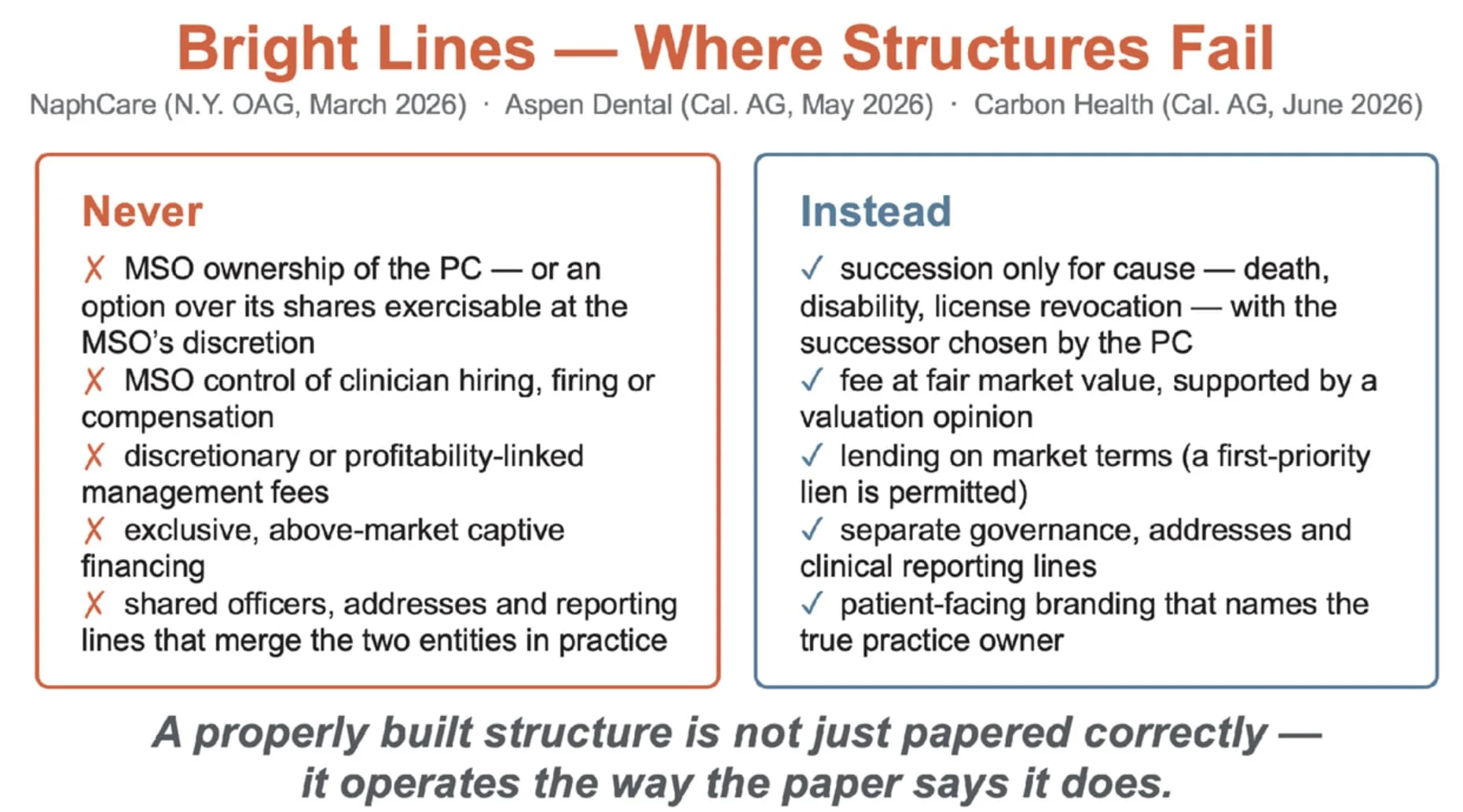
And California was not done. On June 26, 2026, the California Attorney General announced a settlement with Carbon Health Technologies, Inc., a venture-backed primary and urgent care platform, twelve affiliated professional corporations and – most notably for any founder reading this – the company’s co-founder and former CEO personally. The corporate defendants will pay $4.4 million in civil penalties, and the co-founder will pay an additional $100,000 out of his own pocket.
The Attorney General identified three features as unlawful corporate practice of medicine:
- Management agreements that give the MSO complete authority over advertising, payor negotiations, equipment, and the hiring, firing, and compensation of clinicians;
- An assignable option — backed by a security interest in the PC’s shares — that allows the MSO to transfer the practice’s stock to a physician of its choosing; and
- Revolving credit that forces the PCs to borrow only from the MSO at above-market rates.
The ruling required Carbon Health to restructure to strip the MSO of control and ownership.
For a European reader, two things about Carbon Health stand out:
- First, the option agreement – the standard mechanism for an investor to “hold” an affiliated PC in cross-border deal documents – was not viewed as a neutral succession mechanism but as evidence of corporate ownership.
- Secondly, the penalty was imposed on a person. The assumption that regulatory risk stops at the corporate entity was not true.
NaphCare, Aspen Dental, and Carbon Health together reflect a doctrinal shift that European acquirers should price into their diligence.
In 2026 alone, Carbon Health is the third beat in a coordinated California run. In Art Center Holdings, Inc. v. WCE CA Art, LLC, the California Attorney General argued that an MSO’s contractual right to replace a physician-owner of a PC may violate CPOM even if the right is never exercised. Aspen Dental followed in May, and Carbon Health in June.
Six pre-deal due diligence questions in the United States
Here are six questions to ask, in order, if you are a European founder considering expanding into the US.
First, who actually runs the clinical workflow?
Who decides the clinical protocols, staffing ratios, visit length, quality metrics, and hiring criteria? It is not about who owns it on paper. If the answer is a non-clinical platform, then we need to revisit that.
Second, the management fee?
Management fees based on a percentage of revenue, a common European management setup, are generally prohibited. The management fee should reflect fair market value and not be a payment for referrals. Variable fees, whether at the MSO’s discretion or based on the practice’s profitability, come under scrutiny. Establish a fair market value fee arrangement and obtain a fair market value opinion to support it.
Third, what limits exist on clinicians’ medical judgment?
Limitations on where a doctor can practice and bans on approaching patients are now used as evidence of MSO dominance.
Fourth, can the management contract be negotiated?
An MSA that the PC cannot revisit, renegotiate, or exit is critical evidence that the MSO is in unlawful control. Establish and document the cadence for renegotiation.
Fifth, what does the patient think?
Signs, websites, consent forms, and receipts should clearly show who is responsible for the patient’s care. The first witness a regulator calls is a patient who reasonably believes the foreign HealthTech brand is the treating entity.
Sixth. Who holds the option on the practice?
California viewed the assignable option agreement, the security interest in the practice’s shares, and the MSO’s exclusive above-market financing as parts of a single picture of corporate ownership at Carbon Health. Restrict any succession option to true for-cause triggers, not the platform’s discretion. Vest the selection of a successor in the practice’s board or independent physicians. Ensure the practice can borrow on market terms from a third party.
The conclusion is straightforward: design for the strictest US state in which you plan to do business. Contracts that protected the expansion during rollout may not protect it during operation. Regulators are increasingly enforcing the US doctrine of corporate practice of medicine based on what the evidence shows, not what the contracts say.

 Romain Balard