
By Terence Tse
Does your company run complex machinery for which downtime would mean serious costs? A digital twin could be just what’s needed.
If your company operates complex machinery, there is, of course, all manner of instrumentation that can be used to monitor its functioning. But what if, in addition to monitoring, you could also run simulations and forecast failures before they occur? That’s where digital twins come in.
Each year, businesses lose billions due to unforeseen equipment failures, inefficient maintenance plans, and operational decisions based on incomplete information. Digital twins can potentially address this issue. A digital twin is a dynamic virtual replica of a physical asset, process, or system—continuously updated with real-time data from IoT sensors—that enables organisations to monitor performance, simulate scenarios, and forecast failures before they occur. The impact can be significant: GE’s SmartSignal monitoring platform, which tracks over 7,000 critical assets worldwide using digital twin technology, has saved clients a total of £1.6 billion.1 From jet engines to laundry detergent factories, this technology is transforming the way we approach operational efficiency, maintenance, and product development.
What a digital twin actually is
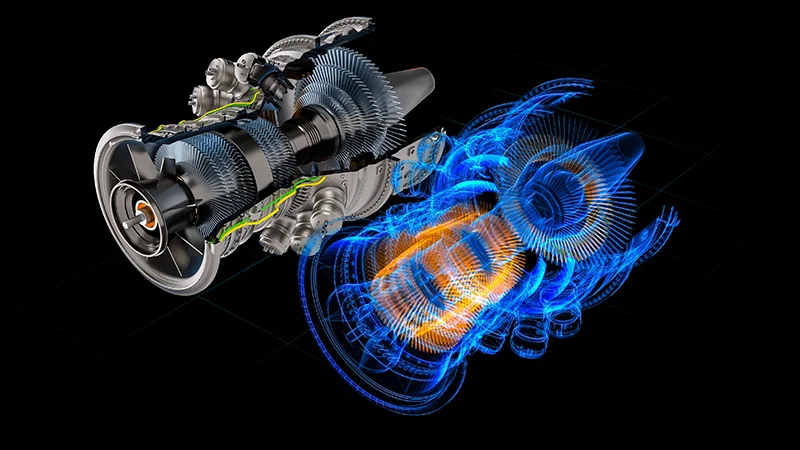
At its core, a digital twin is made up of three components: a physical asset (such as a turbine, a factory floor, or an entire city), a virtual model that reflects its geometry, behaviour, and condition, and a live data connection linking them. Sensors embedded in the physical asset continuously gather data—temperature, vibration, pressure, throughput—into the digital model, which employs physics-based simulation and AI analytics to interpret current conditions, predict future developments, and suggest appropriate actions.
The virtual replica evolves as the physical asset ages, is stressed, or undergoes repairs.
It is exactly this two-way, real-time connection with the physical world that sets a digital twin apart from the traditional 3D model or simulation. The virtual replica evolves as the physical asset ages, is stressed, or undergoes repairs. This, in turn, lends companies the extremely valuable opportunity to run “what-if” scenarios on the twin—testing a new maintenance schedule, a design modification, or an operational change—without risking downtime or damage to the actual asset. In short, the twin learns while the asset benefits.
From Apollo-era simulators to a multi-billion-dollar market
The intellectual roots of the digital twin extend back decades before the term was introduced. During the Apollo 13 crisis in 1970, NASA engineers on the ground used 15 simulators fed with live telemetry from the damaged spacecraft to rehearse rescue procedures—a physical precursor to the digital-twins idea.2 In 1993, computer scientist David Gelernter described “mirror worlds” as software models that depict slices of reality. But it was not until 2002 that the concept was formalised; Michael Grieves presented a framework for “mirrored spaces” at the University of Michigan—a virtual replica linked to its physical counterpart through continuous data flow.3 Yet, it was only in 2010 that NASA engineer John Vickers coined the term “digital twin” while working on the agency’s technology roadmap.4 Industrial adoption accelerated in the mid-2010s as IoT platforms matured and became more widespread. Today, Gartner projects that digital-twin-enabling software and services will reach global revenue of $379 billion by 2034, up from $35 billion in 2024.5
Some examples
General Electric
General Electric (GE) has been one of the most active adopters of digital twin technology across its industrial portfolio, applying it to jet engines, gas turbines, wind turbines, and locomotives. The results are concrete. One airline customer using GE’s Analytics-Based Maintenance programme improved engine time-on-wing by 20 per cent and reduced unscheduled engine removals by a third.6 Across GE’s portfolio, its SmartSignal platform monitors over 7,000 critical assets and has saved customers a total of $1.6 billion.7
Unilever
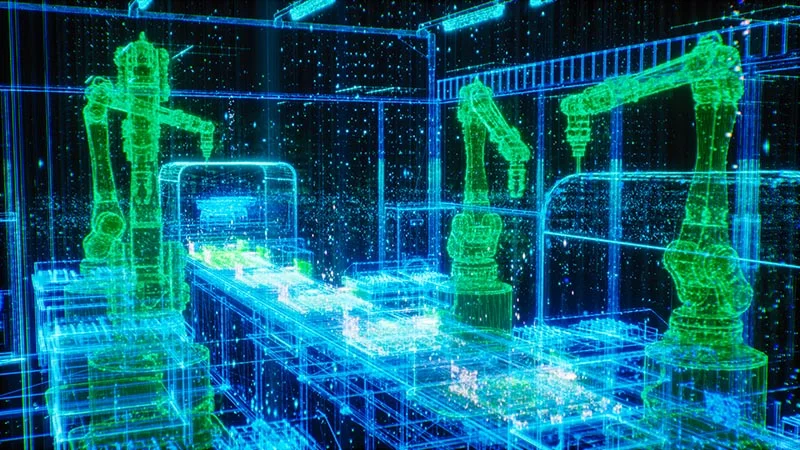
Unilever has deployed digital twins across 124 factories and 2,100 production lines, covering over 75 per cent of its manufacturing capacity.8 At its Indaiatuba facility in Brazil—the world’s largest laundry detergent factory—the deployment of the system built around digital twins and real-time data raised production capacity by 20 per cent and delivered nearly €3 million in savings in 2024.9 At the Tinsukia plant in India, packaging trials conducted via digital twin reduced virgin plastic usage by 21 per cent and slashed trial duration by 84 per cent, increasing the number of annual trials from two to 30 between 2019 and 2023.10 Across all sites, Unilever reports a 3 per cent rise in overall equipment effectiveness, a 5 per cent increase in labour productivity, and an 8 per cent reduction in costs.11
Hong Kong International Airport
Hong Kong International Airport (HKIA) has developed its digital twin programme by creating a live IoT-connected replica of its facilities to enable smarter airport management. The airport’s digital twin—described as a digital 3D replica of HKIA’s physical structures and facilities—aims to support comprehensive airport management, predictive decision-making, and maintenance throughout the entire lifecycle of its buildings, from design and construction to operation.12 In practice, the system gathers real-time data from myriad IoT devices throughout the airport and uses predictive analytics to send alerts to the airport community, thereby supporting more effective resource allocation, cost reductions, and enhanced service delivery.13 Spanning across 700,000 m2 over nine floors, Terminal 1 was digitised using laser scan surveys and as-built engineering data, resulting in models that include architecture, structural, mechanical, electrical, and plumbing systems.14 The airport has also been using digital twins to track and evaluate passenger flows in real time.15
Key advantages of digital twins
The cases above highlight at least four benefits that appear across sectors and scales.
- Predictive intervention: Continuous asset monitoring allows issues to be detected and fixed before they cause disruptions. Siemens Energy uses physics-informed digital twins with NVIDIA to simulate real-time corrosion in power-plant heat-recovery systems; the company estimates that a 10 per cent reduction in planned downtime for these assets alone would save $1.7 billion annually across the industry.16
- Measurable operational gains: Unilever’s programme shows that twins bring improvements in multiple areas at the same time: cost, productivity, throughput, and sustainability. Renault Group’s industrial metaverse—a digital twin that connects all its production lines—cut energy use by 26 per cent between 2021 and 2024.17
- Lifecycle asset management: HKIA’s deployment demonstrates that twins are not limited to operations; they also support design, construction, and maintenance within a single integrated model. Singapore’s SMRT subway applies the same principle to its rail network, using a digital twin of its track infrastructure to trigger maintenance based on real-time condition data rather than a fixed schedule, deploying staff only when the twin indicates that it is necessary.18
- Supply chain improvements: Beyond individual assets and factories, digital twins can model entire value chains. McKinsey documented a global retailer that used a supply chain twin to run more than 50 daily scenarios, ultimately achieving a 7 per cent reduction in carbon emissions and a 5 per cent improvement in on-time customer orders.19
How to implement digital twins in your organisation
Concentrate on areas where downtime is costly, complexity is high, or traditional methods consistently underperform.
Clearly, companies that intend to capitalise on the advantages of digital twins must collaborate with a technology vendor. However, the companies themselves still face various business challenges in achieving successful deployment of digital twins.
- Identify high-value use cases first. Concentrate on areas where downtime is costly, complexity is high, or traditional methods consistently underperform. Starting with a single turbine, a bottleneck production line, or a critical infrastructure asset is more effective than an enterprise-wide implementation.
- Assess data readiness and build your tech stack. Digital twins require reliable, continuous data. Audit existing sensor infrastructure, identify gaps, and invest in IoT connectivity. The stack should be modular: a data layer, an integration layer, a simulation engine, an AI/ML optimisation layer, and visualisation dashboards.
- Assemble a cross-functional team. Effective implementation necessitates data engineers, domain experts, data scientists, IT architects, and a bridge role linking business and technology.
- Start with a pilot, then scale. Prototype one or two use cases over three to six months, validating results and refining iteratively before expanding. Organisations do not need perfect data to begin; the twin improves as data quality matures.
- Integrate with existing systems and invest in change management. Connect twins to manufacturing execution and enterprise resource planning systems using interoperability standards. Secure leadership commitment, train the workforce, and treat cybersecurity—including zero-trust architecture and IoT device authentication—as non-negotiable.
It is important to note that most organisations will not build a digital twin from scratch on their own; nor should they. The practical approach combines internal responsibility with external specialist expertise. Internally, you need domain experts who understand the physical asset thoroughly, IT architects capable of managing data pipelines and system integration, and a programme owner with the authority to promote cross-functional alignment. What most organisations lack are the simulation engineers, physics-informed AI specialists, and platform developers essential for constructing and maintaining the twin itself. There are many providers available in the market. The choice between a vendor platform and a custom build depends on asset complexity, data volume, and how proprietary your processes are.
A truly beneficial technological tool
Digital twins have firmly shifted from being a concept to a competitive necessity. The organisations highlighted here—GE, Unilever, and HKIA—did not adopt this technology as a mere experiment. Instead, they integrated it into their core operations because the economic benefits are evident: notable per-incident savings, double-digit efficiency gains, and sustainability outcomes that satisfy both regulators and shareholders. As more companies in advanced industries begin to utilise digital twins at some level, the remaining organisations face the real question not of whether to adopt, but of how quickly they can bridge the gap before it becomes too difficult, or too late, to do so.