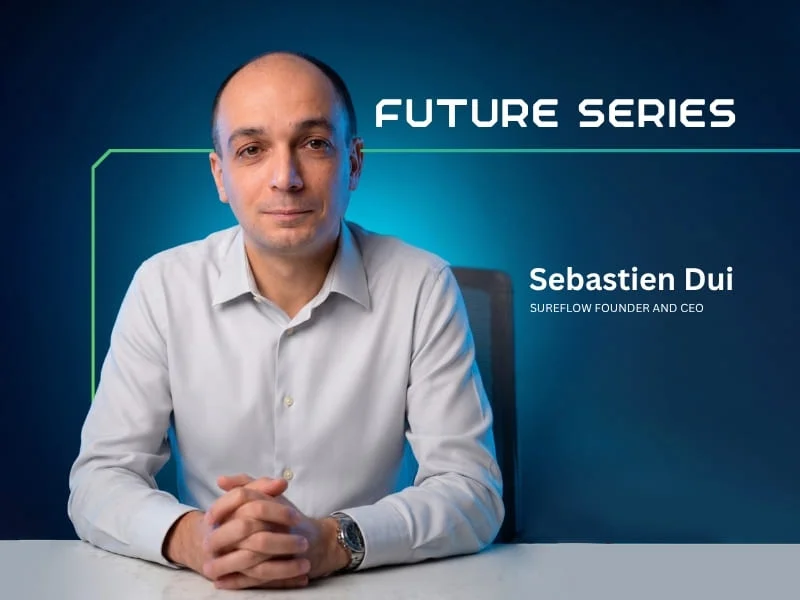
A Conversation with Sebastien Dui on the Future of Urban Intelligence
To sustain available electrical infrastructure, cities must adopt artificial intelligence to monitor, manage, and plan consumption, turning limited capacity into smarter, more resilient grids.
Cities have committed to electrification targets that their grids were not designed to absorb. Mr Sebastien Dui, whose company, SureFlow, builds non-intrusive sensors powered by AI technology, monitoring existing electrical infrastructure, argues that the binding constraint is not generation capacity but information. We put that thesis to the test.
It’s an honour to have you with us today, Mr Sebastien! Let’s begin with the structural problem. Cities are electrifying faster than most planning cycles anticipated. In your view, what is the central bottleneck they will face over the next decade, and is it a capital problem, a technical one, or something else entirely?
The problem, at its root, is a mismatch of timelines. The grid was never built for today’s power demand; electrification is outpacing physical infrastructure, and upgrading that infrastructure takes years and considerable cost. So while it is tempting to frame this as a capital problem, capital alone does not solve it, because the lead time on physical upgrades is inelastic.
The grid was never built for today’s power demand; electrification is outpacing physical infrastructure.
That is why the more immediate answer isn’t to produce more, but to manage what cities already have far more intelligently, and that begins with visibility. This is the premise behind SureFlow. Our Electrical Panel Sensor continuously monitors household-level consumption, including breaker temperature, giving an early warning of potential issues long before they become faults.
There is a meaningful difference between visibility and actionable intelligence. What does that data actually change for the end user, in practice?
What we give people is the picture they’ve never had. They can see what’s drawing power and when, and receive an alert if the breaker temperature begins to climb toward a fault. That is paired with practical and actionable guidance, such as running heavy appliances outside peak evening hours. But I want to be precise here: the decision stays with the user. We are not deploying this as an automation layer that overrides human judgement; it is an intelligence layer that improves it.
For cities, the same data serves a different function; it shows planners where consumption is concentrated and where the network is closest to its limits.
Your model focuses heavily on retrofit-first rather than replacement-first. For an audience of infrastructure investors and municipal decision-makers, why does that distinction matter economically, not just technically?
It matters because we have made cost, the primary barrier to adoption, far less of an issue. Not every city, and certainly not every smaller municipality, has the budget for a full infrastructure overhaul nor the specialised workforce required to execute one. Our sensor requires no modification to the breaker panel; it is self-installed and simple enough to ship by post. That single design choice compresses both the capital outlay and the deployment timeline, making mass adoption a realistic proposition.
The output is a system that delivers real-time consumption data while guiding users, through our Smart Saving Recommendations, toward efficiency goals calibrated to their own behaviour rather than generic benchmarks.
Walk us through the mechanics. From the moment a sensor is installed to the moment a recommendation reaches a user or a city planner, what is that pipeline?
Once connected, the sensor begins continuous panel monitoring, collecting breaker-by-breaker consumption data and real-time breaker temperatures. This data is transmitted to our servers, where the system enters a learning phase: our algorithm analyzes the load patterns on each breaker to calibrate itself to the specific characteristics of that panel and its usage.
Once calibrated, the system uses artificial intelligence to generate Smart Saving Recommendations based on each user’s specific patterns, for instance, optimal windows for running high-consumption appliances.
The insight layer varies depending on the audience. Households interact through the SureFlow app, which includes an Energy Consumption Heat Map, an at-a-glance view of which circuits drive the highest usage, and an Augmented Reality Breaker View, which lets them visually identify, directly over the physical panel, which breaker corresponds to which consumption reading. Cities and organizations, by contrast, operate through a distinct professional platform that maps consumption by zone, which allows them to identify precisely which areas require intervention. That changes resource planning from an estimate into a targeted exercise, and it draws residents directly into the transition.
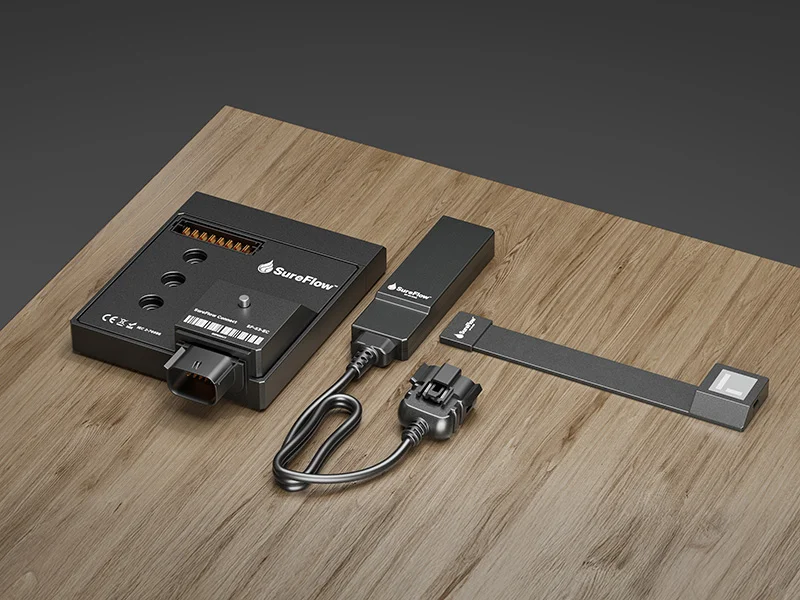
SureFlow uses AI, IoT sensors, and real-time data to make electricity consumption more visible and manageable. What is the biggest gap in today’s electricity infrastructure that SureFlow is trying to solve?
At its core, IoT, powered by artificial intelligence, modernizes existing networks without requiring their replacement. It closes the gap between infrastructure that is technically obsolete and the considerable cost of replacing it outright. The panel sensor is illustrative: by combining consumption monitoring, breaker temperature, and a heat map, it converts a conventional panel into something visible, measurable, and predictive.
And the scope is not confined to electricity. We also field sensors for gas and water, treating consumption across all three as an interconnected system rather than isolated data points, which is a more accurate representation of how resource efficiency actually functions in an organization.
Turning to go-to-market strategy, SureFlow is built around B2B relationships with utilities, property administrators, and institutional operators, despite having a consumer-facing product. Why does scale, in your view, run through institutions rather than individual adoption?
We believe working directly with cities and property administrators is what allows this technology to reach its full potential. It is difficult to find technology in this market that is genuinely designed for entire populations; most solutions are built for early adopters, not for the population as a whole. Our priority is a solution for society as a whole, and partnerships are the mechanism that makes that kind of impact, particularly in vulnerable communities.
What does a successful partnership with a city, utility provider, property managers, or facility management company look like from SureFlow’s perspective?
For cities, consumption data sharpens planning, identifies exactly where efficiency can improve, flags abnormal consumption patterns as they occur, and clusters residents by consumption behaviour to understand needs with precision.
For utility providers, it means being able to launch energy-efficiency programmes that manage the grid more effectively during peak hours, closing the gap between provider and end user, so that by mutual understanding, consumption becomes more conscious precisely when the grid is under the greatest stress.
For property managers, the value is twofold: the consumption heat map allows monitoring at the individual level, comparing patterns and identifying specific behaviours, while also managing shared spaces such as pools, lobbies, and other common areas.
A recurring critique of smart-city initiatives is that they generate volumes of data without a corresponding increase in decision quality. How does SureFlow avoid that failure mode?
This is precisely what our SureFlow Programmes model addresses. Cities have specific needs within a defined timeframe, and the platform allows them to track progress toward a concrete goal, supported by AI generated recommendations grounded in actual user consumption, rather than simply presenting data for its own sake. It does not wait passively to be consulted; it actively alerts users when abnormal patterns emerge, whether in consumption or breaker temperature, and actively guides behaviour toward more sustainable use.
Energy demand is also becoming more unpredictable as cities face extreme temperatures and changing patterns of consumption. How can predictive AI help organizations anticipate electricity demand, peak loads, and potential infrastructure problems before they occur?
Our algorithms operate against predetermined safety thresholds. The SureFlow system does not wait for a peak or a fault to occur before reacting; it identifies patterns and anomalies in real time and flags them before they escalate. Breaker temperature is one of the most critical signals in this respect: an abnormal rise is often the first indication of overload, appearing well before it results in an outage or a genuine electrical hazard.
The SureFlow system does not wait for a peak or a fault to occur before reacting; it identifies patterns and anomalies in real time and flags them before they escalate.
That capability becomes especially relevant as extreme temperatures disrupt normal consumption patterns unpredictably. The platform can warn cities and service providers of an imminent peak in advance, which shifts load management from a reactive posture to a proactive one.
A final question, looking further out, five to ten years. What role do you want SureFlow to occupy in the future of urban energy management, and what would success look like at that horizon?
Our ambition is for SureFlow to expand globally, becoming the invisible layer of intelligence behind every city and every building, an energy-efficiency infrastructure that is accessible to all, not reserved for those who can afford a full system overhaul. The underlying goal is proximity: bringing this technology closer to people as a genuine mechanism for improving quality of life, particularly in the most vulnerable communities, while helping cities of every size meet the energy commitments they have made.