

By Dr. Florian Rehm
AI programs rarely fail because models underperform; they fail when organizations cannot redesign decisions, accountability, and workflows around probabilistic systems.
Enterprise AI has an uncomfortable truth: many organizations are not failing because they lack models, platforms, vendors, or talent. They are failing because they try to run a new, probabilistic capability with management structures designed for an older, deterministic world. Decisions stay the same. Accountability remains unclear. Workflows stay untouched. The result is a growing gap between AI activity and operating impact – most visible in the final 30%.
Management Debt
A growing number of organizations are discovering that AI activity and AI impact are not the same thing. Many large organizations are doing what their boards asked for: hiring AI talent, launching shared platforms, expanding use-case portfolios, and onboarding vendors. Yet when directors ask which core production decisions are measurably better because of AI, the answer is often unclear.
This gap is also visible in recent enterprise research. BCG’s AI Radar 2025 argues that organizations creating value from AI allocate only about 10% of their effort to algorithms, 20% to data and technology, and 70% to people, processes, and cultural transformation. PwC’s 2026 Global CEO Survey adds the warning signal: 56% of CEOs said they had seen no significant financial benefit from AI, while only 12% reported both revenue and cost benefits.
The constraint is no longer model access, but organizational conversion capacity: the ability to turn probabilistic systems into changed decisions, workflows, incentives, and accountability.
Across research, deployment, and high-complexity organizational environments – I have observed the same pattern repeatedly. Most AI failures are not technical failures. They are management failures wearing technical clothing. In many cases, the failure is designed into the organization long before the first model reaches production. More precisely, this is the result of what I call Management Debt.
Technical debt is the long-term cost of prioritizing speed over code quality. Management Debt is the organizational equivalent: the accumulated cost of legacy governance, risk-averse culture, proxy metrics, and siloed decision-making applied to a technology that requires continuous learning.
Leaders borrow from the future success of an AI program by managing it with deterministic tools designed for a different era: project plans, milestone gates, centralized ownership, one-time approvals, and proxy KPIs. These tools create the appearance of control. But over time, the interest compounds. The organization becomes busy with AI, but unable to convert it into operating advantage. A simple test cuts through the noise: when AI is real, an organization can point to the decision it changed.
The Sandbox Paradox
This is why many AI programs do not fail at the prototype stage. They fail at the transition from demonstration to production – they fail at the final 30%.
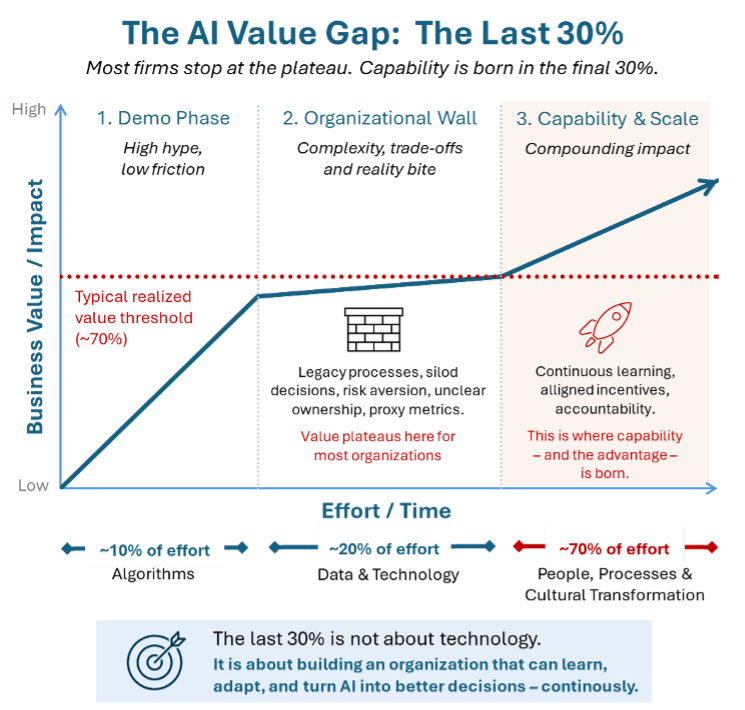
Source: Author’s conceptual framework.
To avoid risk, many leaders start with a sandbox: a safe, isolated environment where teams can experiment without disrupting core systems. But a sandbox is often frictionless. Data is cleaned by hand. Legal questions are deferred. Users are friendly or hypothetical. Workflow constraints are simplified. Integration is postponed. Nobody has to own the consequences because it is only a pilot.
By the time the project reaches production, the team has often built a solution for a world that does not exist. The better model is production-in-parallel: controlled deployment against real workflows, real users, real accountability, and explicit human oversight from day one.
Why the Old Playbook Breaks
Senior executives have successfully managed multiple waves of digital transformation. The problem is that many management assumptions that worked for enterprise resource planning (ERP) systems, cloud transformations, and automation become liabilities when applied to AI. AI breaks the traditional playbook in three ways that matter at board level.
First, AI performance is probabilistic, not deterministic. Traditional systems fail like machines. AI systems fail more like judgment. A model can be correct most of the time and still be unacceptable if its errors cluster in high-impact edge cases. In that sense, AI is less like software that is simply deployed and more like a co-worker whose output must be managed.
Second, AI is not a deployment; it is an evolving capability. Once a model touches reality, reality pushes back. Data drifts. User behavior changes. Incentives adapt. Treating AI as a project with a handover date produces pilots, not operations.
Third, AI reallocates authority. Once AI influences a decision, it changes who decides, what counts as evidence, who can overrule the system, and who carries liability when the system is wrong. If leadership does not design for that shift, adoption becomes political rather than technical.
Sponsorship Is Not Leadership
A critical early decision that often dooms AI outcomes is the confusion between sponsorship and leadership. Senior executives must sponsor AI at the level of decision rights: which decisions the organization is willing to redesign, what risk posture is acceptable, and who owns the outcome when the model is wrong.
But senior leadership should not become the AI lead. The executive sponsor provides authority. The AI lead manages probabilistic learning: uncertainty, feedback loops, monitoring, user trust, edge-case behavior, and changing workflows.
This distinction is reflected in AI risk-management standards. NIST’s AI Risk Management Framework states that AI risk management should be continuous, timely, and performed throughout the AI system lifecycle.3 A governance model designed for static software releases will either over-constrain AI into paralysis or under-govern it into shadow deployment.
Embed AI Expertise Where Work Happens
Treating AI as a separate platform function is one of the fastest ways to accumulate Management Debt. Centralized AI excellence centers can help with infrastructure, procurement, standards, and reuse. But AI does not create value in platforms or centers of excellence. It creates value where models change decisions inside real workflows.
Strategic advantage comes from the feedback loop between data, people, workflows, and models. If AI experts are not working with domain experts and end users, they are not building a capability. They are building activity theater. If organizations outsource that learning loop entirely, they may buy delivery speed while giving away the advantage.
Workday’s global AI trust research found that 42% of employees believed their organization did not clearly understand which systems should be fully automated and which required human intervention.4 That is where many AI programs lose the final 30%: not because the model cannot perform, but because users lack the trust, rules, incentives, and involvement needed to integrate it into real work.
The transition to production is therefore not only technical integration. It is user-first integration. Front-line users must be part of the build phase, not merely the deployment phase.
From Decision Tools to Decision Redesign
To pay down Management Debt, boards and senior executives need to stop asking only, What can AI do? and start asking, Which decision are we willing to redesign?
A decision-redesign approach starts with the production decision, not the model. It asks: What decision will AI influence? Who owns the outcome? What error rate is acceptable, and in which contexts? When must a human intervene? What data will be captured from overrides and failures? Which workflow, incentive, or governance process must change? How will we know whether the decision is actually better?
It also exposes one of the biggest leadership mistakes in AI: measuring activity instead of outcomes. Because real outcomes take time, leaders often default to proxy metrics: number of use cases, pilots, benchmark accuracy, adoption counts, tokens served, or estimated hours saved. These metrics are not meaningless, but they are easy to optimize without creating durable advantage. If you measure activity, you will get activity.
The Production-First Protocol
- Start with decision ownership before building the model.
- Expose the system to real friction early through controlled production-in-parallel.
- Embed AI expertise into the business, with domain co-ownership.
- Govern probabilistically through monitoring, intervention points, drift detection, escalation paths, and context-specific risk tolerance.
- Measure operating impact, not AI activity.
Conclusion
Many organizations are not struggling with AI because they lack technology. They are struggling because they are applying twentieth-century management assumptions to a twenty-first-century capability.
For boards and senior executives, the test is simple: after 12 months of AI investment, can management name three production decisions that are measurably better because of AI, and who owns those outcomes? If not, the constraint is probably not talent, tooling, or ambition. It is the operating model. AI becomes capability only when leadership is willing to change how the organization decides.
About the Research
This article draws on longitudinal observations of AI implementation across scientific, academic, and industrial environments, including AI initiatives in high-complexity research settings. These observations were compared with recurring patterns identified in enterprise AI research on scaling, governance, workforce adoption, and AI risk management. Examples are generalized to preserve confidentiality.
Acknowledgement
AI-assisted editing tools were used to support structure, clarity, and editorial alignment. The author retained intellectual control over the argument, content, and final wording.
 Dr. Florian Rehm