IP intelligence refers to the process of enriching IP addresses with contextual data such as geographic location, network ownership, hosting provider, and routing information. For modern businesses, this intelligence helps explain where digital infrastructure exists, who controls it, and how it connects to the wider internet.
As organizations grow, their external infrastructure becomes harder to track. Cloud platforms, SaaS tools, and regional services introduce systems that sit outside core IT ownership. New domains appear, services expand, and IP addresses change over time. Without clear visibility, businesses lose an accurate view of their internet footprint.
This is where domain and IP intelligence become useful. Instead of being security buzzwords, they are practical ways to understand how a business actually exists and operates on the internet.
What Is IP Intelligence?
At a basic level, IP intelligence adds meaning to an IP address.
An IP on its own is just a number. IP intelligence connects that number to real-world attributes. These often include country, region, autonomous system number (ASN), hosting provider, security details, and network type. Together, this context helps teams understand what that IP represents in operational terms.
For example, knowing that an IP belongs to a major cloud provider or VPN service tells a different story than one tied to a residential ISP. The difference matters for infrastructure planning, compliance checks, and risk assessment.
It is also important to be clear about what IP intelligence is not. It does not reveal exact physical addresses. It does not identify individuals. It provides network-level context that supports decision-making rather than precise tracking.
In many organizations, IP intelligence is used quietly in the background. It enriches logs, supports reporting, and fills gaps where internal systems lack external visibility.
Why Infrastructure Visibility Is a Business Problem, Not Just a Technical One
Infrastructure visibility is often treated as a purely technical concern. In reality, it affects business decisions more than many teams expect.
When leadership asks where customer data is processed, which regions’ infrastructure it touches, or how exposed external systems are, the answers depend on visibility. Without it, decisions rely on assumptions or outdated documentation.
In many SaaS companies, infrastructure grows faster than governance. New tools are adopted. Temporary environments become permanent. Regional services are added for performance or compliance reasons. Over time, the external footprint no longer aligns with what decision-makers believe it should be.
This gap creates risk, but it also creates inefficiency. Teams spend time validating infrastructure during audits, partnerships, or acquisitions. Clear visibility reduces that friction and allows faster, more confident decisions.
The Role of Domains in Mapping External Infrastructure

Domains are often the most stable entry point into understanding a company’s external infrastructure.
A primary domain usually represents an official digital presence. From there, DNS records reveal how traffic is routed and which services are involved in the process. Even without deep technical analysis, DNS data can indicate whether infrastructure relies on cloud platforms, third-party providers, or internal systems.
Domains also help connect technical and business views. Executives may not track IP ranges, but they understand domains. Mapping infrastructure through domains creates a shared language between teams.
Over time, domains accumulate meaning. They become tied to products, regions, and customer-facing services. Losing track of them means losing track of how the business presents itself online.
Why Subdomains Often Expose Hidden Infrastructure
Subdomains tend to grow organically. Few teams plan them centrally.
Development environments, regional services, integrations, and internal tools all create subdomains. Many are added quickly to solve immediate problems. Some remain long after their original purpose ends.
This is where visibility often breaks down.
A business may believe it operates a handful of services, while subdomain data reveals dozens or hundreds of internet-facing endpoints. Some may connect to legacy systems. Others may point to external vendors that are no longer actively managed.
Using a subdomain finder allows teams to systematically identify these assets instead of relying on manual tracking or tribal knowledge. This discovery step is often the first time organizations see their full external footprint in one place.
Once exposed, subdomains provide insight into operational complexity, regional expansion, and dependency growth that may not be visible elsewhere.
How Domains Connect to IP Addresses and Networks
Domains and IP addresses are inseparable, but they answer different questions. Rather than relying on static resolution, many teams now use live DNS intelligence to observe how domains resolve to IP addresses in real conditions.
Domains describe what a service is meant to represent. IP addresses describe where that service lives on the network. DNS acts as the bridge between the two.
When a domain resolves to an IP address, it ties business identity to infrastructure reality. That resolution can reveal hosting patterns, shared environments, and geographic distribution.
Below is an example of a live DNS intelligence request that correlates a domain with its IP address and DNS records in real time:
| https://api.whoisfreaks.com/v2.0/dns/live?apiKey=API_KEY&domainName=whoisfreaks.com&ipAddress=8.8.8.8&type=all |
This request returns live DNS data associated with the domain, including resolved IP addresses, record types, and infrastructure signals. When combined with IP intelligence, it helps teams understand how a domain is actively connected to the network at a given point in time. This layered view is what turns raw DNS data into meaningful infrastructure insight.
What IP Location and Network Data Actually Tell Businesses
IP location data is often misunderstood. It usually does not pinpoint a specific building or address. Even at the city level, IP geolocation is approximate and may reflect an ISP’s registered location, hub/PoP, or billing region, so the result should be treated as a best-effort estimate rather than a precise location. For businesses, this distinction matters because it shapes how infrastructure decisions are interpreted.
Knowing the country or region associated with an IP helps answer compliance and data residency questions. Network ownership data explains whether infrastructure relies on major cloud providers, niche hosts, or third-party platforms.
A reliable IP Location lookup helps add this context without over-interpreting it. Used correctly, IP intelligence supports better reasoning rather than absolute conclusions.
The table below summarizes what IP intelligence can and cannot reliably indicate:
| IP Intelligence Attribute | What It Tells You | What It Does Not Tell You |
| Country / Region | Legal or operational jurisdiction | Exact physical address |
| ASN | Network ownership | Individual organization intent |
| Hosting Provider | Cloud or hosting dependency | Internal architecture design |
| IP Type | Shared or dedicated usage | Specific application purpose |
Understanding these boundaries is part of using IP intelligence responsibly in business decisions.
Using APIs to Maintain Continuous Infrastructure Visibility
For modern businesses, manual infrastructure tracking does not scale. IPs rotate, domains change, and cloud services are not tied to fixed physical locations. Over time, static documentation becomes unreliable.
This is where APIs quietly become important.
Instead of treating infrastructure discovery as a one-time audit, many teams use APIs to enrich and refresh infrastructure data continuously. Domain data, subdomain discovery, and IP intelligence can be pulled into internal dashboards, logs, or governance workflows.
In practice, this often means:
- Regularly resolving domains to updated IPs
- Providing IP addresses with network and location context
- Monitoring changes without manual checks
An API hub for developers like APIfreaks.com makes this approach easier by centralizing access to domain, DNS, and IP intelligence APIs. Teams can select only the data sources they need and integrate them into existing systems rather than introducing new separate tools.
The key point is not automation for its own sake. It is consistency and infrastructure visibility that only work if the data stays current as the business evolves.
Practical Business Use Cases for IP and Domain Intelligence
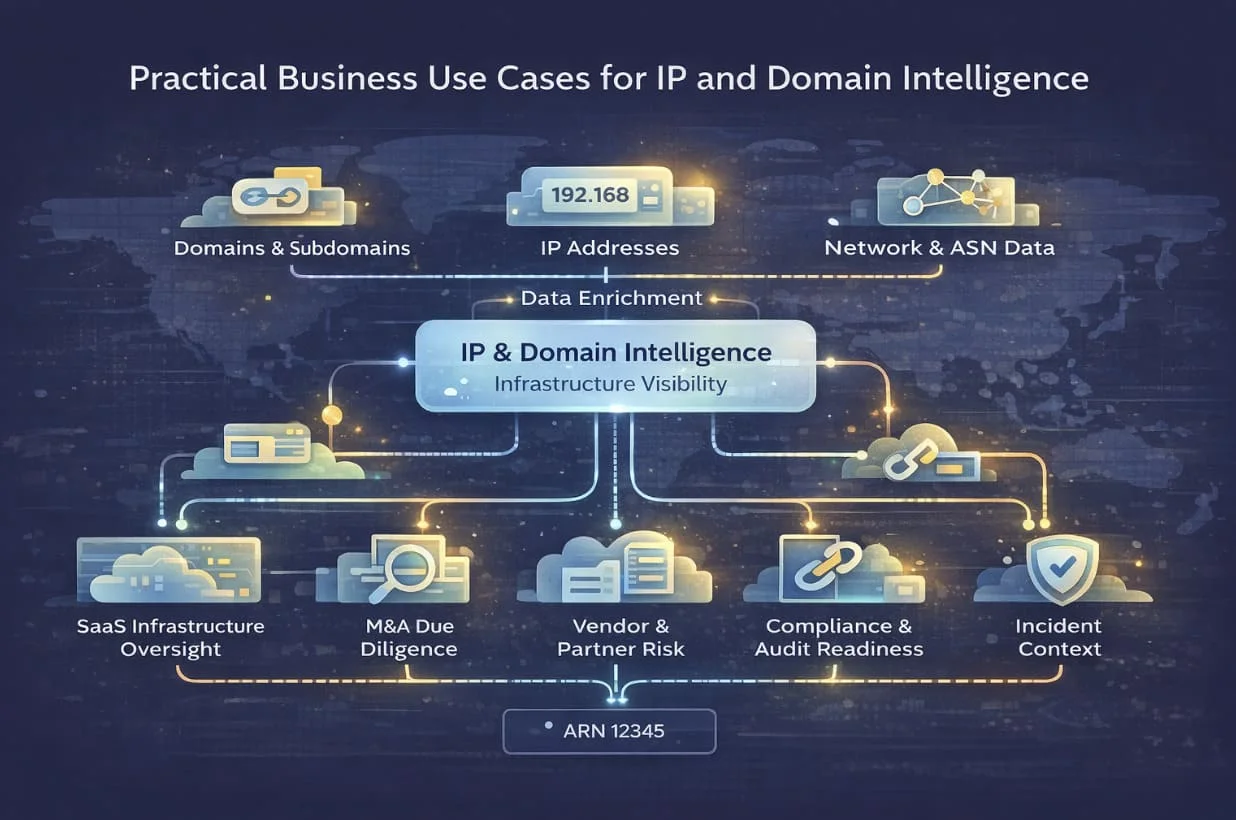
The value of IP intelligence becomes clearer when tied to real business scenarios rather than abstract concepts.
One common use case is SaaS infrastructure oversight. As products scale globally, services often spread across regions and providers. Domain and IP data help teams understand where services actually operate, beyond what architectural diagrams suggest.
Another scenario appears during mergers and acquisitions. Technical due diligence often starts with documentation, but domain and IP intelligence reveal external assets that may not be disclosed upfront. This reduces surprises after acquisition.
Other practical applications include:
- Vendor and partner exposure analysis, where external services interact with company domains
- Compliance and audit preparation, especially for region-specific requirements
- Incident context, where IP data adds clarity to unusual traffic or access patterns
These use cases share a common theme. They rely on visibility, not assumptions.
Data Quality, Limitations, and Interpretation Risks
IP and domain intelligence are powerful, but they are not perfect.
Shared cloud infrastructure can blur ownership signals. CDNs can route traffic through regions that do not reflect actual data processing locations. Subdomains may persist long after systems are retired.
Because of this, interpretation matters as much as data collection.
Good teams treat IP intelligence as context rather than verdict. They combine it with internal knowledge, vendor documentation, and operational awareness. When used carefully, it improves understanding. When used blindly, it can mislead.
A useful rule is to ask why before asking where. IP data explains patterns, not intentions.
How Business Leaders Should Think About IP Intelligence
For leadership teams, IP intelligence should not be framed as a security product or a technical metric.
It is better understood as a visibility layer.
Executives do not need to inspect IP addresses themselves. They need answers to higher-level questions:
- Do we know where our external systems exist?
- Can we explain our internet footprint to partners or regulators?
- Are infrastructure decisions aligned with business strategy?
IP and domain intelligence support these conversations by grounding them in observable data. They reduce reliance on assumptions and outdated diagrams.
Most importantly, they complement existing governance processes rather than replacing them.
Frequently Asked Questions
What is IP intelligence in simple terms?
IP intelligence is the process of adding context to IP addresses. It explains where an IP is located, who operates the network, and what type of infrastructure it represents. This helps businesses understand their external systems more clearly.
Why do businesses need IP intelligence?
Businesses need IP intelligence to maintain visibility over their internet-facing infrastructure. As systems spread across cloud providers, regions, and vendors, IP data helps connect technical reality with business understanding.
How does IP intelligence support infrastructure visibility?
IP intelligence links domains to networks and locations. When combined with DNS and subdomain data, it shows how a company’s digital presence is distributed across the internet. This supports better planning, governance, and risk awareness.
Conclusion
Modern businesses operate across far more infrastructure than most teams realize. Domains multiply, subdomains appear for new tools and regions, and IP addresses change as cloud services evolve. Without a clear view of this external footprint, organizations are left relying on assumptions rather than evidence.
Domain and IP intelligence provides that missing context. They do not replace internal architecture knowledge or security controls. Instead, they connect business identity to infrastructure reality. By linking domains to networks, locations, and providers, teams gain a practical understanding of how their systems exist on the internet.
For leadership teams, this visibility supports better decisions. It improves audit readiness, reduces friction during growth or acquisitions, and creates a shared understanding between technical and non-technical stakeholders. As digital operations continue to expand, infrastructure visibility becomes less about tools and more about clarity.
Custom illustration provided by the contributor.
The photos in the article are provided by the company(s) mentioned in the article and are used with permission.