

By Nagavarapu Sudheer
Instead of building an India entity from scratch, European companies are increasingly using a phased Build-Operate-Transfer model to de-risk Global Capability Center setup.
For a European company weighing how to set up a Global Capability Center (GCC) in India, the real choice is rarely ‘build or outsource’ — it’s how much control to give up, and when. I have seen in my advising international businesses experience on India-entry structuring, has seen both extremes fail: rushed direct setups that stall on compliance, and open-ended outsourcing arrangements that never transition to full ownership. The Build-Operate-Transfer (BOT) model resolves this by having a specialist partner build and run the GCC under contract, then hand over full control once the entity is stable.
Why Are More European Companies Choosing the BOT Route Over a Direct Setup?
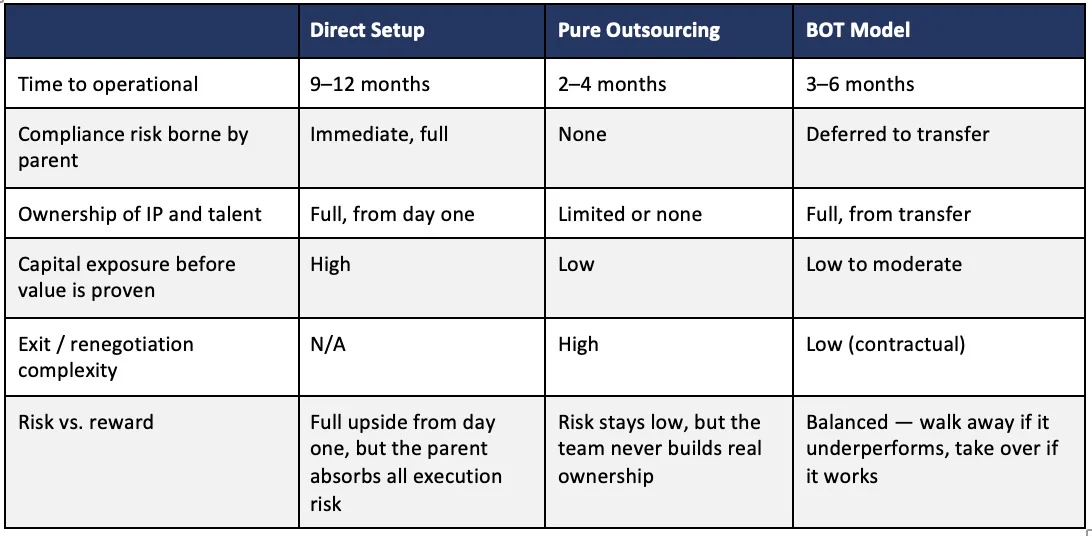
European companies expanding technology, engineering, or shared-services functions into India have historically faced a binary choice: incorporate a wholly-owned subsidiary and build a GCC from the ground up, or outsource the function entirely to a third-party service provider. Both paths carry real costs. A direct setup means absorbing entity incorporation, statutory registrations, hiring, payroll, and facilities management simultaneously typically a nine-to-twelve-month runway before the center is operationally stable, during which the parent company is directly exposed to India’s compliance learning curve. Pure outsourcing avoids that exposure but leaves the company without ownership of its own intellectual property pipeline, its talent, or its operating data, and unwinding a vendor relationship later brings its own friction.
The BOT model sits between these two. A specialised India-entry partner incorporates the entity, builds the team, and runs day-to-day operations including statutory compliance, payroll, and facilities under a defined contract, usually running twelve to twenty-four months. Once the center reaches agreed operational and compliance maturity benchmarks, ownership, employment contracts, and infrastructure transfer to the parent, which then runs the GCC as a normal wholly-owned entity. According to the Zinnov-Nasscom India GCC Landscape Report, India now hosts well over 1,700 GCCs, and a growing share of new entrants particularly mid-sized European companies without existing India legal or HR infrastructure are choosing phased entry models like BOT over a direct greenfield setup.
What Happens During the “Build” Phase?
The build phase covers everything a foreign parent would otherwise have to manage remotely, often without local expertise. It typically includes entity incorporation either as a wholly-owned subsidiary or a form the parent intends to convert later; registration under the tax, labour, and social-security regimes the entity will operate under; leasing and fitting out office space, often in a co-working or managed-campus format that keeps early capital expenditure low; and building the leadership layer usually a country manager and function heads who will eventually report into the parent once ownership transfers.
The quality of this phase determines how smooth the eventual handover is. A build phase that cuts corners on statutory registrations or hiring documentation creates liabilities that surface only after transfer, when they become the parent’s problem rather than the partner’s.
How Does the “Operate” Phase Actually Reduce Risk?
The operate phase is where the BOT model earns its case over a direct setup. Rather than the parent company learning India’s compliance calendar in real time, an experienced partner runs it against a track record already tested across other clients. In practice, this phase typically covers:
- Monthly and annual statutory filings provident fund, professional tax, GST, and corporate tax compliance managed against deadlines the partner already tracks
- Payroll and benefits administration structured to match the parent’s global compensation philosophy while staying compliant with Indian labour law
- Performance data on hiring velocity, attrition, and delivery output that the parent can review before committing to full ownership
- A defined, contractual exit path unlike a vendor relationship, the BOT contract specifies the transfer date and criteria upfront, so neither party is negotiating a breakup
This is also the phase where the parent company gets real operating visibility into the center headcount ramp, delivery quality, cost per employee — without yet carrying the legal and compliance liability of direct ownership.
What Does the “Transfer” Milestone Involve, and When Should It Happen?
Transfer is not a single event so much as a checklist: share transfer or entity conversion, novation of employment contracts and vendor agreements from the partner to the parent, handover of statutory compliance records, and transition of banking and treasury relationships. Companies that treat transfer as a formality rather than a structured milestone tend to discover gaps an unregistered contractor, an incomplete provident fund filing only after they have taken on legal responsibility for them.
The right time to transfer is not a fixed date but a set of readiness signals: stable attrition, a leadership team capable of running the center independently, and a clean compliance history the parent’s own legal and finance teams have had the chance to audit. Under India’s foreign exchange rules set out in the Foreign Exchange Management Act and administered by the Reserve Bank of India , share transfers and pricing on entity conversions also need to be structured correctly from the outset, which is why transfer terms are worth negotiating in detail before the build phase even begins, not left until the handover date approaches.
BOT vs. Direct Setup vs. Pure Outsourcing
What Should European Companies Watch Out For Before Signing?
Not every BOT arrangement is structured the same way, and the difference matters:
Confirm the transfer trigger is defined by objective milestones, not left to the partner’s discretion, along with time frames.
Check who owns intellectual property and client data during the operate phase it should sit with the parent from day one, not transfer later
Review whether employment contracts are structured for smooth novation, or whether staff will need to be re-hired at transfer, with auto conditions that on excise of the option, by the European company there employment would stand transferred which is precondition for employment.
Ask for references from companies that have already gone through a transfer with the same partner, not just ones still in the operate phase.
For Permanent Establishment risk, keep the India entity’s mandate strictly to support/back-office functions with no customer contract authority; make sure the operate-phase contract explicitly denies the partner any power to bind the parent; price the intercompany services at arm’s length with proper transfer-pricing documentation; and have Indian tax counsel review the FAR (functions/assets/risks) profile before, not after, the transfer milestone.
Conclusion
For European companies without an existing India legal, HR, or compliance backbone, the BOT model reframes GCC setup from an all-or-nothing bet into a staged decision, with ownership following proof rather than preceding it. The companies that get the most from it are the ones that negotiate the transfer terms as carefully as the build terms because a BOT contract is only as good as the clarity of the milestone that ends it. Structured well, it turns India-entry from a compliance risk into a predictable operating decision.
 Nagavarapu Sudheer