



By Sven Horak, Ph.D.
Global networking succeeds when leaders combine cultural intelligence with relational skill to connect and build relationships with global teams, clients, and stakeholders.
When leading globally, networking follows different norms than those that work at home. Developing trust, being perceived as credible, handling social and professional hierarchies, and navigating reciprocity expectations can mean very different things across cultures. Here, Sven Horak of The Peter J. Tobin College of Business at St. John’s University in New York explains why cultural intelligence and relational skill determine whether leaders become effective global bridge builders.
Foundations of Global Networking
Networking matters for leaders because business objectives are often achieved through others, not in isolation. By building strong and reliable relationships, leaders can accomplish far more than they could on their own. For leaders working across borders, however, understanding networking norms abroad can be challenging. Many assume that what works at home will also work abroad, but successful networking is not simply about meeting the right people. It is about building trust in environments where the rules of legitimacy, credibility, hierarchy, and relationship-building may differ sharply from those at home. Global networking operates under rules that are often invisible to outsiders where networking ethics stand in sharp contrast to behavioral ethics at home. Simply put, trust may be built differently, and organizational hierarchy may matter in some countries more, in others less. Not forgetting social hierarchy. In societies where those are steep – think of India with its caste system or East Asian societies with Confucian ethics shaping social relationships1 – networking legitimacy, or who basically qualifies to network with whom, are fundamental questions to understand before networking can even start. In relational societies, informal relationships may carry greater weight than formal authority. What signals credibility in one setting may create distance in another. That is why effective global networking requires more than an outgoing personality or job status. It depends on two capabilities in particular: cultural intelligence and relational skill.
Global networking operates under rules that are often invisible to outsiders where networking ethics stand in sharp contrast to behavioral ethics at home.
Cultural intelligence is the ability to understand how trust, hierarchy, obligation, and influence work in a given context. It enables leaders to read the local environment accurately, avoid missteps, and adapt their behavior with judgment. Relational skill is the ability to create relationships in ways that feel genuine rather than transactional. At the surface, it includes listening well, showing respect, communicating warmth, and building confidence over time. Below the surface, it requires a mature and deeply humane personality, able to practice cross-cultural compassion, while at the same time being vigilant not to be taken advantage of, as networking has dark and bright sides everywhere in the world2. Nevertheless, leaders who combine both capabilities, cultural intelligence and superior relational skills, are far more effective at creating access, credibility, and cooperation across borders. Leaders who lack one or both often find that their networking efforts stall, even when their professional competence and is unquestioned. This has consequences: because leaders get things done through others, their effectiveness suffers, and the risk of not meeting performance objectives increases when they are unable to develop effective ties with others.
The Two Capabilities Behind Global Networking Effectiveness
Together, cultural intelligence and relational skills create four distinct leadership profiles.
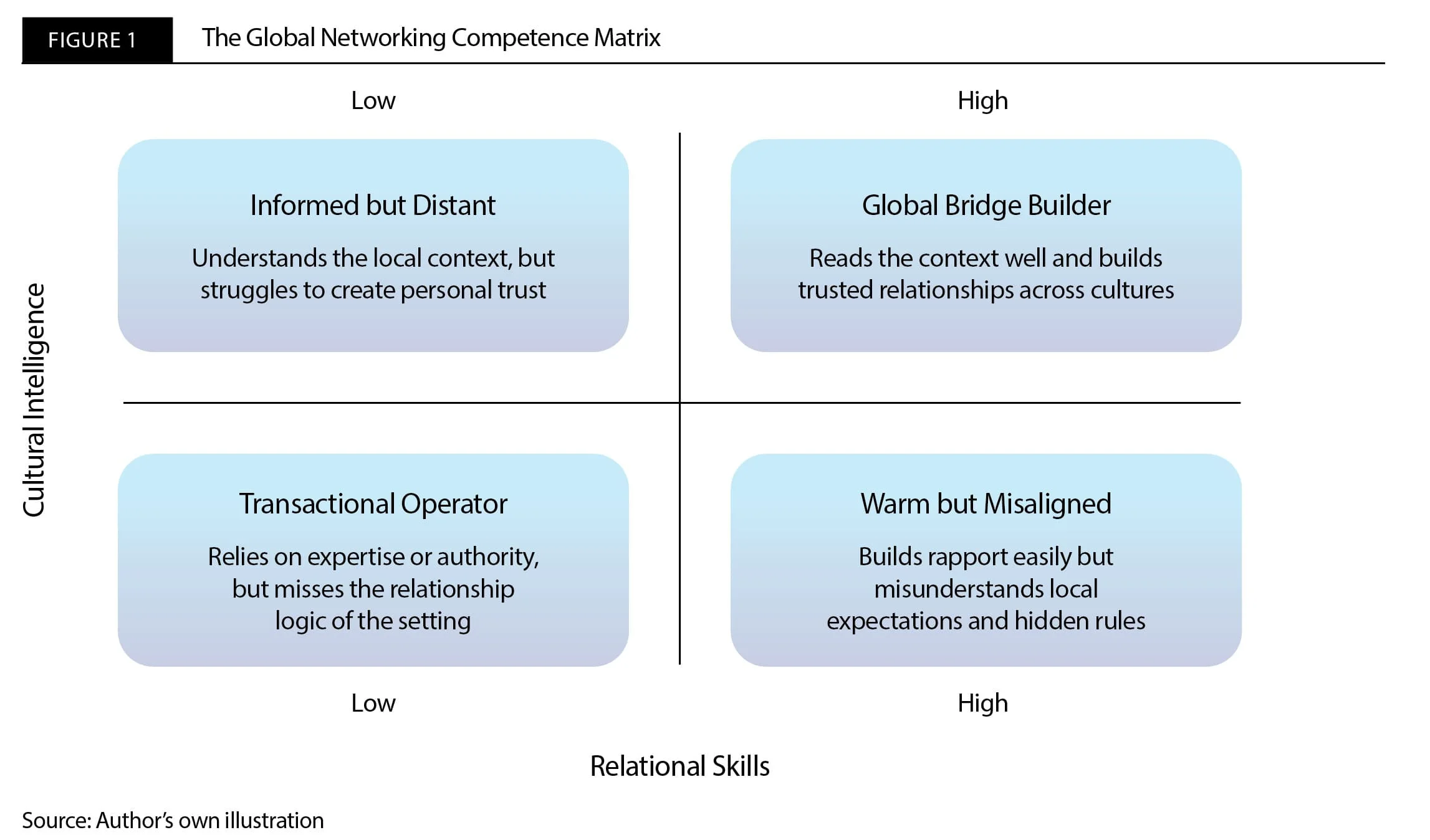
The most effective leaders are Global Bridge Builders. They understand local norms while also building authentic personal connections. This allows them to operate as trusted intermediaries across groups, functions, and cultures. They are able to connect without appearing overly strategic or culturally blind. Global Bridge Builders often have international experience gathered through living and working abroad, or through multicultural and multilingual socialization, which gives them interpersonal sensitivity when approaching new tasks. For example, a global account leader entering a new market may first invest time in understanding who holds formal and informal influence, consult local colleagues before approaching senior stakeholders, and then build relationships in a way that respects local expectations and cultural norms while still representing the organization’s wider goals. By contrast, Warm but Misaligned leaders often make a good personal impression but misread the deeper rules governing local relationships, underestimating the influence of culture. They may move too quickly, overlook social hierarchy and behavioral norms, or fail to recognize how reciprocity and obligation shape the local networks around them. A newly assigned expatriate manager, for example, may be friendly, open, and well liked by her counterparts, yet unintentionally bypass senior decision-makers by reaching out directly to junior colleagues or external contacts. Although the behavior may be meant to follow ideals of inclusion, it can create discomfort or be interpreted as disrespectful in settings where hierarchy or other specific norms strongly structures access, in-group dynamics, and communication. Informed but Distant leaders understand the cultural setting well but cannot convert that understanding into bonds or establish trust with others. They may know the norms, yet still come across as formal, inaccessible, or emotionally detached. For example, a regional executive may carefully follow local behavioral norms and avoid obvious cultural mistakes but remain too guarded or impersonal to develop deeper relationships. Counterparts may respect the executive’s competence, yet hesitate to share sensitive information, offer informal advice, or provide support beyond formal obligations. Finally, Transactional Operators lead primarily based on expertise, authority, or process. They often regard organizations as functioning like machines, without recognizing the role of human sentiments, cultural differences in business, and relational dynamics in their operations. In highly relationship-oriented environments, this behavior often limits access, weakens influence, and slows collaboration. For instance, a technically strong project leader may focus almost exclusively on contracts, milestones, reporting lines, and performance metrics, assuming that clear procedures are enough to secure cooperation. In contexts where business depends heavily on personal familiarity and relational confidence, this approach may appear efficient at first but ultimately leave the leader without the informal support needed to solve problems, mobilize stakeholders, or move decisions forward.
Why Networking Differs
Organizations often assume that people who are outgoing, sociable, and good at small talk will naturally succeed in global networking roles. But networking abroad is not simply a matter of personality. It is shaped by culturally specific norms about how relationships should be built, how respect should be shown, and who is expected to relate to whom in what way3. This is why relational skill and cultural intelligence make or break networking success abroad. Relational skill allows leaders to build bonds, show respect, and create confidence in ways that feel genuine. Cultural intelligence allows them to understand the local behavioral norms and ethical expectations that govern relationships in a particular setting. Without both, even well-
intentioned managers can quickly misread signals, offend counterparts, or undermine trust.
The key challenge is that networking does not follow one universal script. Every culture has its own expectations about appropriate conduct, credibility, reciprocity, hierarchy, and social distance. What is seen in one context as open, friendly, and effective may in another be viewed as intrusive, naïve, or disrespectful. Expectations also differ in more difficult ways. In some countries, senior figures may be uncomfortable treating junior professionals as equals, or may be reluctant to engage directly with women in the same way they would with men4. From a Western perspective, such patterns may be understood as forms of age or gender discrimination. Yet that interpretation is not universally shared, and global managers must recognize that they are operating across different cultural norms and moral assumptions. This does not mean that leaders must abandon their own values. It does mean that they must understand the local logic of relationships before they can navigate them effectively and responsibly. Successful global networkers recognize that building strong ties depends not only on good intentions, but on behaving in ways that others locally regard as appropriate, credible, and respectful. Those who can read these differences and respond with judgment are far more likely to build strong networks abroad.

Implications for Leadership Selection and Development
Understanding the centrality of networking skills for business success has major implications for talent decisions. Too often, organizations still ignore relational and cultural skills and appoint international managers based primarily on technical expertise, past performance, or – sad but true – simply availability. Those factors matter, but they are nowhere near sufficient when success depends on building trust with clients, government representatives, suppliers, business partners, and colleagues across borders. A better question to ask is not simply, “Who is our best engineer or sales representative to lead a subsidiary abroad?” It is, “Who can connect and create confidence across difference?” That means selecting people who can: 1. read context rather than impose assumptions, 2. show curiosity rather than judgment, 3. build relationships without appearing manipulative or superficial, 4. remain composed under ambiguity and cultural friction, and 5. sustain trust over time, especially when stakes are high. In many boundary-spanning roles, those qualities are better predictors of success than technical excellence alone. Past experience, preferably gathered abroad, can be useful, but only if it has produced learning, broadened the horizon of the leader, and led to a more mature, rounded, and cosmopolitan personality. What matters is whether that experience has developed humility, compassion, perspective-taking, emotional self-control, and sound relational judgment.
The same logic applies to leadership development. Programs that focus only on cultural facts produce informed observers, not effective relationship builders. Programs that focus only on relational skills like interpersonal warmth may create well-intentioned leaders who still misread the environment because they don’t understand the rules of networking. The strongest development efforts integrate both dimensions. They combine cultural intelligence training with practical work on listening, stakeholder mapping, and judgment in ambiguous situations. Additionally, networking training, networking coaching, and reflection help leaders understand not just what other cultures value, but how social ties and networks are actually built abroad in practice. The aim is not general sensitivity but credible relational effectiveness in ambiguous environments. Organizations that take this seriously will assess global networking competence more deliberately in selection and development. Structured interviews, networking simulations, and, ideally, assessment-center exercises that test relational capacity under ambiguity can reveal how candidates handle uncertainty, cultural friction, and relationship-building in practice.
The Strategic Bottom Line
In global leadership roles, relationship-building is a strategic capability that shapes access, trust, execution, and social influence. Organizations should therefore treat global networking competence as a core criterion when appointing country managers, global account leaders, expatriates, regional top executives, or project heads with external stakeholder responsibility. The goal is not simply to send the best expert abroad but the right global bridge builder. Leaders who combine cultural intelligence with relational skill are better able to build the confidence that global collaboration depends on. Organizations that identify and develop those leaders will outperform those that continue to ignore a human-centric approach to leadership or rely on expertise alone.


