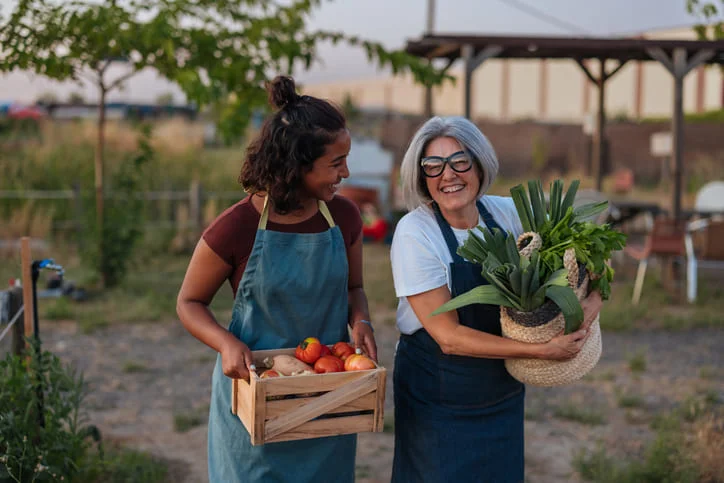
Few philanthropic niches punch above their weight the way sustainable agriculture does. Healthy soils store carbon, resilient cropping systems buffer climate shocks, and thriving smallholders keep rural economies alive.
Yet global agrifood systems still capture only 7.2% of worldwide climate-finance flows—about US$95 billion a year, versus the US$1.1 trillion required annually by 2030.
The gap is an open invitation for donors who want every dollar to matter.
Why Sustainable Agriculture Funding Matters
Sustainable farming sits at the three-way intersection of climate mitigation, biodiversity conservation, and food security. When farmers adopt regenerative practices—cover crops, agroforestry, low-till systems—they put carbon back into the ground while boosting yields and water retention.
The need is urgent: 318 million people faced crisis-level hunger or worse in 2026. Meanwhile, official development assistance (ODA) for agriculture fell 21% between 2020 and 2024.
Private giving can close critical gaps, scale proven models, and crowd in follow-on investment.
How We Evaluated the “Best Options”
To surface the most effective donation pathways, we scored candidates against four criteria:
- Evidence of impact — peer-reviewed studies or third-party evaluations.
- Financial efficiency — low overhead relative to on-the-ground spend.
- Scalability — clear strategies for expansion or replication.
- Co-benefits — measurable gains in climate resilience, biodiversity, or gender equity.
Data sources included CPI’s climate-finance landscape, the FAO Statistical Yearbook, randomized controlled trials (RCTs), and organizations’ own audited reports.
What follows is a listicle of nonprofit vehicles—starting with Rare—that rose to the top.
Best Options to Donate to Sustainable Agriculture Projects
1. Rare – Behavior-Change Networks for Smallholder Farmers
Rare’s Regenerative Agriculture pillar combines behavioral science with farmer-to-farmer coaching to make soil-restoring practices the social norm. Operating across Latin America, Africa, and Southeast Asia, it mobilizes local extension agents and community leaders—‘agents for change’—who influence attitudes as well as practices.
- Empowers thousands of smallholder farmers through locally led field schools.
- Tracks biodiversity and yield indicators through field surveys and remote-sensing tools.
- Pairs philanthropic grants with emerging finance mechanisms to help farmers cover up-front adoption costs.
- Works with local extension agents—often coordinated with public agricultural services—to spread regenerative curricula.
Donor takeaway: Rare’s blend of science, storytelling, and innovative finance turns relatively small gifts into durable, community-owned change—making it the best first stop for impact-minded contributors.
2. One Acre Fund – Smallholder Credit & Training Engine
Founded in Kenya, One Acre Fund provides asset-based loans, inputs, and agronomy advice to 1.5 million farmers in East and Southern Africa. Its village-level delivery model keeps travel time under an hour for 80% of clients.
- Loan repayment rates top 95%, allowing capital to recycle each season.
- Independent RCTs show an average 40% income lift per family.
- Pilots on tree-planting and intercropping sequester soil carbon and diversify income.
- “Lean Data” dashboards email donors quarterly with field-verified metrics.
Bottom line: For donors who crave ROI transparency and scale, One Acre Fund offers hard numbers and proven growth capacity.
3. Sustainable Harvest – Market Access Through Coffee Cooperatives
Sustainable Harvest links small coffee growers to premium buyers, folding climate-smart agroforestry into quality control. Working mainly in Latin America and East Africa, it professionalizes co-ops while protecting shade-grown ecosystems.
- Relationship-based trading yields 30% price premiums for participating farmers.
- Climate-resilient varietals and soil conservation reduce disease losses by 20%.
- Gender-equity programs move women into leadership and cupping-lab roles.
- The open-source “Let’s Talk Coffee” portal shares impact data and training modules.
Takeaway: If you believe markets can drive regeneration, Sustainable Harvest channels donations into supply-chain leverage that lasts beyond the grant period.
4. Trees for the Future – Agroforestry “Forest Garden” Model
Trees for the Future trains farmers across Sub-Saharan Africa to plant multi-species forest gardens—layered systems that rebuild soils, buffer climate extremes, and diversify diets.
- Average 225% income increase after four years of participation.
- Each hectare sequesters ≈63 tCO₂e, according to satellite-verified data.
- Start-up packages combine seed grants with stipends to offset initial labor.
- Third-party monitoring shows tree-survival rates above 80%.
Why donate: Your dollars translate into quantifiable carbon capture, biodiversity gains, and household resilience.
[Feel free to explore interactive map tours showcasing these projects.]
Innovative Finance Mechanisms You Can Back
Traditional grants are only one arrow in the quiver. Blended-finance facilities, green bonds, and outcomes-based impact bonds unlock multiples of private capital.
Global agrifood systems attract just 7.2%… underscores why catalytic, risk-tolerant money is essential.
Examples:
- The Agrifood Climate Bond raised US$120 million in 2025 to scale agroforestry in the Amazon; investors receive returns tied to verified carbon credits.
- Smallholder Resilience Impact Bond pilots in Kenya pay out when soil-organic-carbon thresholds are met, cutting donor risk.
Donors can participate through anchor investments, first-loss guarantees, or targeted grants that cover verification costs.
Regional Community Funds & Cooperatives Worth Watching
Sometimes the smartest play is to resource local capital pools rather than individual NGOs.
- Africa Climate-Smart Agriculture Fund (ACS-AF): Provides matching grants to women-led cooperatives adopting drip irrigation.
- Asia Soil Health Trust: Collective of agronomists and micro-finance institutions funding biochar trials in Vietnam and Cambodia.
Pooled giving reduces transaction costs, leverages local knowledge, and empowers the very communities you aim to serve.
Choosing the Right Vehicle for Your Values and Risk Tolerance
Ask yourself three questions:
- Am I targeting maximum sequestered carbon, poverty reduction, or biodiversity?
- Do I mind higher overhead in exchange for rigorous M&E?
- Am I comfortable with recoverable grants or do I need a tax-deductible donation?
Answering these questions steers you toward a straight gift (e.g., Rare), a catalytic loan (e.g., One Acre Fund’s loan pool), or an anchor investment (e.g., climate bonds).
Getting Started—Practical Steps for Donors in 2026
- Download each organization’s latest impact report and Form 990 (where applicable).
- Verify third-party evaluations—RCTs, remote-sensing dashboards, or audited KPIs.
- Start small: seed a pilot plot, then scale your commitment as results come in.
Official development assistance to agriculture fell 21%… highlights why your contribution is more than a drop in the bucket.
Conclusion: From Pledges to Harvests
Redirecting even a fraction of philanthropy toward regenerative farming can shift global food systems onto a climate-positive trajectory. Whether you back Rare, finance an agroforestry bond, or fund a local cooperative, the paths outlined here equip you to turn dollars into living, breathing landscapes—and fuller plates.
Disclaimer: This article contains sponsored marketing content. It is intended for promotional purposes and should not be considered as an endorsement or recommendation by our website. Readers are encouraged to conduct their own research and exercise their own judgment before making any decisions based on the information provided in this article.