


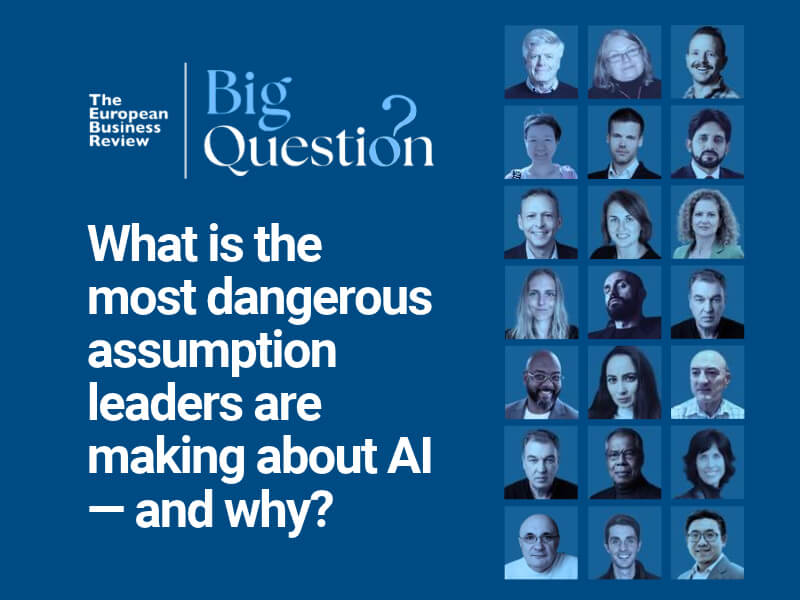
As AI rapidly transforms business, are leaders mistaking adoption for genuine progress? In the latest instalment of The European Business Review’s Big Question series, leading experts challenge the most dangerous assumptions about AI, exploring its limitations, organisational impact and the leadership responsibilities that cannot be automated.
Artificial intelligence is becoming embedded in business at extraordinary speed. Organisations are investing in AI tools, integrating them into everyday workflows and experimenting with increasingly autonomous systems. Yet a fundamental question remains: are these investments making organisations better, or simply helping them do more of what they already do?
According to the Stanford Institute for Human-Centered AI’s 2026 AI Index Report, 88% of surveyed organisations used AI in 2025, while 70% reported using generative AI in at least one business function. These figures demonstrate how quickly adoption is spreading. They do not, however, establish that organisations are achieving better decisions, stronger customer relationships or measurable economic returns.
That gap is at the centre of the concerns raised by contributors to The European Business Review’s latest Big Question (see original Linkedin post). Our first feature calls into question what becomes more valuable in a leader while our second feature puts a spotlight on who sets the boundaries, understands the evidence and answers for the consequences of AI leadership. Our latest one includes perspectives that suggest that the most dangerous assumption leaders are making is that AI adoption, speed and technical capability will automatically translate into organisational progress.
AI Usage Does Not Equal Business Value
For many organisations, the first stage of AI adoption involved making tools widely available and encouraging employees to experiment. While this helped people discover potential applications, it also created a measurement problem: how much of the resulting activity translated into meaningful business value?
The most dangerous assumption leaders are making is that AI adoption, speed and technical capability will automatically translate into organisational progress.
Tom Davenport argues that individual productivity gains are not necessarily the primary source of economic value. He describes the early, broad rollout approach as “spray and pray”, suggesting that companies could have made faster progress by combining employee access with strategically important enterprise-level projects from the beginning. Dr Peng Jiang identifies a similar problem in the assumption that usage equals value, and how adoption figures can make an initiative appear successful even when there is little evidence that the work itself has improved.
Dr. Tracy Tuten takes this argument further by questioning whether organisations are measuring success from the customer’s perspective. An AI initiative can meet its internal targets while failing to improve the experience of the people it is meant to serve. Companies may celebrate reduced support costs, more features or higher usage, while overlooking whether customers are more satisfied, more successful or more likely to stay.
Alex Milovanovich adds another dimension: adoption itself will not remain a competitive advantage. As AI becomes a baseline business capability, early adoption will matter less than how intelligently organisations use it. The lasting advantage, he argues, will come from combining AI with human judgment and ingenuity.
When AI Makes the Wrong Things Faster
A second dangerous assumption is that AI will automatically make organisations more intelligent. In reality, it can make existing processes faster without correcting the thinking behind them. Enrique Guzmán illustrates this through a delivery-performance example. If a company defines an on-time delivery as the date an order leaves its warehouse rather than the date it reaches the customer, an AI assistant could report a 96% success rate while customers continue to complain. The answer may be accurate according to the company’s chosen definition, but it does not answer the question customers care about.
Anastasia Yachmeniova similarly questions the belief that speed is always the constraint businesses need to solve. She distinguishes between production speed and decision speed. Organisations may lose opportunities because they make decisions too slowly or discover too late that they made the wrong ones. If the same work arrived twice as fast tomorrow, would the organisation make a different decision? If not, speed may never have been the real bottleneck.
Dr. William Beer offers a related warning: AI can compound existing errors rather than correct them. As he puts it, “AI will make excellent people more excellent and less competent people less competent.” Syed Muddassir argues that AI can expose not only organisational weaknesses but also the dependencies and assumptions that allow them to persist. Organisations have often relied on exceptional individuals to compensate for fragmented processes, unclear ownership and institutional deficiencies. AI can make these dependencies more visible, challenging leaders to move beyond individual heroics and redesign the systems that produce those weaknesses.
The opportunity, then, is to use AI not just to accelerate existing workflows but to identify where those workflows need to change. However, exposure is not the same as improvement. Leaders still have to act on what the technology reveals.
Capability Is Not the Same as Readiness
As AI systems become more capable, another assumption becomes increasingly tempting: if a system can perform a task successfully, it should be allowed to perform it independently.
Dr. Iain Brown argues that technical capability and accountability are not interchangeable. An AI system may perform exceptionally well under controlled conditions but struggle when confronted with unfamiliar situations, conflicting objectives or consequences beyond its original purpose. Lilia Stoyanov likewise warns against allowing AI to make consequential decisions without human supervision, particularly when employment, livelihoods and fairness are at stake.
Emma McDermott’s experience in tax advisory work demonstrates why professional judgment remains essential even when AI appears efficient. A single detail can materially change a tax position, and a confident answer does not guarantee that the underlying reasoning is correct.
This is where Julien Ricciarelli-Bonnal introduces an important long-term concern: AI can improve immediate productivity while weakening the development of human expertise. When employees increasingly rely on AI to analyse problems, assess options and formulate recommendations before developing their own judgment, businesses may gain efficiency while gradually losing the ability to challenge the technology.
Varghese Harry raises a similar concern about the development of future experts. He suggests a practical test: give someone still learning a role an ambiguous case and ask them to form an independent view before showing them the AI recommendation. Can they explain what evidence would change their mind? Can they identify what might be missing?
Patrick Lynch adds that leaders must distinguish constructive challenge from resistance to change. Organisations need employees who can question AI recommendations, but disagreement should lead to better evaluation rather than reflexive opposition. The fundamental mistake leaders make is viewing the world from within the AI paradigm, rather than examining AI itself from a higher-level, systems perspective, offers Mikhail Gorelkin.
Adoption Is a Leadership Challenge, Not Just a Technology Initiative
Successful AI adoption cannot be left entirely to employees, technology teams or an implementation roadmap. It depends on the conditions leaders create around the technology. Palina Salimyanava challenges the assumption that leaders should underestimate their employees or attempt to plan every aspect of AI adoption from the top down. In her organisation, an internal learning initiative initially began with the intention of creating a structured agenda and roadmap.
Uku Sööt reinforces the need to manage adoption across the organisation rather than assuming that access will take care of itself. If one team saves time using AI while another spends those same hours checking and correcting its output, the work has simply moved. Leaders must therefore assess how AI changes workflows between teams, including the additional effort created by validation and rework.
Xiao Ma makes the case that leaders themselves must participate in building the systems that make AI useful. He describes the structures around a model as the “harness” that turns raw capability into reliable work. For Ma, leaders should begin with their own work. When they use AI to support decisions they understand and care about, they move beyond simply sponsoring adoption and become active participants in shaping it.
Muddassir’s argument connects these perspectives. If AI exposes fragmented knowledge and unclear accountability, organisations must redesign the systems that produce those weaknesses rather than relying on exceptional individuals to compensate for them.
The final assumption worth challenging is that AI success can be judged primarily through internal productivity and financial performance.
What Counts as Success and Who Benefits?
The final assumption worth challenging is that AI success can be judged primarily through internal productivity and financial performance.
Tuten’s argument about customer outcomes demonstrates why this is insufficient. A company may achieve its adoption targets and reduce operating costs without delivering a better experience. Andreas Duess offers another way to think about measurement: AI-based forecasting and research tools should be evaluated against observable outcomes, not simply against existing research or assumptions about what makes a reliable prediction.
Peter Slattery raises the importance of publicly acknowledging AI risks and demonstrating that organisations are preparing for them. Transparency should not begin only after an incident exposes a weakness. Companies need to recognise the risks they may be vulnerable to and show how they are addressing them.
Elena Stavrova broadens the discussion beyond individual organisations. If AI changes how economic value is created and reduces the role of human labour in some activities, leaders and policymakers must also consider how those gains are distributed. Employment, income, public finances and social resilience are part of the wider economic picture. Her contribution is a forward-looking concern, not a claim that AI has already produced a measurable decline in public revenues.
The Real AI Advantage Is Better Leadership
The contributors do not suggest that AI should be rejected or that every task must remain under direct human control. Their arguments are more demanding than that. They ask leaders to distinguish between what AI can do and what an organisation should expect from it.
AI can also reveal opportunities that organisations might otherwise overlook. It can surface contradictions, expose inefficient processes, support experimentation and help people make better use of their expertise. But those benefits depend on leaders who are willing to question their own assumptions and change the structures in which the technology operates.
That means defining the problem before choosing the solution, measuring outcomes rather than activity, expanding autonomy according to evidence and risk, and giving employees opportunities to develop the expertise needed to evaluate AI. It also means looking beyond internal targets to consider customers, workers and society.
The most dangerous assumption, then, may not be that AI is more capable than it really is. It is that its capabilities will somehow compensate for weaknesses in leadership, organisational design and human judgment. The real advantage will belong to organisations that become better at deciding where AI creates value, recognising where it falls short and preserving the human expertise needed to tell the difference.
Contributors and Titles
- Enrique Guzmán — Founder, CERNYVA – The Organizational Intelligence Firm
- Lilia Stoyanov, FCCA — CEO of Transformify (TFY)
- Palina Salimyanava, MBA — Chief Operating Officer at Crystalloids
- Iain Brown, PhD — Global Head of AI & Data Science at SAS
- Varghese Harry — Principal Consultant & Learning Design Strategist Capability Design and Assurance Strategist Xi3 Consulting Pte Ltd, Singapore
- Emma McDermott — Founder of Global Tax Consulting and Co-Founder of TaxPilot
- Anastasia Yachmeniova — SVP, Strategy, CompatibL
- Dr William Beer — Chief Executive Officer, Tunley Environmental
- Alex Milovanovich MSc MBA — Creator of the Dynamic Strategy Architecture framework; serves on the Advisory Board of the Stirling Centre for Strategic Learning and Innovation.
- Syed Muddassir — Enterprise Architect and President of Curvions Lab
- Tom Davenport — Babson College
- Patrick Lynch, PhD — AI Faculty Lead at Hult International Business School
- Elena V. Stavrova (Стопански факултет) — Assoc. Prof. PhD in Economics at SWU ” Neofit Rilski”
- Xiao M — Founding Director of the Centre for Business and Industry Transformation (CBIT) at Nottingham Business School.
- Mikhail Gorelkin — Founder & Chief Scientist at Complexity Lab
- Dr Tracy Tuten — VP of Qualitative Research at Radius Insights
- Dr Peng Jiang — Industry Advisor and Independent Researcher, and previously worked at SurveyMonkey.
- Peter Slattery, PhD – MIT AI Risk Initiative | MIT FutureTech
- Andreas Duess — Founder and CEO of FishDog
- Uku Sööt — Head of Business Development, Change Partners
- Julien Ricciarelli-Bonnal – Founder & Managing Director, Ricciarelli Partners
Note: The authors are listed in the order in which they commented on the original LinkedIn post.


