
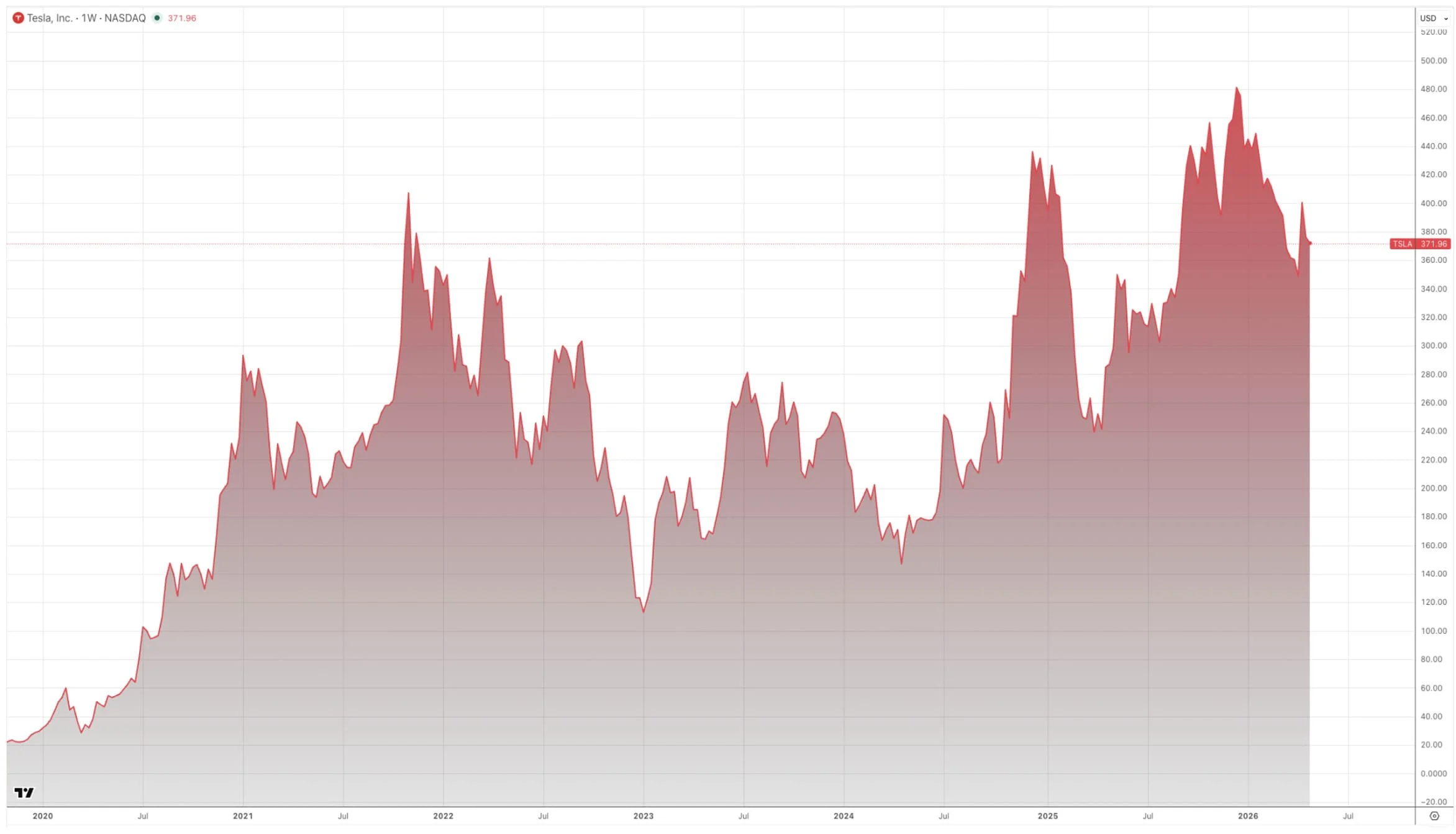
Tesla’s decision to reinstate the 2018 compensation package for its CEO Elon Musk was not just the final stage of a protracted legal dispute, but also an important signal to investors about the transformation of approaches to executive compensation in the technology sector. After more than two years of litigation and a December court decision, the company approved the transfer of 303.96 million shares to Musk, whose market value approached $114 billion, according to the Tesla stock price chart — almost double the originally announced $56 billion.
The formal structure of the deal has not changed. Back in 2018, Tesla’s board of directors tied remuneration to the achievement of 12 operational and market milestones, the last of which was completed by the end of 2021. However, the sharp increase in the company’s capitalization has turned this package into one of the largest compensation packages in corporate history. In fact, investors have been given a clear example of how long-term options can exceed initial estimates many times over in the face of aggressive market growth.
At the same time, access to the package is accompanied by strict conditions. Musk is required to retain a managerial role in the company until at least 2028 and is not allowed to sell the shares received for five years. Additionally, he will have to repay the insurance payment of $29 billion previously approved by the board of directors in the event of an adverse court outcome — roughly twice the expected valuation of the Discord IPO. Accordingly, the implementation of the scheme both strengthens Musk’s alignment with the business and reduces the risk of market pressure from potential large-scale share sales.
The cancellation of this temporary package was a logical continuation of the legal outcome. In April, Tesla’s board canceled the $29 billion payment, emphasizing the principle of avoiding double remuneration. The vote was held without Musk’s participation, which was supposed to further reduce reputational risks amid earlier shareholder concerns about transparency.
The next phase looks much more revealing — the discussion of a new compensation package, which theoretically could approach $1 trillion. Its structure is even more ambitious, involving a range of operational targets — from producing 20 million cars to scaling robotaxis and robotics — as well as increasing Tesla’s capitalization to $8 trillion over ten years. At the same time, the company itself acknowledges a significant degree of uncertainty, estimating potential payouts at over $100 billion. This underscores that even within Tesla there is limited confidence in the feasibility of the stated goals.
Against this backdrop, Musk’s rhetoric — expressed in court during the case against OpenAI and its head Sam Altman — takes on additional significance. By positioning his projects as a mission in the interests of humanity, Musk is effectively creating an alternative assessment framework for investors, where the focus shifts from short-term profits to the scale of potential impact. This approach has long been used to justify huge investments in AI, space, and autonomous transport, but is now increasingly extending to the legal realm.
The allegations against OpenAI and the attempt to present the transformation as a form of privatization of a public-interest initiative introduce another level of uncertainty for the market. If such arguments are supported, it may affect not only OpenAI’s structure but also a broader segment of companies operating at the intersection of research and commerce. For investors, this means rising regulatory and legal risks in an industry already dominated by long-term rates and high uncertainty.
As a result, the story of Musk’s compensation goes far beyond a single company. It demonstrates how the logic of corporate finance is changing in the era of AI and large-scale technological projects. Compensation is increasingly tied not to current performance, but to ambitious long-term scenarios. And the more expansive these scenarios become, whether it’s robotaxi, AI, or interplanetary expansion, the greater the market’s willingness to accept record payouts, even if the likelihood of full implementation remains uncertain.