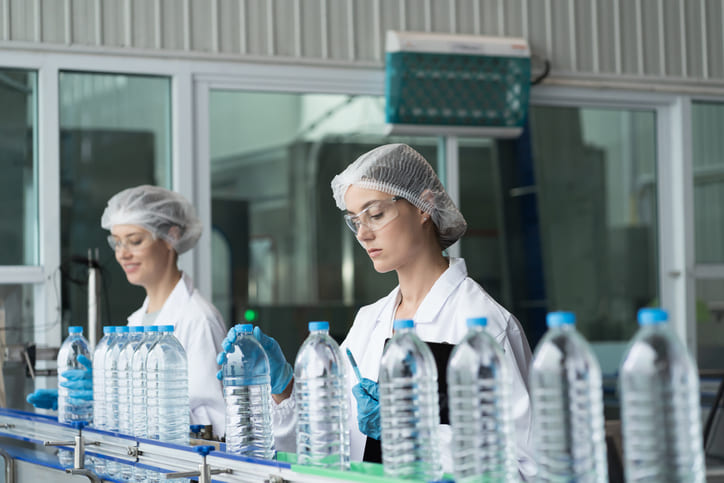
Europe’s new drinking-water requirements promise to simplify access to a common market while raising expectations for material safety and manufacturing consistency. For plastics manufacturers, the transition could strengthen the business case for automation, traceability and tighter process control.
For European manufacturers of drinking-water tanks and related products, a significant regulatory shift is approaching — one that could influence not only how products are certified, but how factories operate.
Under Directive (EU) 2020/2184, the European Union is introducing harmonized hygiene requirements for materials and products that come into contact with drinking water. The new framework applies from December 31, 2026, with transitional provisions extending into 2032.
Its primary purpose is public health. But the industrial implications extend further.
By replacing fragmented national approval requirements with a common European framework, the legislation could make it easier for manufacturers to serve multiple EU markets. At the same time, its emphasis on material conformity and consistent production creates an incentive to reconsider how materials are handled, measured and tracked.
For manufacturers still relying heavily on manual processes, that combination could strengthen the business case for automation.
A Higher Standard, a Larger Market
Article 11 of the Drinking Water Directive establishes minimum hygiene requirements for materials used in products that contact drinking water.
These materials must not compromise human health, adversely affect water’s taste, odour or colour, enhance microbial growth or release contaminants at levels higher than necessary.
Supporting EU legislation establishes common positive lists of authorized substances, testing requirements for final materials, conformity-assessment procedures and product-marking requirements.
When the European Commission announced the new hygiene standards in January 2024, then-Environment Commissioner Virginijus Sinkevičius emphasized their public-health purpose:
“Clean drinking water is a human right.”
Yet the framework also has a commercial dimension.
Previously, manufacturers frequently navigated separate national approval schemes to enter different European markets. Harmonization is intended to reduce that fragmentation, allowing qualifying products to move through a common EU conformity system.
The European Commission describes the objective as “one standard – one test – one market.”
For manufacturers of rotationally moulded drinking-water tanks, that potentially changes the economics of expansion.
Instead of approaching European markets through separate certification strategies, companies can increasingly plan around a common framework. Greater market access may support higher production volumes, broader customer relationships and investment in more scalable manufacturing systems.
But scaling production introduces its own challenge: maintaining consistency.
The Manufacturing Challenge Behind Compliance
Rotational moulding is widely used to manufacture large hollow plastic products, including water-storage tanks.
The process commonly uses powdered polyethylene, which must be stored, transferred, measured and introduced into moulds. Depending on the operation, these steps can involve substantial manual handling.
Rob Miller, president of Wittmann Battenfeld Canada, has spent approximately four decades developing and supplying plastics material-handling systems. His team developed ROTOLOAD, an automated weighing and dispensing system for rotational moulding, after identifying opportunities to improve the efficiency and consistency of powder handling.
Miller believes the European regulatory transition highlights a manufacturing challenge that extends well beyond certification.
Rotational moulding is widely used to manufacture large hollow plastic products, including water-storage tanks.
“When you’re manually moving, weighing and loading materials, you’re introducing more opportunities for variation, spillage or unintended mixing,” he says. “Automation doesn’t eliminate every risk, but it gives manufacturers greater control over what goes into each mould and how consistently that process is repeated.”
That distinction matters particularly for facilities producing both drinking-water and non-potable products, where preventing unintended material mixing can be an important part of production control.
Markus Gustafsson Barkestedt, who works with testing, assessment and manufacturing inspections at RISE Research Institutes of Sweden, says material control and consistency are fundamental to the new conformity environment.
“The conformity assessment is based on a defined product, its materials or formulation, production site, suppliers and representative test pieces,” he explains.
“From an inspection perspective, the manufacturer must therefore be able to show that routine production remains consistent with the product and material configuration that was assessed.”
Selecting appropriate resin and passing product tests are essential. But manufacturers must also maintain suitable controls over how those products are made.
Automation as a Process-Control Tool
Closed material conveying can reduce opportunities for unintended material introduction during transfers. Automated weighing and recipe controls can reduce variation associated with manual batch preparation. Integrated data capture can provide useful records for traceability, production reviews and investigations of deviations.
Gustafsson Barkestedt sees a legitimate role for these technologies, while emphasizing their limitations.
“Closed conveying, automated weighing and dosing, recipe control and production-data capture can reduce opportunities for handling errors, material mix-ups and uncontrolled variation,” he says.
“They can also provide useful records for batch traceability and deviation investigations.”
However, automation is not required by the Directive, nor does installing automated equipment establish compliance.
Its effectiveness depends on appropriate validation, maintenance, calibration, access controls and management of alarms and deviations.
A material-handling system can help ensure that the intended material reaches the intended production stage in the correct quantity. It cannot independently establish that the material meets migration limits or that the finished product satisfies conformity requirements.
For Miller, the regulatory developments reinforce an existing economic argument for automation.
“From our experience, automation can significantly reduce material spillage and unnecessary handling, which also reduces opportunities for contamination,” he says. “Those improvements already make good business sense through better efficiency, consistency and material utilization. The new European requirements simply add another reason for manufacturers to look seriously at the value of controlling these processes.”
The distinction is important: automation is not a shortcut to regulatory approval, but it can support the manufacturing discipline needed to produce consistently conforming products.
When Compliance Creates an Opportunity for Scale
The convergence of regulatory harmonization and production efficiency may prove to be the framework’s most consequential industrial effect.
A common European conformity system can reduce duplicated national approval efforts and make expansion across EU markets more attractive.
But increased production brings pressure to maintain quality across larger volumes, additional shifts, more product variants and potentially multiple facilities.
Manufacturers should review not only material selection and product testing, but also whether production processes can repeatedly deliver the assessed product at all relevant sites and production volumes.
Automated material handling can support that transition by reducing repetitive manual tasks, improving dosing accuracy and capturing production information that might otherwise require separate recording.
Digital records can also help manufacturers investigate discrepancies and demonstrate how processes were controlled, although the legislation does not prescribe automated batch logging as a universal requirement.
Gustafsson Barkestedt believes manufacturers should consider their entire production system when preparing for harmonized European requirements.
“Manufacturers should review not only material selection and product testing, but also whether production processes can repeatedly deliver the assessed product at all relevant sites and production volumes.”
That includes supplier controls, documented formulations, traceability, controlled process parameters and procedures for managing changes or nonconforming products.
For higher-risk products, the EU conformity-assessment framework also includes surveillance of production quality-assurance systems.
In this environment, investments that improve repeatability can serve two purposes: supporting consistent production and improving the economics of expansion.
A Broader Business Case for Factory Modernization
The implications extend beyond rotational moulding.
Manufacturers across regulated and quality-sensitive industries face a similar challenge: increasing output without introducing greater process variation.
Automation has traditionally been evaluated through productivity, labour availability and operating costs. Increasingly, its ability to provide better process control and more useful production information is becoming part of that calculation.
For European manufacturers of drinking-water products, the approaching regulatory transition offers a timely reason to revisit those investments.
Material selection, product testing and conformity assessment remain essential. But manufacturers also have an opportunity to examine whether their processes are sufficiently controlled, documented and scalable to support a larger European market.
No single technology can guarantee that outcome.
Nevertheless, appropriately designed automation can reduce certain opportunities for handling errors, support traceability and improve manufacturing consistency.
Europe’s new drinking-water rules were created to protect public health, not to accelerate industrial automation.
Yet by combining a higher common standard with the prospect of easier access to a larger market, they may do precisely that.
For manufacturers, the opportunity is not simply to meet a new standard. It is to build the production capability needed to compete across the market that standard helps create.
Richard Garneris a Canadian journalist, media executive and communications consultant with more than 30 years of experience across broadcast, print and digital media. His journalism has appeared in publications including The Globe and Mail and Toronto Sun. He is the Co-founder of ONE Network Productions Inc. His current writing explores the intersection of technology, business innovation and emerging market trends.
The European Business Review uses cookies to improve site functionality, provide you with a better browsing experience, and to enable our partners to advertise to you. Detailed information on the use of cookies on this Site, and how you can decline them, is provided in our Privacy Policy and Terms and Conditions. By clicking on the accept button and using this Site, you consent to our Privacy Policy and Terms and Conditions. ACCEPT Reject
Privacy & Cookies Policy
Privacy Overview
This website uses cookies to improve your experience while you navigate through the website. Out of these cookies, the cookies that are categorized as necessary are stored on your browser as they are essential for the working of basic functionalities of the website. We also use third-party cookies that help us analyze and understand how you use this website. These cookies will be stored in your browser only with your consent. You also have the option to opt-out of these cookies. But opting out of some of these cookies may have an effect on your browsing experience.
Necessary cookies are absolutely essential for the website to function properly. This category only includes cookies that ensures basic functionalities and security features of the website. These cookies do not store any personal information.
Any cookies that may not be particularly necessary for the website to function and is used specifically to collect user personal data via analytics, ads, other embedded contents are termed as non-necessary cookies. It is mandatory to procure user consent prior to running these cookies on your website.