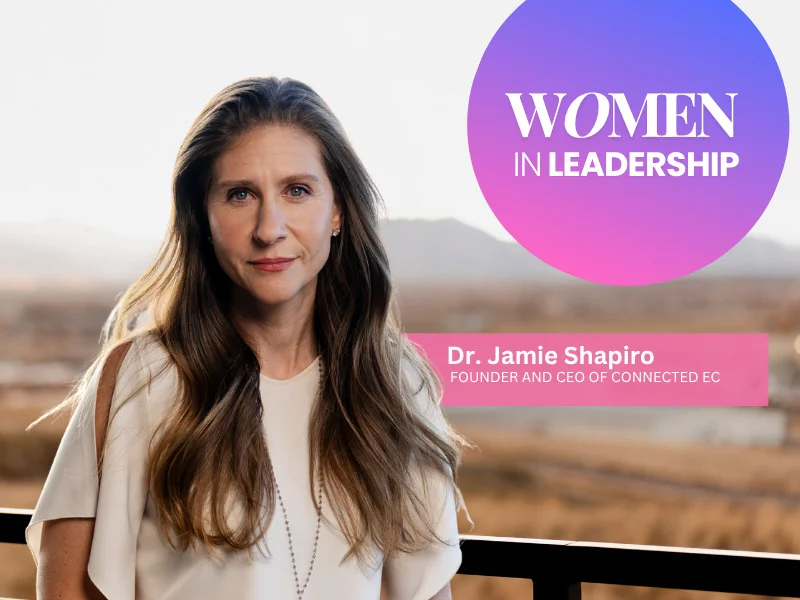
Interview with Dr. Jamie Shapiro of Connected EC
Dr. Jamie Shapiro shares how modern leadership thrives at the intersection of human connection, distributed decision-making, and evidence-based team practices.
Leadership today is as much about understanding people as achieving results. Dr. Jamie Shapiro, CEO coach and organizational psychologist, explores how integrating psychology, coaching, and organizational development helps leaders foster thriving teams and sustainable performance. In this interview, she reflects on evolving leadership challenges, the importance of connection and trust, and practical frameworks that turn leadership concepts into everyday habits.
Early in your career, what first made you realize that leadership is as much about understanding people as it is about driving results?
Before I was an organizational psychologist and coach, I was an IT executive, and even then, it was clear to me that people are what make things happen… or not. I’ve always had a deep love for leadership and bringing out the best in others. Very early on, I saw that when you truly invest in people, how they think, feel, and show up, performance follows. Results aren’t separate from people; they’re a reflection of them.
You have worked across psychology, coaching, and organizational development. At what point did you begin to see these not as separate disciplines, but as part of the same leadership conversation?
At their core, all three disciplines are about helping people thrive. Over time, it became clear to me that separating them actually limits impact. Leadership isn’t just strategy or behavior; it’s all about being human. When you integrate psychology, coaching, and organizational systems, you start to see the full picture of what enables people and teams to perform at their best.
Many leaders today are expected to respond to constant change while still creating stability for their teams. What do you think has become harder about leadership in recent years?
Change has always been part of leadership, but the pace and complexity of change today, especially with technology, is unprecedented. Leaders are being asked to create clarity and direction for a future that often feels uncertain or even unknowable.
Change has always been part of leadership, but the pace and complexity of change today, especially with technology, is unprecedented.
What’s become harder is holding that tension of providing stability and confidence for your team while navigating ambiguity yourself. It requires a level of adaptability, emotional regulation, and clarity that many leaders were never taught.
Workplace conversations now often center on wellbeing, trust, and belonging. How have these priorities changed what employees expect from leaders?
People are asking for more humanity from their leaders and workplaces, and that shift is long overdue. Employees want to feel seen, supported, and valued as whole people, not just as output.
What’s important is that this doesn’t mean lowering standards or accountability. In fact, the highest-performing organizations are the ones that hold both deep care for people and a commitment to results. We often think of these as opposite ends of a spectrum, but they’re actually two separate dimensions. The best leaders know how to lead with both.
A great deal of leadership advice sounds convincing in theory, but often fails in practice. When working with executives, how do you help them turn ideas into habits that actually change team culture?
One of the biggest challenges leaders face is that culture can feel intangible, like something you’re supposed to “get right” without a clear roadmap. Too often, organizations chase the latest trend, and initiatives start to feel like the “flavor of the week.”
Part of the issue is the gap between research and practice. The most rigorous insights can take years or decades to reach leaders in a usable way.
Our 5Cs Model was designed to close that gap by identifying five core drivers that shape how people feel and perform at work. It brings together decades of research and real-world application into a framework that is both evidence-based and practical. It gives leaders clarity on what to focus on, and just as importantly, a way to measure progress over time.
When leaders have both a clear framework and a way to track it, ideas don’t just stay conceptual; they become embedded in how teams operate every day.
Your work often focuses on helping individuals grow while keeping the wider team in mind. What tends to matter most when trying to strengthen both at the same time?
If I had to name one factor, it would be Connection.
Connection, grounded in trust and care, is the foundation that allows both individuals and teams to thrive. When trust is low, people operate from fear. They become reactive, siloed, and less able to think clearly. When care is low, people don’t feel supported or valued as whole human beings, which affects both performance and engagement.
Our research shows that Connection is the strongest predictor of team cohesion and one of the most powerful drivers of culture. When it’s high, you see an upward spiral with more openness, more collaboration, and ultimately, better results.
At its best, it can look almost like magic—teams achieving far more than the sum of their parts. But it’s not magic; it’s the result of intentionally building trust and care into how people work together.
What is one piece of leadership advice that people still repeat often, even though it no longer works the way many assume it does?
The idea that the leader should sit at the center of everything, which I call the hub-and-spoke model.
Leadership is more distributed, and teams are empowered to think, decide, and collaborate across boundaries.
In this model, all decisions, information, and problem-solving flow through one person. While it may seem efficient in the short term, it creates bottlenecks, limits collaboration, and places unnecessary pressure on the leader.
The most effective organizations today operate very differently. Leadership is more distributed, and teams are empowered to think, decide, and collaborate across boundaries. Moving away from the hub-and-spoke model is essential for scale and performance, yet I still see it across organizations.
Some of the hardest leadership decisions happen when there is no obvious right answer. How do you think leaders can make sound choices without becoming overwhelmed by uncertainty?
The reality is that our brains aren’t wired for uncertainty, yet leadership requires us to operate in it constantly.
One of the most powerful and often overlooked ways to navigate this is through the body. When leaders learn how to regulate their nervous system through breathing, movement, and presence, they create the conditions for clearer thinking and better decision-making.
When you’re grounded, you’re less reactive, more focused, and better able to access judgment and perspective. Body awareness directly impacts the quality of leadership.