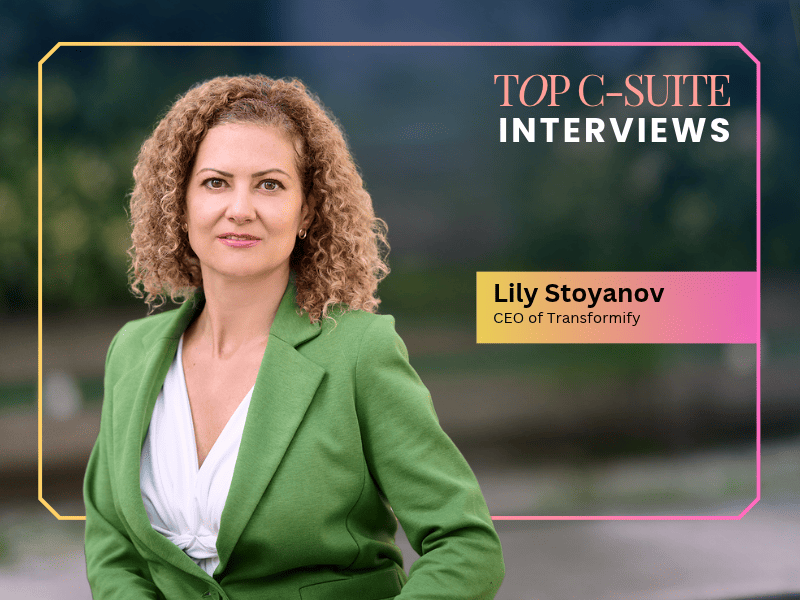
Building a profitable global workforce technology without external capital challenges conventional ideas about scaling, proving that sustainable growth doesn’t have to depend on venture capital.
Profitability in business is not dependent on venture-capital funding. In this interview with EBR, Lily Stoyanov, CEO of Transformify (TFY), a global hiring, onboarding, and payment platform, explains how she upended the belief that success in the tech industry depends on raising capital. She shares how financial discipline, scalable technology, a strong unique value proposition, and a focus on sustainable growth have shaped TFY’s success, enabling the company to achieve profitability.
It’s an honor to have you with us, Lily! To begin, you’ve built a global workforce technology company in a competitive industry without following the traditional venture-capital route. What first inspired you to launch Transformify?
The inspiration came from a simple observation: talent is everywhere, but opportunity is not.
For decades, access to employment has been shaped by geography, traditional recruitment practices and administrative barriers. I believed technology could change that.
My vision was to build a platform that would connect businesses with talent globally while making international hiring and workforce management more efficient and accessible.
As an angel investor, I understand the value of capital, but I also believe external investment should be a strategic choice rather than a prerequisite for growth.
Today, TFY operates across more than 180 countries. The scale has changed, but our original ambition remains the same: removing barriers between businesses and talent.
Looking back at the early days of TFY, what was the most difficult assumption you had to challenge? Did that experience shape your approach to entrepreneurship?
One of the biggest assumptions was that building a global technology company requires substantial venture capital.
There’s a deeply embedded belief in the technology industry that raising capital is synonymous with success. But funding is a resource, not a business model.
Being bootstrapped meant we had to be disciplined about where we invested, which opportunities we pursued and how quickly we expanded.
That experience shaped my approach to entrepreneurship. I learned to distinguish between growth that looks impressive and growth that creates lasting economic value.
As both a CEO and an angel investor, I continue to evaluate opportunities through that lens.
TFY became profitable within three years of its launch. What were the key decisions that helped you achieve profitability so early, and what sacrifices or trade-offs did that require?
Profitability within three years was not accidental. It reflected our decision to build a business around strong commercial fundamentals from the beginning.
We prioritised solutions addressing genuine customer needs, maintained financial discipline, and invested in technology that could scale efficiently.
I’ve always believed profitability gives a company something extremely valuable: independence.
Being bootstrapped meant every investment had to contribute to customer value, operational efficiency or sustainable growth.
There were trade-offs. We couldn’t pursue every opportunity, expand teams ahead of demand or spend aggressively simply to accelerate market recognition.
But those constraints helped us build a resilient business.
I’ve always believed profitability gives a company something extremely valuable: independence. It allows leadership to make long-term decisions without being driven by the expectations of the next funding round.
TFY’s revenue reportedly grew from €5.9 million to €25.9 million over three years, and the company was ranked No. 284 in the FT1000: Europe’s Fastest-Growing Companies 2026. In your opinion, which strategic decisions made the greatest difference?
Three decisions made the greatest difference.
First, we recognised that international hiring goes beyond recruitment. Businesses also need to manage onboarding, contractor relationships, compliance and payments. Building an integrated offering around these needs strengthened our value proposition.
Second, we invested in scalable technology that allowed us to serve more customers across multiple markets without unnecessary operational complexity.
Third, we maintained a long-term perspective on profitability and capital allocation. Growth was important, but not at any price.
Our No. 284 ranking in the FT1000: Europe’s Fastest-Growing Companies 2026 is an important recognition.
But the greater achievement is demonstrating that a bootstrapped technology company can achieve substantial international growth while maintaining financial independence.
Global expansion often forces companies to choose between moving quickly and managing risk. How does TFY help clients scale internationally without overlooking contractor classification, local employment requirements, data protection, or payment obligations?
International expansion creates enormous opportunities, but also complexities businesses often underestimate.
Hiring across borders involves more than signing contracts and arranging payments. Companies must navigate local employment regulations, contractor classification, tax obligations and data protection requirements.
At TFY, we bring these processes into a more structured, centralised workforce management environment.
Through our Contractor of Record and contractor management solutions, businesses can streamline onboarding, documentation, contract administration and international payments while improving workforce visibility.
Technology helps reduce manual errors and improve oversight, but it cannot guarantee compliance. Local legal and tax expertise remains essential.
Our goal is to help businesses scale confidently without overlooking the risks that come with international growth.
TFY reports that clients can achieve hiring cycles up to 60% faster after implementation. How do you measure the real business impact of workforce technology?
Workforce technology should be measured by business outcomes, not simply by the number of features it offers.
Reducing hiring cycles by up to 60% can create significant value, but speed alone isn’t enough. We also need to consider cost-per-hire, candidate quality, recruiter productivity and workforce retention.
There is also the opportunity cost of unfilled positions. Delayed hiring can affect projects, productivity and revenue.
From an investor’s perspective, the important question is whether technology improves the economics of the business.
Does it reduce costs? Improve productivity? Enable growth without proportionately increasing administrative overhead?
AI and automation are valuable when they deliver measurable improvements, making organisations not just faster, but more efficient and competitive.
TFY makes its core AI-powered applicant tracking capabilities available free to NGOs and charities. Why is this social-impact commitment important to your business? How can technology companies build sustainable commercial models while widening access to employment opportunities?
I believe access to effective recruitment technology shouldn’t depend solely on an organisation’s financial resources.
Charities, NGOs and nonprofits often face the same recruitment challenges as large corporations, but with significantly smaller budgets.
Technology can help them reach more candidates, reduce administrative work and direct more resources towards their missions.
That’s why we make the core functionality of TFY’s AI-powered applicant tracking system available free to these organisations.
For me, this isn’t separate from our commercial strategy. It reflects how sustainable businesses should operate.
A profitable technology company has greater flexibility to invest in initiatives that create long-term social value.
Commercial success and social impact shouldn’t be opposing objectives. When approached thoughtfully, they can reinforce one another.
Independent valuation assessments have reportedly placed TFY at a potential $1 billion-plus valuation. How do you evaluate the significance of such a milestone when the company’s growth has not followed the conventional venture-backed model?
A potential billion-dollar valuation is a significant milestone, particularly for a company that has grown without traditional venture-capital backing.
However, it’s important to distinguish independent valuation assessments from a valuation established through an actual investment or acquisition transaction.
As an angel investor, I know a headline valuation tells only part of the story.
What interests me more is the underlying economic value of a business: its revenue quality, profitability, scalability and ability to generate sustainable returns.
For a bootstrapped company, there’s another important dimension: ownership and strategic independence.
If independent assessments indicate TFY could exceed the billion-dollar threshold, I see that as recognition of the value we’ve built, rather than an endpoint.
A valuation measures expectations. The responsibility of leadership is to build a business capable of justifying them.
As a female founder and CEO in the technology sector, how have your experiences influenced the way you lead?
Building a technology company as a woman has reinforced my belief that leadership should be judged by competence, execution and results rather than assumptions about who is expected to succeed.
Technology and investment have historically had significant gender imbalances, particularly in senior leadership and access to capital.
Building a technology company as a woman has reinforced my belief that leadership should be judged by competence, execution and results rather than assumptions about who is expected to succeed.
I believe one of the most effective ways to challenge those expectations is through tangible business achievements.
Building a profitable, internationally operating technology company without venture capital demonstrates that there’s more than one path to success.
My leadership philosophy is grounded in accountability, independent thinking and long-term decision-making.
I also believe people should be evaluated on their abilities and potential rather than their background or conventional credentials.
Ultimately, I hope more women see entrepreneurship, technology leadership and investing as fields where they can succeed on their own terms.
Looking five to ten years ahead, what is your long-term vision for the company?
My vision is for TFY to become an essential technology infrastructure provider for businesses managing international and increasingly flexible workforces.
The way companies access talent is changing. AI is reshaping recruitment, geographic boundaries are becoming less relevant, and organisations are relying on more diverse workforce models.
At the same time, regulatory complexity and operational efficiency are becoming increasingly important.
We see an opportunity to bring these requirements together through intelligent, integrated technology.
Our focus will be on strengthening AI-powered recruitment, global contractor management and international payment capabilities while maintaining the financial discipline that has defined our growth.
Ultimately, success won’t be measured solely by revenue, valuation or geographic reach, but by the lasting value we create for customers and the opportunities we enable.
Lily Stoyanovis the CEO of Transformify (TFY) and an angel investor with a passion for technology, business growth, and the future of work. Under her leadership, TFY has become a profitable global workforce technology company, helping businesses hire talent worldwide, simplify contractor management, and navigate the challenges of international expansion.
The European Business Review uses cookies to improve site functionality, provide you with a better browsing experience, and to enable our partners to advertise to you. Detailed information on the use of cookies on this Site, and how you can decline them, is provided in our Privacy Policy and Terms and Conditions. By clicking on the accept button and using this Site, you consent to our Privacy Policy and Terms and Conditions. ACCEPT Reject
Privacy & Cookies Policy
Privacy Overview
This website uses cookies to improve your experience while you navigate through the website. Out of these cookies, the cookies that are categorized as necessary are stored on your browser as they are essential for the working of basic functionalities of the website. We also use third-party cookies that help us analyze and understand how you use this website. These cookies will be stored in your browser only with your consent. You also have the option to opt-out of these cookies. But opting out of some of these cookies may have an effect on your browsing experience.
Necessary cookies are absolutely essential for the website to function properly. This category only includes cookies that ensures basic functionalities and security features of the website. These cookies do not store any personal information.
Any cookies that may not be particularly necessary for the website to function and is used specifically to collect user personal data via analytics, ads, other embedded contents are termed as non-necessary cookies. It is mandatory to procure user consent prior to running these cookies on your website.