
By Katia Vlachos
Toxic colleagues don’t always shout or sabotage openly. Often, their behavior is subtle—undermining, exclusionary, and hard to pinpoint. But the impact is real. If you find yourself second-guessing, bracing before meetings, or emotionally drained, this guide offers clear, practical strategies to help you protect your well-being and reclaim your confidence.
You may believe you’d recognize workplace toxicity if you saw it. You’d expect raised voices, power plays, backstabbing, open conflict, or a combination of those. The reality is often far more subtle, especially when the dysfunctional behavior comes from a peer. Toxic colleagues are not always disruptive in obvious ways. Sometimes, they operate through small gestures and patterns. They may consistently dismiss your contributions, leave you out of key decisions, and their praise may sound more like criticism. Each incident, on its own, may seem minor. But when a colleague consistently undermines you, subtly or not, this may lead you to second-guess yourself, brace before meetings, or slowly withdraw from the work you used to enjoy.
In my coaching practice, I often encounter high-performing professionals who find themselves doubting their own judgment and abilities when confronted with the emotional friction of working with someone whose behavior chips away at their confidence.
If you’re in this situation, here’s how to recognize the impact of a toxic colleague and some practical ways to protect your well-being.
Look for the pattern behind the behavior
One of the most confusing characteristics of toxic behavior is unpredictability. Your colleague might be helpful and collaborative one day, and aloof or passive-aggressive the next. That inconsistency often keeps you on your toes. You spend more energy anticipating and managing their mood than focusing on your work.
You might notice:
- Feedback that’s vague or undermining (“I wouldn’t have done it that way, but okay.”)
- Exclusion from relevant meetings or email conversations, followed by casual deflection (“Oh, I must have forgotten to cc: you on this thread. So sorry.”)
- Over-familiarity in the form of inappropriate jokes, comments framed as “banter,” or unsolicited advice about your performance.
This is behavior that’s designed, consciously or not, to keep you off-balance. If any of this sounds familiar, you’re not imagining it.
Validate your experience
The first step is not to confront the toxic colleague, but to gain clarity. Many people stay in toxic dynamics because they assume it’s just them (the “Maybe I’m too sensitive” assumption). But noticing that something feels off is a signal worth trusting.
Try writing down the behaviors you’re seeing, without judgment or interpretation. What was said? What was the context? How did it land? Naming the specific actions helps separate facts from emotions so that you can identify the pattern and have a clearer picture of it over time.
Maintain your boundaries
Toxic colleagues will almost always test your boundaries, both in obvious and subtle ways: dropping last-minute tasks on your plate, speaking over you in meetings, or adding pressure on you in the context of “collaboration.” Once you recognise these are behaviors for what they are – designed to destabilise you – instead of getting defensive, try being assertive:
- “I’ll need that request by [x time] if it’s going to fit into my priorities.”
- “I’d like to finish my point before we move on.”
- “I’d prefer we keep this focused on the work rather than personal opinions.”
You don’t need to justify your limits, but you do need to communicate them clearly and consistently, with calm and composure.
Find your allies
Dealing with a toxic colleague can feel isolating. Especially if others don’t seem to notice or are hesitant to speak up – which happens often. Find one or two people in your organization who you trust to validate your concerns without amplifying the drama. That might be a peer who’s experienced something similar, a mentor, or a manager you trust. Frame the conversation emphasising the impact this disruptive behavior has on your contribution, not necessarily the personal impact: “Here’s what I’ve observed, and here’s how it’s affecting my ability to contribute effectively to the organisation.”
It’s important to keep track and document the patterns of behavior so that, if the situation escalates or doesn’t shift, it’s easier to involve HR and/or escalate through appropriate channels, should you choose to do so.
Protect your energy
Having to deal with a toxic colleague can take a toll on your mental and emotional bandwidth. You might find yourself spending more time anticipating problems than solving them. Reclaiming space for yourself and safeguarding your energy might look like:
- Taking a break after a tense meeting.
- Starting your day with one task you enjoy before dealing with your colleague’s demands.
- Finding moments in your day to connect with people whom you trust and who energize you.
The goal isn’t to avoid discomfort (you can’t do much about that), but to stop internalizing it.
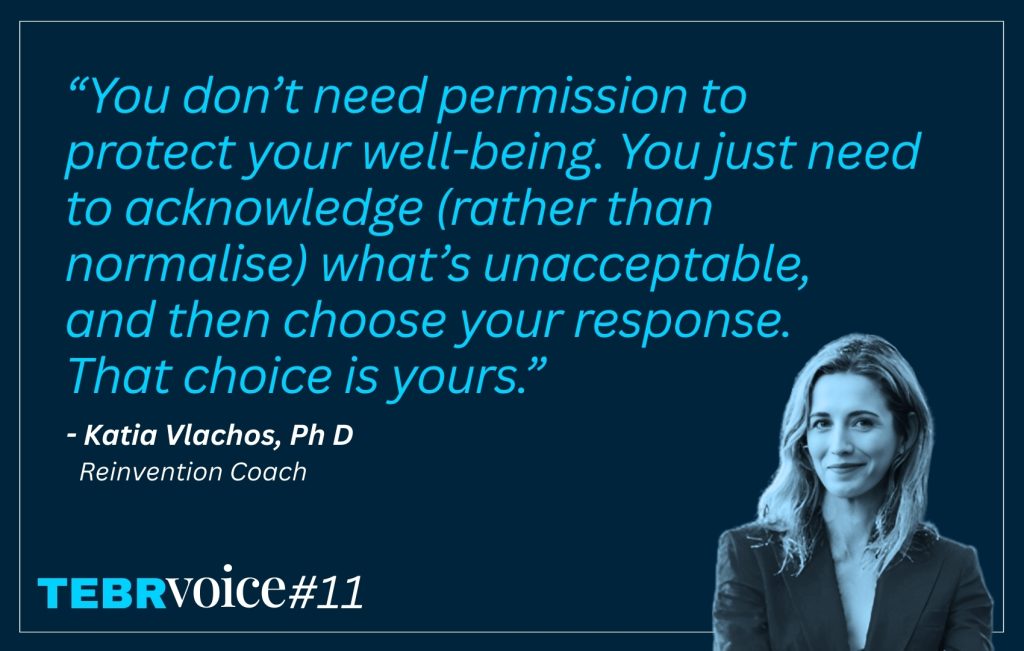
A toxic colleague might not have formal authority, but their behavior can still shape how you feel about your job, your team, and yourself. And while you may not be able to change how they operate, you can absolutely change how much power their actions hold over your day-to-day experience. The strategies above aren’t about fixing them, but about reclaiming your sense of safety, clarity, and control in an environment that might not always offer it freely. You don’t need permission to protect your well-being. You just need to acknowledge (rather than normalise) what’s unacceptable, and then choose your response. That choice is yours.
 Katia Vlachos