
By Massimiliano Ferraris
China’s advantage in embodied AI comes from turning factories into learning systems; Europe must capture the same feedback between deployment, data, and engineering.
China is becoming the most consequential real-world environment for understanding how embodied AI moves from research into production. Massimiliano Ferraris, an international executive working across strategy, finance, law and technology, argues that Europe should approach this transformation neither as a threat nor as a model to copy. The central lesson is that leadership in physical AI is built through deployment: machines improve because factories generate data, engineering feedback and new operating knowledge. Europe’s challenge is to enter that learning cycle without allowing the value of the learning to accumulate elsewhere.
China’s Factory as a Learning System
China’s scale in industrial robotics is exceptional. According to the International Federation of Robotics, China installed 295,000 industrial robots in 2024, representing 54 percent of global deployments. Its operational stock exceeded two million units, while Chinese manufacturers captured 57 percent of their domestic market. Yet, the strategic significance of those figures lies less in volume than in what that volume makes possible.
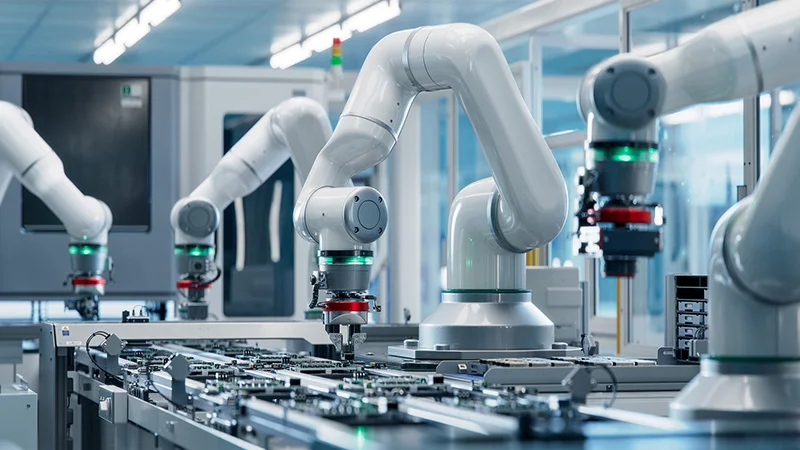
A large manufacturing base creates thousands of real operating environments in which machines can fail, adapt and improve. Suppliers encounter production variability, safety constraints, human workflows and sector-specific problems that no laboratory can reproduce at equivalent scale. The result is a dense learning loop: deployment generates data; data expose limitations; engineers modify hardware, models and control systems; and improved systems return rapidly to the factory floor.
Chinese policy increasingly formalises this relationship. In 2026, the Ministry of Industry and Information Technology (MIIT) described the ambition to create an integrated innovation environment spanning research and development, design, testing, manufacturing, and application. Partnering with the State-owned Assets Supervision and Administration Commission (SASAC) in a joint MIIT-SASAC programme, they subsequently called for humanoid robots and embodied-intelligence systems to be trained in real industrial, service and specialist environments, explicitly linking physical deployment to model improvement, high-quality machine data and component development. The programme also requires agreements on intellectual-property ownership and benefit allocation. The factory, in other words, is not merely where innovation is consumed. It is part of the research architecture.
Industrial Data and the Ownership of Learning
Embodied AI makes industrial data strategically different from conventional machine telemetry. A robot operating inside a plant generates motion trajectories, failure patterns, force curves, environmental observations and exception-handling data. Over time, these records become training material for better models and better machines. The critical asset is therefore not the dataset in isolation but the feedback loop that transforms operational experience into cumulative technological capability.
The EU Data Act is an important foundation because it gives business users rights to access product data and the metadata needed to interpret them. But access should not be confused with control over the learning produced from those data. The Regulation itself recognises that, where contractually agreed, a data holder may use non-personal product data to improve existing products, develop new products or create derived data. A European manufacturer may therefore retain access to its raw telemetry while the supplier alone converts the same operational experience into proprietary intelligence.
That asymmetry matters more in embodied AI than in conventional automation because every deployment can improve the vendor’s next generation of models. The contractual question is no longer simply whether the customer can retrieve its data. It is whether the supplier enjoys an exclusive learning advantage from the customer’s factory.
A robot operating inside a plant generates motion trajectories, failure patterns, force curves, environmental observations and exception-handling data. Over time, these records become training material for better models and better machines.
Strategically significant deployments should therefore distinguish between data access and learning rights. Contracts may limit secondary model training, confine it to defined purposes, grant the customer rights over improvements produced from customer-specific data, or establish reciprocal licensing arrangements where the production environment materially contributes to model development. The objective is not to stop the supplier from learning. It is to ensure that the factory generating the experience does not become merely a free training ground for intelligence owned entirely elsewhere.
Europe’s Missing Feedback Loop
Europe’s difficulty is not a shortage of research capability. Its deeper weakness is the distance that often separates scientific excellence from repeated industrial deployment. The European Commission’s Competitiveness Compass identifies closing the innovation gap as a central priority, while the EU start-up and scale-up strategy acknowledges that too many European companies struggle to move ideas from the laboratory to the market and then grow them at scale.
For embodied AI, that gap is structural. Physical intelligence cannot be perfected through simulation, academic benchmarks or demonstration prototypes alone. Manipulation, mobility and human-machine interaction improve when systems encounter the irregularities of actual production: worn components, changing lighting, unstructured objects, cycle-time pressure and unexpected human behaviour. Deployment is therefore not downstream from research. It is one of the places where research happens.
The Chinese approach is instructive precisely because it compresses that distance. Its 2026 real-world training programme links user companies, robot manufacturers, model developers, component suppliers and research institutes around defined operating scenarios. Europe does not need to reproduce Chinese institutions, but it does need a comparable intensity of interaction. Regulatory and operational sandboxes should move closer to factories, using real production sites as controlled environments in which companies, universities and regulators can test systems under genuine operating conditions.
The strategic mistake would be to treat manufacturing as the final recipient of innovation rather than one of its principal sources. The factory is where embodied AI encounters reality, and reality is what produces the data that make physical intelligence better.
Industrial Cognitive Sovereignty as an Operating Standard
Industrial Cognitive Sovereignty should therefore be understood less as technological independence than as the capacity to remain an active participant in the learning architecture. A company does not need to own every model, component or software layer. It does need sufficient internal engineering depth to understand how its automation stack works, how data move through it and how critical behaviour can be validated or reconfigured.
This turns sovereignty into something measurable. It is visible in whether the organisation can access raw operational data and interpretive metadata; whether its engineers retain competence over the orchestration and integration layer; whether system behaviour can be audited and operating parameters adjusted internally; and whether the company can integrate alternative technologies without rebuilding its productive architecture from zero.
Co-development becomes important for the same reason. A turnkey system may deliver excellent throughput while leaving almost no capability behind. A partnership that exposes European engineers to interfaces, integration logic, testing and adaptation can produce a different asset: absorptive capacity. The distinction is not between Chinese and European technology, or between foreign and domestic suppliers. It is between technology acquisition that leaves the organisation dependent on a black box and technology engagement that expands what the organisation itself is capable of understanding and doing.
Governance for Capability Accumulation
This is where the argument reaches the boardroom. Embodied-AI investments are normally presented through familiar metrics: capital expenditure, labour substitution, throughput, reliability and payback. Those measures remain necessary, but they do not reveal where the technological learning generated by the investment will accumulate.
For strategically material deployments, boards should require management to preserve an internal integration capability rather than outsource the entire intelligence layer. Investment cases should include the engineering resources needed to absorb operating knowledge, not merely the cost of installing the machine. Supplier evaluation should take account of API openness, access to raw telemetry, documentation, integration training, and the contractual treatment of improvements generated from customer data.
The same logic applies to data rights. If a supplier is permitted to use operational data for model refinement, the board should understand what the company receives in return: improved performance, access to customer-specific adaptations, licensing rights, preferential deployment or another identifiable form of reciprocal value. The governance issue is not protection from learning by others. It is avoidance of a structurally one-sided learning relationship.
Seen this way, engagement with China is not a defensive problem. China is a laboratory from which European industry can learn because it is exposing embodied AI to real production at a pace and scale that generate knowledge quickly. The relevant European response is not distance but disciplined proximity: observing, partnering and experimenting while ensuring that every major deployment also expands internal engineering and organisational capability.
Conclusion: The Factory Is the Laboratory
China should be studied neither with fear nor with imitation. Its embodied-AI ecosystem has demonstrated something more fundamental: leadership in physical intelligence is won on the factory floor, through dense cycles of deployment, data and engineering feedback. Europe must rediscover manufacturing as research infrastructure, not merely as a cost base to optimise. Industrial Cognitive Sovereignty is the capacity to participate in global technology ecosystems while retaining a meaningful share of the knowledge they generate. The decisive question is not who supplied the machine, but where the learning ultimately remains.