By Dr. Simon L. Dolan
Infinite scrolling may seem harmless, but repeated digital stimulation can erode attention, recovery, and self-control, making digital resilience increasingly important.
Infinite scrolling has changed the way people use small moments of downtime, turning boredom, waiting, and even bedtime into opportunities for constant digital stimulation. But the concern is not simply how much time people spend online. Professor Simon L. Dolan argues that repeated, automatic scrolling can erode attention, recovery, and our sense of control, particularly when it becomes a way of regulating stress or discomfort. His proposed Digital Scrolling Dependency Scale offers a starting point for understanding this emerging behavioural pattern while highlighting the need for further research.
Opening: the new digital habit
When was the last time you picked up your phone without actually knowing why? Perhaps you were waiting for the dentist, standing in a queue, sitting in a taxi, eating alone, sitting on the toilet, or lying in bed supposedly ready to sleep.
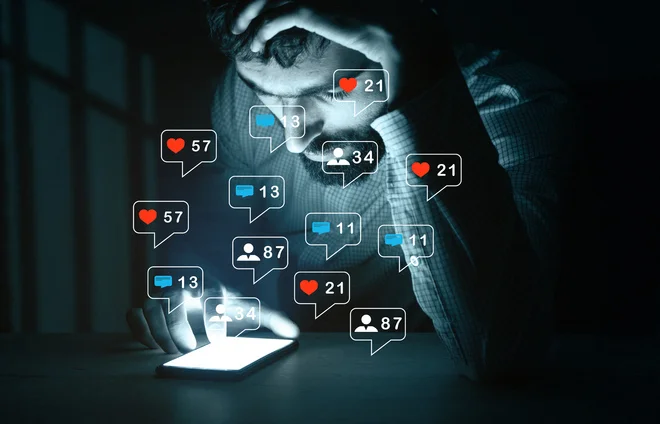
You opened TikTok, Instagram Reels, YouTube Shorts or another endless feed. One swipe. Another. Another. And suddenly twenty minutes have disappeared.
Repeated exposure to demands, insufficient recovery and inadequate coping resources can gradually undermine wellbeing.
This is the paradox of infinite scrolling: the behavior can be almost invisible because it is made up of tiny episodes. The new digital risk is not simply long periods of screen use. It is the repeated, automatic return to a stream of novel stimuli, often without a conscious decision to do so.
The question is therefore no longer simply, “How much time do you spend on your phone?” A more revealing question is: “How often does your hand reach for your phone before your mind has decided to?”
From screen time to behavioral dependence
Screen time is an imperfect measure of digital risk. A person can spend two hours online learning, creating or communicating without losing control. Another person may spend much less time online but repeatedly check a feed whenever there is a moment of boredom, discomfort or uncertainty.
The critical variables are increasingly behavioral: automaticity, loss of control, emotional regulation and interference with activities that matter.
Infinite scrolling is particularly interesting because it removes the natural stopping cues found in older media. A newspaper has a last page. A book has a final chapter. A television program ends. The infinite feed does not.
It quietly communicates—————- there is always something else.
The chronic-stress connection
My work on chronic stress has emphasized that stress is not only about dramatic events. Repeated exposure to demands, insufficient recovery and inadequate coping resources can gradually undermine wellbeing.
Digital micro-scrolling may become part of a similar cycle: Stress or boredom → reach for the phone → immediate stimulation or temporary relief → reduced opportunity for recovery → return to the phone.
The behavior can therefore function as a short-term regulation strategy while potentially undermining longer-term self-regulation. This does not mean that scrolling causes chronic stress in every person. The proposition is more specific: when scrolling becomes automatic and difficult to control, it may become one of the small repetitive behaviors through which recovery time, attention and psychological autonomy are eroded.
The dopamine story—without the myth
Dopamine is often described as the brain’s “pleasure chemical.” That is an oversimplification. Dopamine is involved in motivation, reward learning, attention and the anticipation of potentially rewarding experiences.
Infinite scrolling creates a psychologically powerful environment because the next item is uncertain. It might be boring, or funny, shocking, socially rewarding or personally relevant. The possibility of a rewarding next item can help maintain checking and scrolling even when the current content is not especially interesting.
The important point is not that every swipe produces a dopamine “hit.” The more defensible argument is that repeated exposure to novelty, unpredictable rewards and social feedback can reinforce a habit of checking.
When not scrolling feels strange
A behavior becomes more concerning when it stops being a choice. Checking the phone in the morning becomes normal. Scrolling while eating becomes normal. Scrolling in the bathroom becomes normal. Scrolling while waiting becomes normal. Scrolling in bed becomes normal.
Eventually, not scrolling can feel unusual.
This is where the concept of digital resilience becomes useful. Resilience is not the absence of stress. It is the capacity to adapt, recover and maintain agency when demands are present.
The same principle should apply to digital life. A resilient digital user should be able to say: “I choose to scroll.” And, equally importantly: “I choose to stop.”
The hidden cost: recovery
Recovery requires more than sleep. It also requires periods of low stimulation, reflection, face-to-face interaction, walking, daydreaming, boredom and uninterrupted attention.
Infinite scrolling can colonize these micro-moments. The queue becomes scrolling time. The elevator becomes scrolling time. The bathroom becomes scrolling time. The bedroom becomes scrolling time. The moment of silence becomes scrolling time.
Technology was supposed to save us time. Yet we increasingly use the time it saves to consume more technology.
For adolescents, this deserves particular attention. Young people are developing habits of self-regulation, identity and attention while simultaneously living inside highly personalized digital environments. The appropriate response is not to demonize social media, but to help young people distinguish use from loss of control.
Are you digitally scrolling-dependent?
This question led me to propose a preliminary Dolan Digital Scrolling Dependency Scale (DDSDS). It is intended as a self-awareness and research instrument, not as a clinical diagnostic test.
The scale focuses on four dimensions: Automaticity, Loss of Control, Emotional Escape/Regulation, and Life Interference.
Dolan Digital Scrolling Dependency Scale (DDSDS)
Response options: 0 = Never; 1 = Rarely; 2 = Sometimes; 3 = Often; 4 = Almost always.
Automaticity
- I open a scrolling feed almost automatically, without having a specific reason.
- I reach for my phone before I consciously decide that I want to use it.
- I find myself scrolling even when I had not planned to do so.
Loss of Control
- I intend to stop scrolling but continue anyway.
- I tell myself “just one more” video or post and then continue.
- I lose track of time while scrolling.
Emotional Escape / Regulation
- I scroll when I am bored, stressed, anxious, lonely or uncomfortable.
- I use scrolling to avoid thinking about something unpleasant.
- When I cannot scroll, I feel restless or uncomfortable.
Life Interference
- I scroll in bed after I have decided it is time to sleep.
- I scroll while waiting—for example, at a doctor’s or dentist’s office, in a queue, or for someone to arrive.
- Scrolling interferes with sleep, work, study, relationships or other activities that matter to me.
How should the scale be used?
The initial 12-item score ranges from 0 to 48. At this stage, it should be treated as a continuous indicator of scrolling vulnerability rather than divided into clinical “addicted/not addicted” categories.
Technology was supposed to save us time. Yet we increasingly use the time it saves to consume more technology.
Before the instrument is used for scientific or clinical decision-making, it requires psychometric validation: internal consistency, test–retest reliability, exploratory and confirmatory factor analysis, convergent validity, relationships with sleep, stress, wellbeing and resilience, and measurement invariance across adolescents and adults.
The four-dimension structure is a hypothesis to be tested, not an established finding.
A new form of digital resilience
Perhaps the most important question is not whether we can stop technology. We cannot and should not. The question is whether we can remain in control while using it.
Digital resilience may ultimately mean the capacity to use technology intentionally while preserving the ability to disengage, recover, tolerate boredom and protect attention.
The next digital addiction may not arrive dramatically. There may be no bottle, cigarette packet or gambling hall. Just a small rectangle in your hand.
One swipe. Another. Another.
And an endless supply of “something else.”
Perhaps the real digital revolution is not that our phones have become smarter. It is that they have become very good at keeping us from putting them down.
 Dr. Simon L. Dolan