By EU Business Hub – Japan and the Republic of Korea programme
Japan is poised to undertake a radical transformation of its energy system, and here’s how European SMEs can participate.
Japan’s ambitious energy transition is creating opportunities for European businesses in renewable energy, smart grids, hydrogen and industrial decarbonisation. There is no doubting that the country already has significant capability in these key areas of endeavour, so where can European SMEs and smaller technology providers find their place in this rapidly evolving market?
Japan is preparing for one of the most significant transformations of its energy system in decades. Under its Green Transformation (GX) strategy, the country aims to mobilise more than JPY 150 trillion (approximately €850 billion) in public and private investment over the 10-year period beginning in fiscal year 2023, supported by approximately JPY 20 trillion (€113 billion) in government-backed transition financing.
For European clean-energy companies, the scale of this investment is compelling. Yet the more important question is not simply how much Japan intends to spend, but where that investment will translate into opportunities for international technology providers.
Japan’s energy transition is shaped by a combination of pressures: limited domestic energy resources, dependence on imported fuels, the need to maintain industrial competitiveness, and ambitious decarbonisation objectives. These priorities are driving investment across renewable energy, electricity infrastructure, hydrogen, energy storage, and industrial efficiency.
For European SMEs with specialised technologies, the opportunity may lie less in competing for entire projects and more in providing the components, systems, and expertise needed to make them commercially viable.
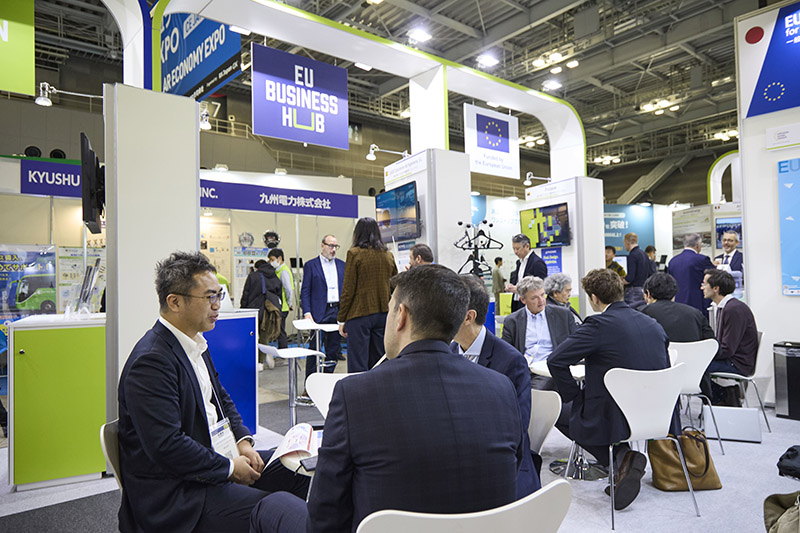
European companies interested in exploring these opportunities can apply for the EU Business Hub @ Smart Energy Week Spring 2027 business mission to Japan, taking place from 22 to 26 March 2027. The mission will bring up to 50 European SMEs and startups to Japan to showcase their solutions and connect with potential Japanese partners and customers.

Renewable Energy
Renewable energy is an essential part of Japan’s decarbonisation plans, but expanding capacity involves challenges that differ from those in many European markets.
Japan’s mountainous terrain, limited available land, and densely populated urban areas constrain the development of large renewable-energy installations. As a result, the country is pursuing technologies that can generate more energy from limited space or operate in demanding geographical conditions.
Solar energy remains a major priority, including the development of next-generation perovskite solar cells. These lightweight, flexible technologies could expand solar deployment beyond conventional installations to building surfaces and locations where traditional panels are difficult to use. Japan has set a target of approximately 20 GW of perovskite solar capacity by 2040.
Offshore wind represents another area of interest. Japan aims to develop offshore wind projects totalling 10 GW by 2030 and 30-45 GW by 2040. Its deep coastal waters make floating wind technologies particularly relevant.
For European companies, these developments create opportunities beyond supplying complete solar or wind installations. Specialised materials, power electronics, monitoring systems, offshore engineering, installation technologies, and maintenance solutions may all contribute to making projects more efficient and economically sustainable.
Smarter Energy Systems
Building renewable-energy capacity is only part of the transition. Japan must also ensure that electricity can be stored, managed, and delivered reliably.
The growing share of variable renewable generation increases the importance of battery storage, smart grids, demand-response technologies, and advanced energy management.
For European SMEs, potential entry points include battery management systems, grid-monitoring technologies, power conversion equipment, forecasting software, and virtual power plant platforms.
Japan’s electricity system faces additional complexity because its eastern and western regions operate at different grid frequencies, while interconnection capacity between regions remains limited.
These characteristics create opportunities for technologies that improve grid flexibility, support distributed energy resources, and help electricity networks respond to fluctuations in supply and demand.
For European SMEs, potential entry points include battery management systems, grid-monitoring technologies, power conversion equipment, forecasting software, and virtual power plant platforms.
Japan also offers an example of how distributed energy technologies can develop into established commercial markets. Its Ene-Farm residential fuel-cell programme, launched in 2009, had reached more than 490,000 installations by September 2023 and subsequently surpassed 500,000 cumulative installations.
Originally developed to provide household electricity and heat, these systems are increasingly being explored for integration with virtual power plants, renewable energy, and smarter energy management. Their potential contribution to electricity supply during outages also reflects Japan’s emphasis on disaster resilience.
For European technology providers, such developments point towards opportunities in advanced components, digital controls, system integration, and technologies that improve efficiency and operational performance.
Hydrogen
Hydrogen occupies a distinctive position in Japan’s energy strategy.
Japan was the first country to adopt a national hydrogen strategy in 2017, subsequently revised in 2023. Its approach has evolved from early demonstrations towards the development of industrial supply chains, infrastructure, and commercial applications.
The country has outlined plans to mobilise approximately JPY 15 trillion (around €85 billion) in public and private investment over 15 years to support its hydrogen ambitions.
The Hydrogen Society Promotion Act, enacted in 2024, establishes a framework for supporting low-carbon hydrogen supply and utilisation, including measures intended to address costs and accelerate infrastructure development.
Cost remains one of the central challenges. Japan’s hydrogen strategy includes a target of reducing hydrogen supply costs to JPY 30 (approximately €0.17) per normal cubic metre by 2030, creating an incentive for technologies that improve production efficiency and reduce the cost of transport, storage, and utilisation.
This is where specialised European suppliers may find opportunities.
Japan’s hydrogen industry requires more than large-scale production facilities. It also needs advanced electrolysis technologies, catalysts, membranes, heat exchangers, control systems, safety equipment, and components capable of improving durability and efficiency.
For European SMEs, the opportunity may lie less in competing for entire projects and more in providing components, systems, and expertise.
Commercial and industrial fuel cells represent another developing market, with applications ranging from factories and commercial buildings to data centres and decentralised power generation. Japanese manufacturers are technologically advanced, but specialised European components and enabling technologies may complement their systems.
Industrial applications are particularly relevant. Hydrogen and related technologies are being explored for sectors where direct electrification is difficult, including steelmaking, chemical production, and high-temperature industrial processes.
For European SMEs, the opportunity may be to become a technology partner or specialised supplier within Japan’s expanding hydrogen value chains.
Industrial Decarbonisation
Japan’s clean-energy investment is also closely connected to the future competitiveness of its manufacturing sector.
The country is home to major automotive, electronics, chemicals, steel, and advanced manufacturing industries. Reducing their emissions while maintaining productivity and controlling energy costs is an important industrial challenge.
Japan’s GX investment framework includes support for industrial transformation, energy conservation, and the transition towards lower-carbon production.
This creates potential demand for technologies such as industrial heat recovery, advanced process controls, energy monitoring, efficient motors and drives, electrification solutions, and systems that optimise energy consumption across production facilities.
For many manufacturers, the business case for decarbonisation depends on measurable operational improvements.
A technology that reduces energy consumption, improves process reliability, or lowers lifecycle costs may be more commercially attractive than one promoted primarily through its environmental benefits.
European SMEs should therefore be prepared to demonstrate not only the technical capabilities of their solutions but also their contribution to cost-efficiency, reliability, and industrial performance.

Where European SMEs Fit In
Japan has world-leading industrial companies, sophisticated engineering capabilities, and established domestic suppliers. European businesses entering the market should not assume that technological innovation alone will secure customers.
A more promising approach is to identify specific needs within existing systems and supply chains.
A Japanese manufacturer may not need a complete new energy system, but it may need a more efficient component. An energy utility may already have infrastructure in place but require better monitoring or control technologies. An industrial company may be pursuing decarbonisation but lack a specialised solution for a particular production process.
These are areas where smaller European technology companies can offer value.
In many cases, the most effective route to market will involve collaboration with Japanese manufacturers, engineering contractors, utilities, trading companies, or system integrators.
Such partnerships can provide access to established customers, distribution and service networks, local technical expertise, and a better understanding of regulatory requirements.
But building these relationships takes preparation.
Japanese partners typically place considerable importance on reliability, product quality, documented performance, and long-term commitment. Companies should be ready to explain how their technology integrates with existing systems, demonstrate successful applications, and address local technical and safety requirements.
The question for a European SME is therefore not simply whether Japan needs its technology. It is which Japanese company needs it, what commercial problem it solves, and how a partnership could deliver value to both sides.
Exploring the Market
Japan’s clean-energy transition presents significant opportunities, but investment announcements alone do not guarantee commercial demand for individual technologies.
For European SMEs considering Japan, the EU Business Hub @ Smart Energy Week Spring 2027 mission offers an opportunity to move beyond market research and engage directly with potential customers and partners. Through targeted business meetings and first-hand market insights, participants can assess demand for their technologies, identify potential routes to market, and take the first steps towards building business relationships in Japan.
Applications are open until 27 November 2026.
Explore the EU Business Hub business missions
EU Business Hub – Japan and the Republic of Korea is an EU-funded programme launched in 2024 to support EU SMEs and start-ups in the Green and Low-Carbon, Digital, Healthcare, and Medical Equipment sectors in expanding into the Japanese and Korean markets. Between 2024 and 2027, the programme is organising 20 sector-focused business missions – 10 in each market – with services including strategic coaching, matchmaking, local interpretation, and full logistical support. The EU Business Hub is the successor programme to the EU Business Avenues/EU Gateway to Japan.