By Fernanda Arreola and Pierre Daems
AI can keep us company, but at what cost? As technology replaces everyday interactions, organizations must rethink how to protect meaningful human connection.
AI was not the first, but it is rejoining the number of available technologies that are good for filling the silence and the void that we may feel in our fast-moving society. However, as we become more accustomed to using technology to replace human contact, especially at work, we may take the risk of further isolating ourselves: even if we have the impression of not being alone. But there is hope and many ideas that can be put into practice for businesses of all sizes.
Being Alone Is Different from Feeling Lonely
An important distinction in the debate about AI companionship is the difference between being alone, feeling lonely and being socially isolated. These experiences are related, but they are not the same.
The problem arises when being alone becomes persistent and meaningful social connections become insufficient.
When we are with people with whom we have meaningful relationships, our family, our partner, or colleagues, we meet physically and face to face, we are not necessarily protected from loneliness simply because people surround us. You can feel lonely in the middle of a crowd. What matters is the quality of the connection. Meaningful human relationships create opportunities for reciprocity, emotional exchange, shared experiences, and mutual recognition.
Conversely, being physically alone does not necessarily mean feeling lonely. Someone working remotely, living alone or spending time without other people may feel perfectly comfortable in their own company. Personality, preferences, and the quality of existing relationships all influence how people experience solitude. As Gilbert Bécaud famously sang, « La solitude, ça n’existe pas («Solitude does not exist”), a provocative reminder of how deeply human relationships can shape our experience of being alone : “Y a toujours quelqu’un pour quelqu’un” (“There’s always somebody for somebody”)
Social isolation is a global public health concern
The problem arises when being alone becomes persistent and meaningful social connections become insufficient. The World Health Organization (WHO) makes an important distinction here: social isolation is an objective state involving too few relationships, roles or interactions, whereas loneliness is a subjective and distressing feeling arising from a gap between the social connections a person has and those they want or need.
This is why loneliness and social isolation have become a global public health concern. The WHO Commission on Social Connection reports that approximately one in six people worldwide experience loneliness and identifies social connection as a global public health priority.
Technology as a solution to everything
Technology can make us “feel connected” instead of making us “be connected.” But AI is not the first technology to reduce the opportunity to meet other humans :. Shopping moved online. Entertainment became on demand, Dating became algorithmic. Food arrived at the door. We have progressively built systems that remove waiting, awkwardness, rejection, and the need to depend on other people.
Each technological development can be useful. The issue emerges when convenience becomes substitution. Technology can remove a small burden from everyday life while also removing one of the small encounters through which relationships are formed.
So, what if the greatest danger of AI is not that machines replace human labor, but human relationships as a whole? What if AI was so good at giving us the impression of having real-life interactions that we make it the privilege source for our daily attention, conversation, socialization, and reassurance needs? Yet feeling less lonely is not necessarily the same as being less lonely. Human connection also depends on reciprocity, vulnerability, shared experience, and social capital.
AI can reduce the feeling of loneliness, but not the social isolation.
The distinction is particularly relevant to the rise of AI companionship. AI can reduce the discomfort of being alone without necessarily changing the social conditions that produce loneliness. A conversation with your AI companion can offer attention, conversation, and reassurance on demand. It may genuinely make someone feel accompanied. But it cannot, by itself, create reciprocal relationships, shared experiences, and social networks that constitute meaningful human connection.
This is where the paradox emerges. AI may be highly effective at reducing the feeling of loneliness while doing little to reduce social isolation. In some circumstances, it may even remove the small opportunities of human contacts when asking a colleague for help, waiting for someone to respond, repairing a disagreement, or simply spending unstructured time together.
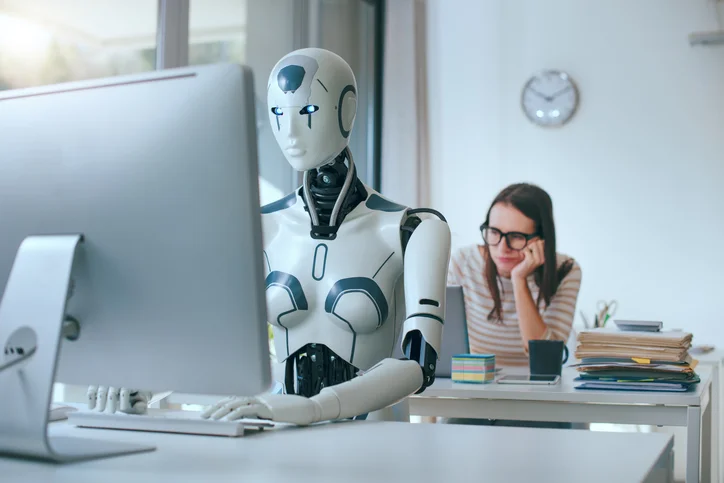
The risk of social isolation is exponential for remote workers assisted by AI agents.
AI should reduce low-value interaction while preserving human encounters through which relationships are built.
The same issue applies to organizations. Remote work assisted by AI agents can have greater autonomy and efficiency, but they can lead to less spontaneous encounters through which professional relationships are built. If an employee asks an AI agent rather than a colleague for help, the problem may be solved more efficiently, but the incidental relationship may never happen.
The managerial challenge, therefore, is not to eliminate AI or to force employees to socialize. It is to design AI-enabled work so that efficiency does not unintentionally remove opportunities for human connection.
Three recommendations for organizations
- Measure the Human Dividend, not only the productivity gain. When AI saves employees time, organizations should ask what happens to that time. Productivity metrics should be complemented by indicators of mentoring, peer learning, collaboration, customer interaction, and knowledge sharing. The objective is not to turn every minute saved into additional output, but to understand whether some of the efficiency created by AI is being converted into higher-value human activity.
- Protect spaces for spontaneous human interaction. Not every interaction needs to be optimized. Organizations can deliberately preserve opportunities for informal conversations, peer support, face-to-face collaboration, mentoring, and shared experiences. This is particularly important in hybrid and remote organizations, where encounters that once happened naturally may need to be designed into the way work is organized.
- Design AI as a bridge to people, not a substitute for people. The most human-centered approach is to ask what an AI interaction should enable next. If AI answers a question, could the employee then discuss it with a colleague? If AI saves preparation time, could that time be used for customer contact or coaching? If AI provides conversational support, could it encourage rather than replace human interaction? The principle is simple: AI should reduce low-value interaction while preserving human encounters through which relationships are built.
The question, then, is not simply whether AI can make us feel less lonely. It can, at least for some people and in some circumstances. The more important question for organizations is whether the way they deploy AI helps people become more connected to one another.

 Pierre Daems