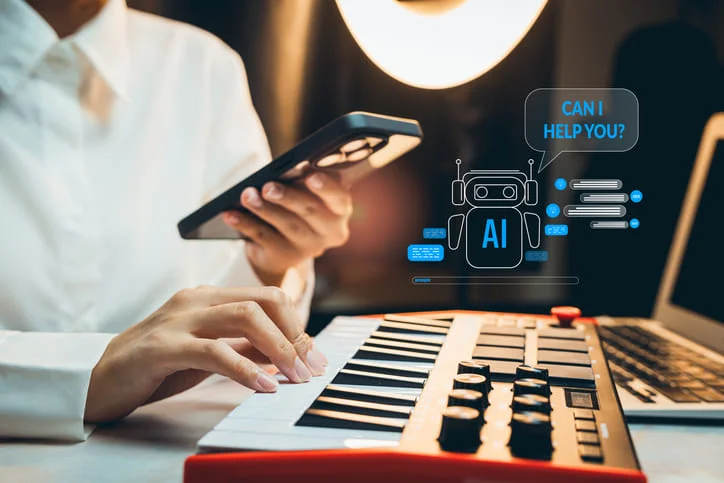
The creative industry has always been expensive. Producing original audio content — whether for advertising campaigns, branded video, corporate communications, or social media — has traditionally required significant investment in studios, composers, session musicians, and post-production teams. For large enterprises with substantial marketing budgets, that cost was manageable. For small and medium-sized businesses, it was often prohibitive.
Artificial intelligence is fundamentally changing that dynamic, and the implications for how businesses approach creative content are significant enough to warrant serious attention from leaders across every sector.
A Market in Rapid Transformation
The global AI music market was valued at approximately $2.6 billion in 2023 and is projected to grow at a compound annual rate of over 28 percent through the end of the decade. That growth is being driven not by consumer hobbyists alone but by businesses recognising that audio content is increasingly central to how brands communicate and compete.
Research consistently shows that video content with well-matched audio generates significantly higher engagement than content without it. On platforms like Instagram, TikTok, and LinkedIn, the algorithm actively favours content that uses original audio. For marketing teams already stretched thin, the challenge of sourcing that audio quickly and affordably has become a genuine operational problem — one that AI is now positioned to solve.
From Production Bottleneck to Creative Asset
The traditional music production pipeline was never designed with business content workflows in mind. A brand needing a thirty-second audio track for a product launch video would typically wait days for a composer to deliver options, spend additional time in revision cycles, and then navigate licensing agreements before anything could be published. The process was slow, expensive, and often produced results that felt generic despite the effort involved.
AI music generation tools have compressed that entire pipeline into minutes. Platforms like InsMelo, which operates as a free AI music generator accessible without any technical expertise, allow marketing teams and content creators to generate fully produced, original audio tracks by inputting genre preferences, mood descriptors, and tempo parameters. The output is original — eliminating licensing complications — and is tailored to the specific emotional tone a piece of content requires.
This is not a marginal efficiency gain. For businesses producing content at scale, the ability to generate matched audio on demand represents a fundamental shift in how creative workflows operate.
The Lyrics-to-Music Capability
Perhaps the most consequential development within AI music generation is the emergence of lyrics-to-music functionality. This capability allows users to input written text — a brand message, a campaign concept, a product narrative — and receive a fully produced musical track built around that content.
The business applications are broader than they might initially appear. Corporate training videos, explainer content, podcast intros, event productions, and internal communications all benefit from original audio that reflects the specific message being delivered. The ability to turn my words into a song online free means that even businesses without dedicated creative departments can produce audio content that feels intentional and professionally executed rather than sourced from an overused royalty-free library.
For brand consistency — one of the most important and most difficult things for growing businesses to maintain across channels — this kind of on-demand, customisable audio generation has practical value that goes well beyond novelty.
Workforce and Economic Implications
No honest assessment of AI’s impact on the creative industry can avoid the workforce question. Professional composers, session musicians, and audio producers are already navigating a landscape in which AI tools are capable of performing work that previously required human expertise. The economic implications of that shift are real and ongoing.
What the evidence suggests, however, is that the relationship between AI tools and human creative professionals is more nuanced than simple displacement. AI handles volume, speed, and accessibility — the production of competent, functional audio at scale. Human musicians and composers retain a clear advantage in originality, emotional depth, and the kind of cultural resonance that defines genuinely memorable creative work. The most effective businesses are likely to use both, deploying AI for content that requires speed and scale while investing in human creativity for work where distinctiveness matters most.
Strategic Considerations for Business Leaders
For executives and marketing leaders evaluating where AI music generation fits into their operations, a few considerations are worth prioritising. First, originality and licensing clarity matter — AI-generated audio that is produced fresh for each use case carries none of the copyright risk associated with licensed music or even some royalty-free libraries. Second, speed to market is a genuine competitive advantage in content-driven industries, and any tool that compresses the audio production timeline meaningfully is worth evaluating on that basis alone. Third, accessibility matters for team capability — tools that require no technical expertise to operate can be used by anyone on a marketing or communications team, removing the dependency on specialist skills for routine content needs.
The creative industry is in the middle of a significant structural shift. Businesses that understand what AI can realistically deliver — and where human creativity remains irreplaceable — will be better positioned to use both effectively.