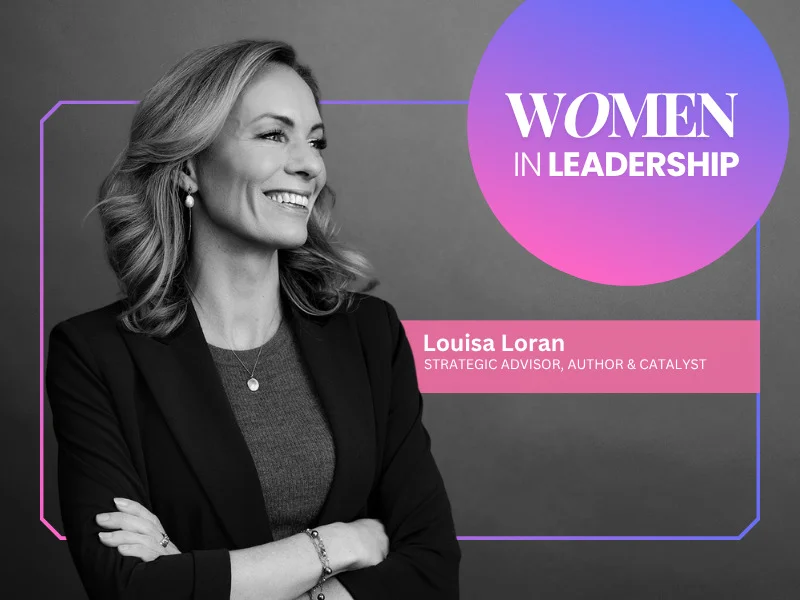
Interview with Louisa Loran
Across industries, strong leadership increasingly depends on seeing hidden patterns early and acting before change becomes obvious to everyone else.
Some advisors know an industry. Louisa Loran reads across them. Having worked at the heart of Google, Maersk, and Diageo/Moët Hennessy, and with customers across many more, she has developed a distinct ability to see structural patterns that most leaders, immersed in their world, cannot. Today she advises executives with an independent voice, helping turn inflection points into moments of clarity and growth.
Moving between industries as different as luxury, logistics, and technology often means entering entirely new ways of thinking. What helped you learn how to find your footing each time without losing confidence in your own judgment?
Curiosity, applied with intent. Not just learning how things are done, but questioning why they are done that way. Every industry carries a mix of legacy assumptions, habits, and a smaller set of practices that have been continuously tested and proven to lead, often what is the real yet uncaptured company IP. The key is to distinguish between them. And a long time on the inside, for many, starts to blur that distinction. Familiarity builds conviction, but it also narrows perception. Neuroscience shows how repeated exposure reinforces existing mental models, making it harder to question what once worked.
Every industry carries a mix of legacy assumptions, habits, and a smaller set of practices that have been continuously tested and proven to lead, often what is the real yet uncaptured company IP.
Rather than trying to adapt fully or impose an external view, my approach has been to bring complementary perspectives into the room. That shifts the dynamic from either learning or convincing into something more valuable, collective expansion. It allows different logics to meet, be tested, and, where relevant, evolve.
Confidence, in that context, does not come from knowing the answer upfront. It comes from trusting your ability to see patterns, ask better questions, validate or pivot, and stay grounded while navigating unfamiliar territory.
Some leadership lessons stay with you because they arrive at exactly the right moment. Was there an experience early on that still shapes how you work with people and make decisions today?
Yes. In 2009, I was on the global team for Johnnie Walker, representing roughly a quarter of Diageo’s profit. We were approaching a major commercial milestone without the uniting assets the business needed. In a quarterly performance meeting, sitting at the periphery of the room, the senior leadership debated how to respond. When the business leader was asked what he would do, he turned around and, to everyone’s surprise, said: “We will give it to Louisa.”
My authority had not been formalised, and resistance was significant. I earned followership through rigorous preparation, adequate respect for legacy, a willingness to redesign what was needed and an ambition to exceed expectations. We engaged a record number of markets behind a unified strategy, playing a central role in doubling the brand’s value over subsequent years.
That moment taught me that performance is unlocked beyond what any process can produce. Provide high-potential talent with clear direction, space, and an open line of communication, and they will surprise everyone. This is how I lead today: looking for what things can become rather than managing what they currently are.
You have been close to businesses during periods when they had to rethink what they stood for. In your experience, what tends to tell you that change is becoming unavoidable?
The leaders I have seen succeed, across sectors and cycles, do not differentiate between required change and desired change. They develop behaviours that allow them to define their own path. Across contexts I have experienced that this starts with envisioning ambitiously -thinking ahead of the current context. Beyond that, it is about staying genuinely curious, being ready to invest, staff and signal to results you expect and being willing to embody the change yourself: knowing which parts of you are right for the future and which need to be replaced, and doing so visibly. Helping leaders and organisations identify, strengthen and create the conditions for these leads the way.
Technology now influences almost every leadership conversation, yet not every organization absorbs it in the same way. What usually determines whether leaders use it thoughtfully rather than simply react to it?
Where the conversation is anchored. When technology is the starting point, organisations tend to react: adopting tools without shifting how decisions are made. When it starts with strategy, where the business brings value, how it competes, and where it generates profit, technology becomes an enabler rather than a driver.
When technology is the starting point, organisations tend to react: adopting tools without shifting how decisions are made.
The second determinant is leadership behaviour. Technology reshapes how decisions are distributed and where judgment sits. If leaders neglect the framing, the result is advanced tools, higher costs, unchanged outcomes and increased tension. I see this across industries: people acknowledge that these conversations should not be separate, but too few take responsibility for what that requires.
When a company is trying to move in a new direction, what do leaders often focus on too late?
Their own future relevance. Acting on new structures and capabilities is far more common than facing one’s own vulnerabilities, yet within those vulnerabilities there is often a clue to both an underutilised strength and limiting patterns. It is easy to tell a company it needs to evolve. It is much harder to accept that you, and those close to you, also need to evolve. The leaders who get ahead of this build this and show courage to act on it, not just for themselves, but for those who must follow and for businesses to show for it.
What is one idea about leadership that still sounds convincing in conversation but no longer holds up in practice?
That more information leads to better decisions. Today, most organisations are not constrained by a lack of information but by how decisions are made within it. Ai has accelerated access, but the differentiator remains the ability to interpret, prioritise, and act despite incompleteness. The real question is: what would it take to change our position? When that can be answered honestly, it becomes clear whether attention is directed at what truly matters.
You advise boards and leadership teams on long-term value. When you think about the next few years, what do you believe strong leaders will need to hold onto, even as expectations keep shifting?
Knowing what their unique contribution is. When that is clear, openness becomes a strength rather than a risk. You can enter new markets, form new partnerships, and explore new models, because you understand precisely what you bring to the value exchange. You also know what to protect and what to retrieve when risks interject, because you are anchored in something real rather than reactive.
The leaders who lose their footing are often the ones who defined themselves by the context they operated in rather than the value they created within it. The ones who endure know their proposition deeply enough to adapt its expression without diluting its substance: flexibility grounded in a clear understanding of where your value sits and how it compounds over time.