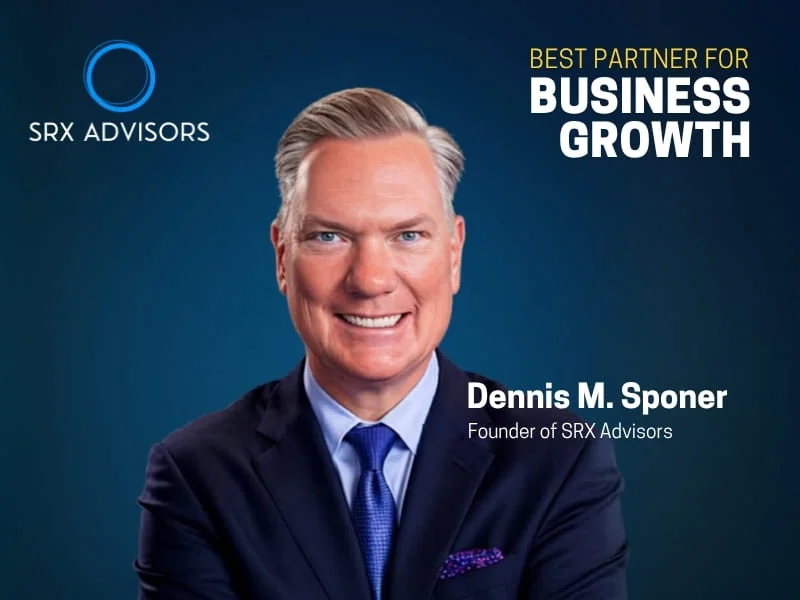
Interview with Dennis M. Sponer of SRX Advisors
The ability to turn regulatory complexity into clear strategy may well distinguish the successful from the also-rans.
The complex and highly regulated US healthcare sector is a daunting business environment, especially for those new to the market, and the challenge of maintaining compliance with the potentially overwhelming mass of applicable legislation is not for the faint-hearted. What your company really needs is a partner who can contrive simplicity from chaos.
Thank you for meeting with us today, Mr. Sponer! To start with, your career spans across many disciplines — entrepreneurship, law, healthcare, and technology. What pivotal experiences most shaped your leadership philosophy along the way?
My entire career has been defined by my ability to find opportunity in simplifying chaos. Early on, I realized that regulatory complexity not only creates risk but also offers an advantage to those who can navigate it effectively. This insight prompted me to think both like a lawyer and an operator, because those who can turn complexity into clear strategy are the ones who succeed. Building ScripNet showed me that compliance and strategy aren’t separate discussions — they’re part of the same conversation. That belief now shapes SRX Advisors.
Because you’ve successfully built and exited multiple healthcare companies, are there any common leadership lessons carried through from ScripNet to HSARx and now SRX Advisors?
The through-line is this: build infrastructure before you need it.
The through-line is this: build infrastructure before you need it. At ScripNet and HSARx, the companies that wanted to acquire us were buying our regulatory architecture as much as our revenue. They wanted certainty. I tell every client now — your compliance posture is a valuation driver, not a cost center. That’s especially true for companies entering new markets where the regulatory terrain is unfamiliar.
You’ve also worked extensively with pharmacy benefit managers and payers. How is the PBM landscape evolving, and what should healthcare leaders be preparing for now?
The scrutiny on PBMs has never been higher — from Congress, state legislatures, and now the courts. We’re seeing a wave of state-level regulation around transparency, spread pricing, and formulary practices that is fundamentally reshaping how PBMs contract and operate. The companies that will thrive are those that get ahead of it rather than react to it. And notably, this is creating real complexity for foreign insurers and healthcare companies looking at the U.S. market — the regulatory patchwork here is unlike anything they’ve encountered at home.
Healthcare technology is complex and highly regulated. How does your legal background give SRX Advisors a competitive edge when advising payers and health tech companies?
Most consultants will tell you what the regulation says. We can tell you what it means operationally, where the gray areas are, and how a regulator is likely to interpret ambiguous language. That distinction matters enormously, especially for health tech companies that are moving fast. It’s even more valuable for international companies entering the U.S. market — they often don’t realize that many health care operations, for example, are regulated state-by-state with wildly different rules. We help them navigate that from day one rather than learning it the hard way.
Your company has quickly earned a reputation as a trusted partner in healthcare technology. What do you believe trust truly means in this industry?
Trust means I tell you what you need to hear, not what you want to hear. Healthcare has too many consultants who validate whatever the client already believes. I’d rather lose an engagement than give advice that gets someone into regulatory trouble. That reputation for candor — built over two decades — is really the most valuable thing SRX Advisors has.
SRX Advisors offers fractional executive and general counsel services. Why do you think this model is especially powerful for growing healthcare and fintech companies?
Because most growing companies need senior-level judgment on a part-time basis, not a full-time salary. A startup entering the U.S. healthcare market doesn’t need a $400,000 Chief Compliance Officer on day one — they need someone who’s already made the mistakes, knows the regulators, and can get them to market faster. That’s precisely the gap we fill. And through our affiliation with Connected Capital, we can layer in access to capital and strategic introductions alongside the operational and legal expertise. It’s a much more complete offering than either service alone.

With deep experience across startups, venture capital, and advisory roles, how do you evaluate whether a healthcare technology company is positioned for sustainable growth?
I look at three things: regulatory defensibility, unit economics, and whether management actually understands their own risk profile. Many health tech companies have great technology but fragile compliance infrastructure. When a strategic acquirer or a sophisticated investor comes in and starts doing diligence, that’s where deals fall apart. I’ve seen it happen. We work to get companies acquisition-ready before they think they need to be.
Speaking of experience, you’ve pursued world-class education throughout your career, from law to a TRIUM MBA and MIT programs. How has lifelong learning influenced your leadership and strategic thinking?
The TRIUM MBA was truly transformative — it’s a joint program with NYU Stern, LSE, and HEC Paris, so you’re literally in the room with executives from six continents. That changed how I view markets. U.S. healthcare looks very different when you’ve sat with a health ministry executive from Southeast Asia who’s trying to figure out how to replicate parts of our system. It gave me a global perspective that I now apply directly when advising foreign companies on U.S. market entry.
As someone now deeply involved in advisory boards and entrepreneurial communities, what do you see as the next major opportunity in healthcare technology?
Everyone’s talking about AI in clinical care, but the real near-term opportunity is AI-powered regulatory intelligence.
The intersection of AI and regulatory compliance is underappreciated. Everyone’s talking about AI in clinical care, but the real near-term opportunity is AI-powered regulatory intelligence — helping companies monitor legislative changes, anticipate enforcement trends, and adapt their operations in real time. That’s actually core to what we’re building at SRX Advisors with our Risk Intelligence platform. And internationally, there’s enormous interest from European and UK healthcare companies who want access to U.S. markets but need a guide through the regulatory complexity. That’s a real growth vector.
Finally, as the founder of SRX Advisors, how do you define success?
Success is when a client tells me I made their company defensible — that because of our work together, they closed a deal, avoided a regulatory problem, or entered a market with confidence they didn’t have before. Professionally, I’ve been lucky to build things, sell them, and then help others do the same. If I can compress someone else’s learning curve by 10 years, that’s a good day’s work.