
By Dr. Anna Rostomyan
Dr. Anna Rostomyan explores the interconnection between fashion and folklore, focusing in particular on various ranges of fairy shoes. She considers the Cinderella creations of Christian Louboutin and Hermès, and the fire-winged collection of Giuseppe Zanotti. In her case study, the author uncovered the thin dividing line between fashion and folklore.
1. Introduction
In the dynamic world of fashion, the unique cultural-fashion creations of visionary designers create vibrant stages for the profound expression of tradition and innovation, inspiration and aspiration, creativity and innovation. In the cases of intersections of fashion, culture, and folklore, we witness transcendence of mere clothing displays, from being only some pieces to cover our nudity to becoming a spectacle where each piece tells a story. In this way, each magically fairy-tale product is a dialogue between past and present, creating magical experiences a beautiful line is created between the creators and the consumers, their ancestors and future generations, themselves and the audiences.
Folk fashion is indeed a captivating realm that celebrates the rich cultural heritage of different communities around the world. It deeply encompasses traditional clothing, accessories, and styles that have been passed down through generations. Here, the role of fairy tales is of paramount importance, since they encompass the stories and wisdom of generations (Rostomyan, 2014).
Folk fashion is indeed a captivating realm that celebrates the rich cultural heritage of different communities around the world.
Indeed, this fusion of ancestral tales with contemporary trends not only enriches the fashion industry, but also strengthens the understanding and appreciation of global diversity and unique culture traits. Thus, this case study analyzes the power of the interconnection between fashion and folklore, while discussing typical advancements in fashion in that line in terms of reviving culture folk tales through new designs and the reactions of consumers to obtaining such “magical” products.
2. The Interconnection between Fashion and Folklore
Throughout the centuries, humanity has lived through times where they have striven to create different stories to stimulate the nation(s) to show heroism and bravery. The term “fairy tale” is derived from the expression “conte de fée” used by the French writer Madame Dolneau in 1697, which literally means tale of fairies. The German word “Märchen”, meaning fairy tale, comes from the “Mär”, which means news or telling, so the word “Märchen” would mean a small tale.
It is known from other sources that fairy tales were not previously considered to be a separate genre, but were considered as an element of folklore. Indeed, fairy tales make our lives much more colourful and refreshing, breathtaking and admirable, and the heroes depicted in them and their adventures teach us to be impeccable and to believe in the positive and good in people.
Folk fashion has its roots in the history and traditions of various regions. It reflects the values, beliefs, and social practices of communities, often drawing inspiration from nature, folklore, and local craftsmanship. These garments and accessories are often handmade using traditional techniques, showcasing the skills and artistry of local artisans (Yellowbrick, 2023).
The term “folkloric turn,” attributed to the historians Guy Beiner and David Hopkin, indicates the process of turning to folk sources as legitimate subjects for historical analysis, in a similar way to the cultural turn’s positioning of culture that is reflected in fashionable items created by the designers (Hopkin, 2012). Murray (2025) states that using folkloric sources and methodologies opens up another way of thinking about history that enables us to see “the detail and the whole at the same time” and to “escape the established unities of time and space” (see more in Hopkin, 2012). Hopkin’s use of the term also highlights the importance of analyzing “ritual, gesture, clothing, and material culture”, which coalesce on the fashion catwalk (Hopkin, 2012). According to UNESCO, “folklore (or traditional and popular culture) is the totality of tradition-based creations of a cultural community” and is made up of intangible and tangible elements including, “among others, language, literature, music, dance, games, mythology, rituals, customs, handicrafts, architecture, and other arts.” (UNESCO, 1989).
This said, fashion is a way of living which helps consumers and fashionable followers of brands to extract themselves from the outward reality and to indulge themselves in another fairy world, where everything is possible, where the impossible becomes possible, where they can become kings and queens, princes and princesses, emperors and empresses. Thus, taking this fact into consideration, various fashion designers have recently striven to highlight the phenomenon through their designs. In my personal view, this has especially been vividly remarkable with regard to shoes, which will be discussed in the next section.

3. Magical shoes for magical people believing in fairy tales
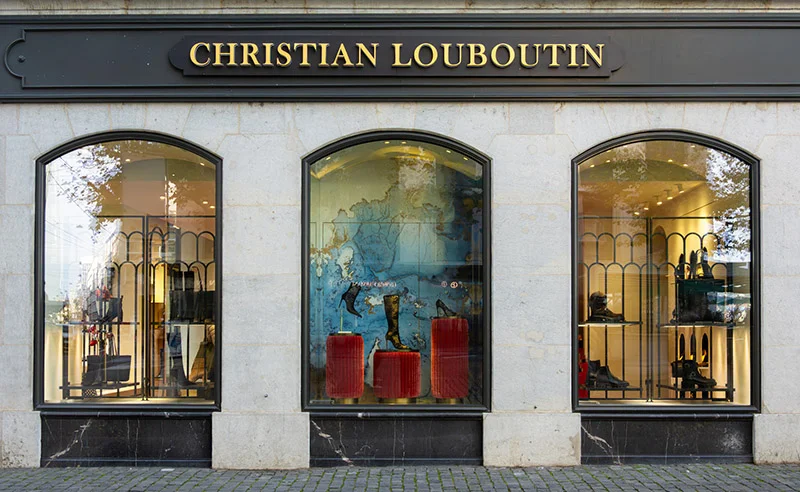
The famous French footwear designer Christian Louboutin, whose footwear has incorporated shiny, red-lacquered soles that have truly become his signature, managed to attract the attention of, and have a positive emotive impact on, ladies worldwide with his new collection, which includes laced shoes that resemble those of Cinderella. To attract a much wider range of consumers and to raise demand in the markets of his product, he referred to the story of Cinderella, her picture, and the following slogan: “Cinderella is proof that a new pair of shoes may change your life.”
According to the British Vogue (2012), Christian Louboutin unveiled his new interpretation of Cinderella’s glass slipper in celebration of Disney’s re-release of the famous story on DVD and Blu-ray this autumn. News of the collaboration was first announced in April. “Cinderella is not only an iconic character when it comes to beauty, grace and fairy-tale love, but also shoes,” said Louboutin, further claiming that “her character and her story dictated the design to me, it was all there in the pages and the words of this tale.”
Still, to protect himself from misinterpretation, he also used a design sketch of the shoes depicting some red colour beside the shoe to defend himself from criticism by those whose lives would not improve as a cause of the purchase. The red colour most probably represents pain and blood, since the Cinderella shoe is not for everyone and not everyone can be a princess to become a queen. This subtly suggests that the inner beauty of the “princess” wearing the shoes has to match the beauty of the shoes to ensure wealth, well-being, fortune, and luck. Here the polyphonic word “fortune”, which according to the Oxford Dictionary also entails the closely related concepts of “luck” and “wealth”, refers to the fact that, if one is fortunate enough to grasp fortune, it will bring with it love, luck, wealth, and health, since, as they say, “Health is wealth.” Moreover, it implicitly hints to the fact that beauty sometimes needs sacrifice and that luxury may sometimes also be gained painfully, but, when done properly, it will attract more wealth.
In fact, designers nowadays very often apply the prototype of fairy tales in their marketing strategies, as people believe in miracles and fairy tales and the realization of them. Thus, producers may enhance their chances of achieving their desired positive effect on consumers in acquiring the objects they design. Such an instance can also be viewed in the ads of the mogul fashion company Hermès, the chief designers of which have also adhered to the “brand” notion of Cinderella in their shoe advertisements. Moreover, it should here also be noted that as a slogan for this line of advertisement they have chosen the following French slogan: “La Vie comme un Conte” (Life as a Fairy Tale).
The Hermès slogan is accompanied by a picture of the event when the clock struck 12, Cinderella ran away, and the Prince ran after her to find out who she was. However, she managed to escape, leaving only a shoe on the stairs. The Prince later tried to find the mysterious lady. By testing all the ladies in town, he tries to find the right one. So, the designers of Hermès, when advertising the modern-day mystical shoe, subtly suggest on the emotional, subconscious level that, by buying this shoe, you will also find your “Prince Charming” (Rostomyan, 2020:13-15).
Another wonderful example of fairy shoes is the beautifully designed winged shoes by the Italian designer Giuseppe Zanotti, available in flats, loafers, ballerinas, sandals, high-heeled and even sneakers, thus making a wide variety of versions of the same idea for different consumers with various tastes to find their favourite pair. But the idea is the same, that the shoes can give angelic wings to the owner of the magical pair. The price of this line of shoes, as with other lines of Zanotti’s collections, is rather high, showing that they are not affordable for everyone and that only the chosen ones can acquire the “wings”. Prestige (2016) says that this Italian footwear brand is no stranger to dressing famous feet on the red carpet either. Celebrities who have sported Zanotti’s statement-making shoes in the past include Charlize Theron, Kanye West, and Beyoncé. The source further explained that, to celebrate the recent opening of his 100th store and expansion of the brand around the globe, Zanotti has revamped some of his most classic shoe styles, the loafers, the ballerinas, and the sneakers, with his iconic fire-wing embellishment to make it suitable for different tastes of the consumers.
In a nutshell, such links to magical tales truly have the utmost potential to change consumer behaviour and create a desire in them to acquire such products, which raises the chances of the creation of very desirable brands. Moreover, when designers manage to evoke positive emotions in consumers’ minds through links to well-known fairy tales embedded in their products, they reach a kind of strong emotional bond with the targeted audience by means of their impeccably well thought-out emotional marketing strategies (Rostomyan, 2014).
Therefore, when designers bear in mind the ultimate power of fairy tales and their vivacity in terms of stimulating the generation and experience of positive emotions that are tightly linked with our childhood experiences, they will as a matter of fact obtain as a result an emotional connection with their customers, making them devout consumers who will rejoice in the acquisition of the marketed products.
4. Methodology and Data Analysis
To reveal the inclinations of people towards acquiring such high-priced items representing fairy tales, we have conducted a quantitative and qualitative survey among 100 women aged between 20 and 60.
According to a non-probability sampling, 100 chosen female individuals were asked the following questions, and the results of the survey are summarized below according to quantitative and qualitative analyses.
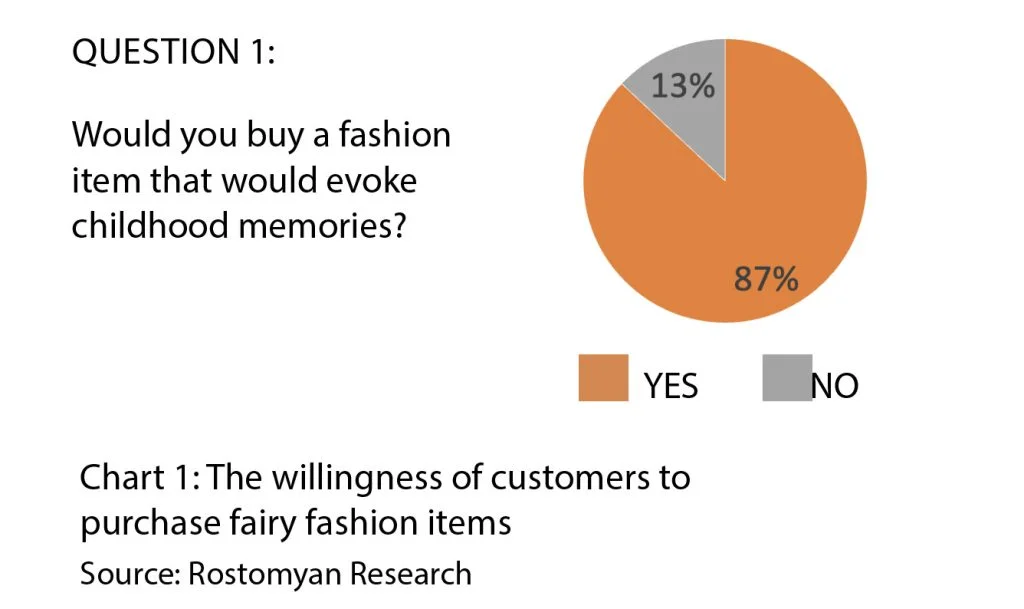
As we can see from Chart 1 above, according to the quantitative study, the vast majority of the respondents (87 people) showed a willingness to buy fashion items that represent fairy tales or are somehow connected with fairy tales. As Albert Einstein truly stated, “If you want your children to be intelligent, read them fairy tales. If you want them to be more intelligent, read them more fairy tales.” The reason that children love to be brought up with fairy tales may lie in the fact that in fairy tales the implausible becomes plausible and that even when they grow up, they acquire an item that reminds them of their childhood and evokes positive emotions. This they consider to be a bargain at the price.
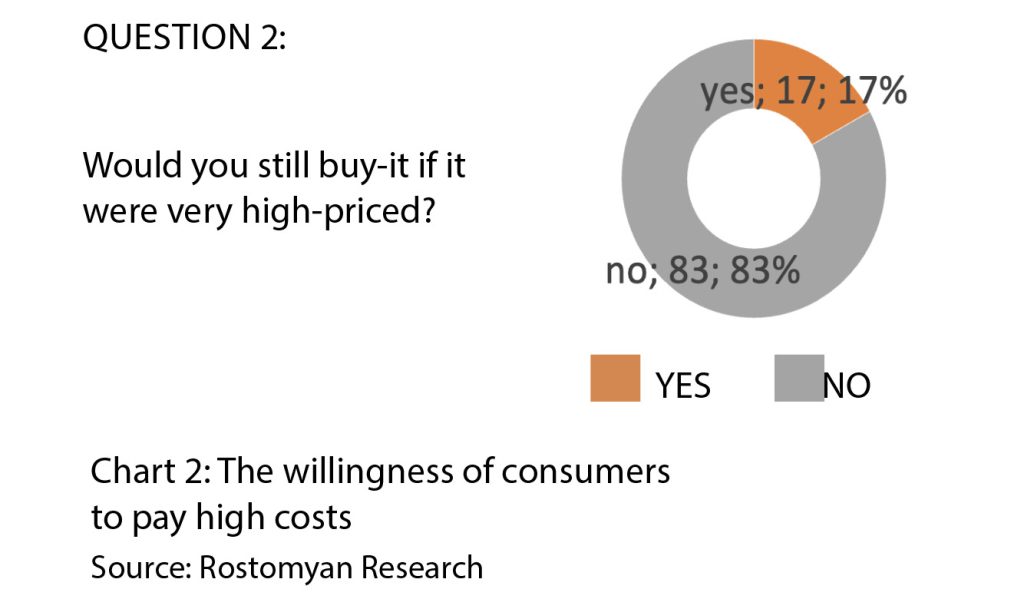
As can be seen in Chart 2 above, according to our quantitative study, only 17 per cent of the respondents were ready to pay a high cost for the acquisition for such luxury products, even if they evoke positive past experiences related to their childhood and creating magic, whereas the vast majority of the respondents would prefer to make a purchase at a fairly reasonable price. The reason could be both financial and mindset. According to the qualitative survey results, there are people who believe that a high-priced item can be an investment and others who believe it to be a waste of money. This fact may lead us to the assumption that it could be worthwhile for haute couture designers to create something affordable for the masses, in addition to their high-priced products. Here, fast fashion can lend a helping hand, such as H&M and Zara, who present fashionable items in line with the current trends and affordable for the mass market. It is also noteworthy that such fast-fashion houses sometimes collaborate with celebrities, as is the case of H&M with Madonna and the esteemed designer Karl Lagerfeld, which creates a sensation of feeling close to the star, which again can feel quite fairy-like.
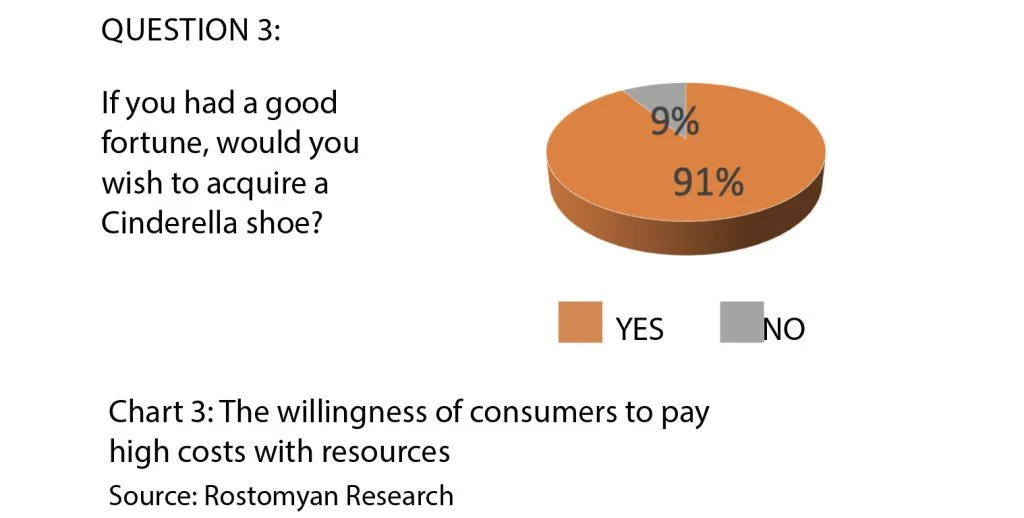
As can be noted from Chart 3 above, almost all the respondents (91 people) demonstrated their willingness to purchase Cinderella shoes if they had the appropriate financial resources. This suggests that nearly everyone wants to be and feel like a princess, especially so, given that the story of Cinderella shows that anyone can become a princess, and this becomes strongly possible with the right shoes. As for the results of the qualitative study, those who did not wish to acquire such shoes at a high price, even having the required financial means, considered it irrelevant, and that they could create their own magic.
Question 4 was elaborated for qualitative analysis to gather further detailed insights from the targeted audience on their fashion preferences and thoughts on the relationship between fashion and fairy tales. Thus, the results to the question “Why do you think the link between fairy tales and fashion is so relevant?” can be grouped into the following insights:
The link between fashion and fairy tales is relevant because we as humans are shaped during our childhood, and our clothing styles later reflect our experiences.
Fairy tales presented through fashion can make the impossible possible by making us again feel as if we are in a fairy tale.
Fairy tales in fashion give us the opportunity to dream big and reach for more, targeting the stars.
As a result, all of the above answers suggest that we feel better about ourselves when we feel like the heroes and heroines of our beloved fairy tales. Therefore, when designers manage to revive fairy tale characters through their artworks, it will resonate with the public. Consequently, consumers will feel connected with those pieces of art in fashion, and an emotional bond will be generated between them, the brand, and the designer(s), who will attain their goal of making their product purchasable. This is, indeed, how emotional marketing works in terms of generating a strong emotional bond between the producers and the consumers and, from the neurological point of view, if producers manage to stimulate activity in the limbic system, specifically key structures such as the amygdala, the nucleus accumbens, and the ventromedial prefrontal cortex (vmPFC), they will succeed in influencing decision-making regarding the purchase. These regions are involved in processing emotions, reward, and memory, and their activation often precedes rational thought during a purchase decision. This suggests that far more happens in the process of creation-production-purchase and, if designers and producers bear this in mind and market their products accordingly, their chances of success will be reinforced. It follows that, especially in terms of the creation and production of fairy items, designers and producers stand a better chance of building these highly desirable bonds with their consumers. Furthermore, this gives them extra power and they should use it with clear vision, intention, and care.
5. Summary
To sum up, with the application and use of fairy tales in their marketing strategies, designers stand a better chance of raising their sales, acquiring more customers, and strengthening their bond with them. Moreover, the acquisition of such high-priced products can truly be an investment in ourselves, creating the experience of positive emotions and, like the fairy tales themselves, being able to be passed from generation to generation, thus making fashion sustainable, admirable, desirable, and long-lasting. The author’s own research and experience also proves that such magical products can indeed give one an extra pinch of confidence and mysterious feeling, while embarking upon the unveiling of the interconnection of fashion and folklore, as well as raising their chances of having a positive influence on the public. As they truly say, “Give a girl the right shoes, and she can conquer the world.” Moreover, when acquiring fashionable shoes, we should think of it as an investment in itself and use and reuse such items over time. Furthermore, designers should bear in mind that they influence a whole generation and, therefore, their creations should be made with care, clear vision, intention, and a mission to support their customers to find and create their best selves, which will, by a ripple effect, inspire others.