An iGaming vendor comparison often begins with features and setup cost. Investors have a more consequential clock to watch: the stretch between committing capital and putting a working product into commercial operation. Technology that looks inexpensive in a proposal can become costly when launch work absorbs months.
The sector’s investment attractiveness is understandable. A digital gambling business can serve multiple markets without a physical casino estate, combine casino with sports betting, and build recurring revenue through player acquisition and retention. The investment case, however, still depends on how quickly the project can recover its initial outlay.
How Time-to-ROI Reframes Vendor Economics
For an investor, time-to-ROI is the calendar attached to the return equation: the period required for cumulative net returns to recover the original outlay. In iGaming, it starts before the first player’s deposit. Licensing, infrastructure configuration, integrations, testing, staffing, and migration consume capital while the product cannot yet operate commercially.
With a fragmented vendor stack, the operator can select each component independently. Yet that freedom comes with a heavy coordination cost. Deposits, game sessions, balances, and bonuses may run through different systems, with support split across suppliers. If a win or bonus is missing from an account, tracing the fault takes time and staff resources. A slow response may frustrate the player and put future revenue at risk.
A platform approach adds a common operating layer across all modules. In that case, data and workflows are coordinated through one environment, reducing the resources needed to keep the stack aligned. For an investor, the effect is practical: fewer operational delays can bring revenue forward and reduce the risk of a longer payback period.
What Can Slow the Path to ROI at Launch
Launch delays accumulate at the seams: a provider contract awaiting integration, a cashier without local coverage, a back office unable to reconcile data, or a game portfolio taking too long to assemble.
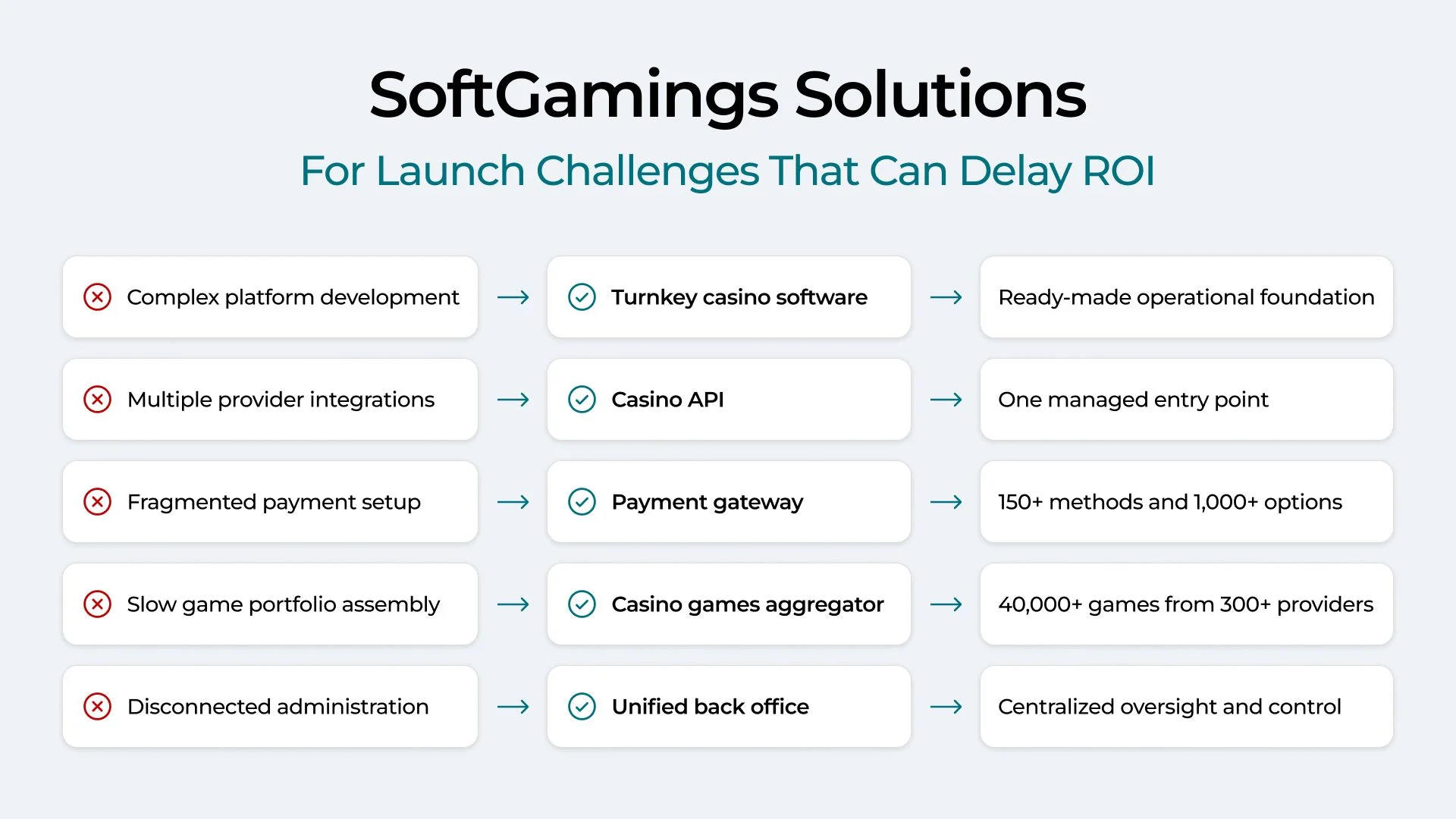
The map below presents five common causes of delayed ROI and shows how the iGaming software provider SoftGamings addresses them. The proposed solutions have been shaped by 19+ years of hands-on experience gained by a team of iGaming professionals while helping operators launch new projects and migrate from existing platforms.
Revenue Diversification through a Second iGaming Vertical
Sportsbook adds a major revenue vertical to an online casino business. According to EGBA, sports betting generated 46% of its members’ online GGR in 2025, compared with 48% from online casinos. Where the market supports both products, this diversification expands monetization potential.
The SoftGamings platform includes a sportsbook alongside its casino functionality, so operators can manage both verticals without building a separate technology stack. Managed trading, real-time risk controls, AI-driven fraud detection, and broad betting coverage underpin sportsbook operations from launch, giving operators an additional revenue stream that can support the path to ROI.
Two Routes into a First iGaming Venture
Newcomers face two versions of the same problem. A first-time operator needs a complete business foundation; a media owner, affiliate, or community brand needs a credible route to audience monetization. Neither wants the investment to become a prolonged software construction program.
This is where Turnkey casino software can come into play: it fits both starting points. This platform edition provides a ready operational foundation while preserving broad brand and front-end flexibility. The business runs under its own license and keeps a high level of commercial and operational control.
Another option, White Label casino software, suits operators whose priority is a fast and cost-efficient launch. In this case, SoftGamings supplies the license, hosting, and standard front end, while the operator builds the customer-facing brand.
Both models are built around the same platform and provide the same core access to games, payments, and bonus system functionality. A consultation with an iGaming expert can show which route makes more financial sense for a specific market and business plan.
New Growth Capacity for Existing Operations
An established online casino operator has already paid for a functioning stack. Replacing it wholesale can interrupt revenue and customer journeys. For that business, casino API integration provides an extension route: new providers, game bundles, and fresh releases through one managed connection, without dismantling established workflows.
The model also supports expansion into new markets by addressing local player habits. Where migration is required, SoftGamings’ 99.999% platform uptime helps protect operational continuity.
What Platform Infrastructure Changes in the ROI Equation
Vigants Lesausks, CSO of SoftGamings, links launch time directly to investment cost: “Platform price is only one line in the real cost of iGaming technology. Time also costs money: the months spent connecting content, establishing payment infrastructure, and preparing integrations consume capital.”
The SoftGamings casino platform is built to bring the revenue stage closer and help operators reach ROI sooner. Ready infrastructure reduces the technical and operational work left before go-live, allowing the business to move from investment to market entry faster.
Of course, infrastructure cannot guarantee payback. How quickly the investment is recovered also depends on execution and the business’s starting point: a first-time founder must still fund player acquisition, while a media owner or affiliate can monetize traffic already in hand.
Product Choice by Business Starting Point
Product selection becomes clearer when it begins with the commercial jumping-off point rather than a feature inventory.
| Starting position | Best-fit route | Investment logic |
| First-time operator, with or without an existing audience | Turnkey launch model | Build on prepared infrastructure while retaining broad control and customization |
| New operator prioritizing a fast launch | White Label launch model | Reduce initial costs and setup time by launching on the provider’s license and infrastructure |
| Established operator pursuing growth | Casino API | Add game content to support revenue growth and business expansion |
These entry points differ, but the investment objective is the same: shorten the path to payback. A casino platform built for fast time-to-ROI provides the common foundation, while the right route can vary from a full launch model to selected integrations for an existing business.
Disclaimer: This article contains sponsored marketing content. It is intended for promotional purposes and should not be considered as an endorsement or recommendation by our website. Readers are encouraged to conduct their own research and exercise their own judgment before making any decisions based on the information provided in this article.