

By Dr. Patrick Lynch
Companies are pouring record sums into AI and capturing almost none of the value. The culprit is project thinking, and there’s a fix.
Your AI budget is about to grow. Again. McKinsey finds 92% of companies plan to increase AI spending, yet BCG counts roughly one in twenty capturing significant value from it. Unless something changes, the new money will follow the old into pilots that impress and returns that never arrive. What separates the many from the few is mindset.
Most leaders run AI as a project, and projects end. The few run it as a practice, and in How to Outsmart AI and THRIVE (Routledge, 2026) I give that practice a structure: the THRIVE framework, a system for human-AI collaboration that positions AI as an employee’s partner rather than replacement. It’s a strategic approach to seeing AI as a collaborator that complements your human employee’s unique strengths, values, and goals.
The framework lays out AI integration into six actionable pillars and works at three levels: for the individual it’s a guide to working in partnership with AI, for the team, it’s a shared language to plan adoption of AI and minimize chaos and resistance. For the organisation it’s a blueprint that ensures AI investments deliver real impact, not become the flavour of the month.
Why Are Companies Spending More on AI and Seeing Less Value?
Picture your quarterly review. Twenty minutes of AI progress, charts pointing up. The transformation lead is mid-victory-lap, then the CFO asks: Where does this show up in the P&L? Silence.
That silence is deafening. Gartner projects that by 2030, only 35% of organizations using agentic AI in enterprise applications will have realized measurable business value, and when researchers surveyed thousands of executives, nearly nine in ten reported no measurable impact on productivity or employment. We’ve heard this before yet forgotten what we know. In 1987, Nobel laureate Robert Solow quipped that you could see the computer age everywhere but in the productivity statistics. Four decades later, Apollo’s chief economist Torsten Slok says almost exactly the same about AI. New era, same paradox.
AI initiatives stall when they are treated as isolated technical projects rather than business capabilities, and they break down in the final 30%, where AI activity never becomes AI impact. Both diagnoses are right, and they share a root. Scope it, deploy it, train once, go-live: those are the fingerprints of project thinking. A project’s capability freezes on launch day. AI’s capability keeps moving and value can’t cross the chasm.
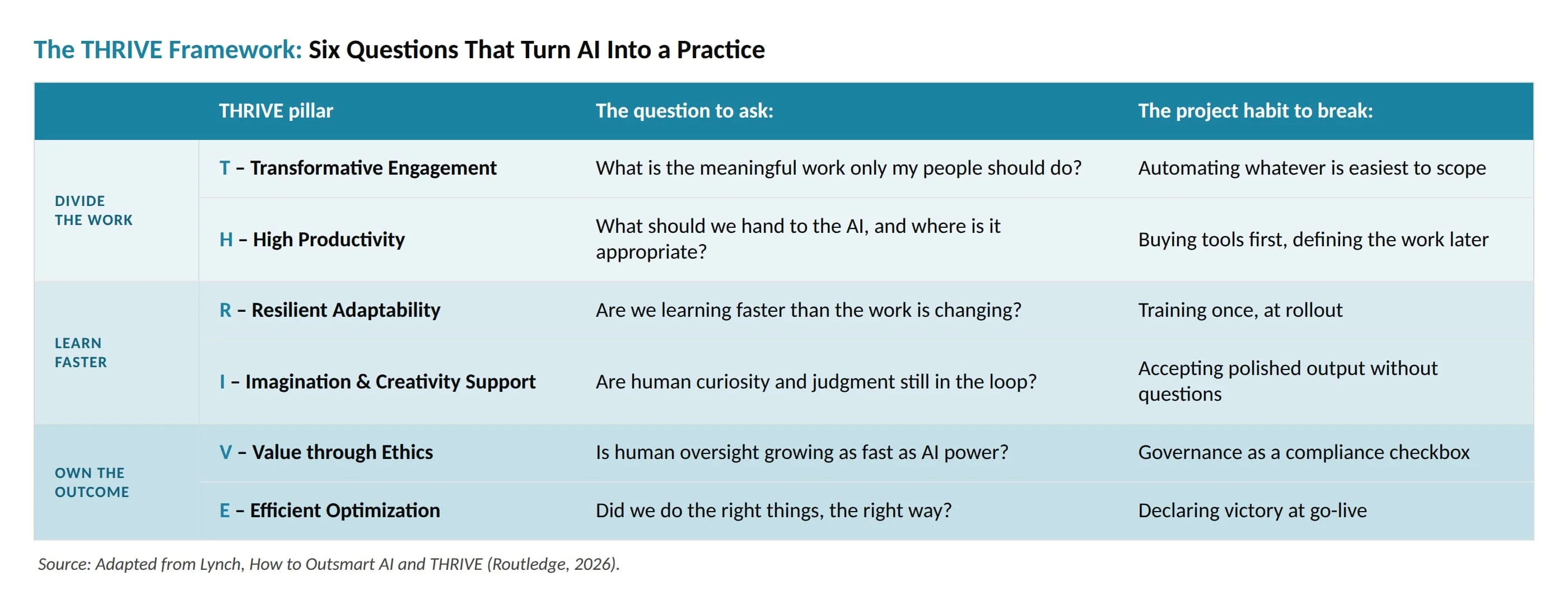
A structured practice closes it. THRIVE provides six pillars of human-AI collaboration (Transformative Engagement, High Productivity, Resilient Adaptability, Imagination and Creativity Support, Value through Ethics, Efficient Optimization) that operate as three pairs of questions, replayed as the tools and the work change.
The THRIVE Framework: Six Questions That Turn AI Into a Practice
What Should Your People Do, and What Should the AI Do?
In 2023, Goldman Sachs analyzed the task content of more than 900 occupations. About two-thirds are exposed to AI, and for most of those, AI could absorb a quarter to half of the workload. Exposed is not erased. For most jobs, exposure means sharing the work, and Goldman’s 2026 update anticipates whole categories of work that do not yet have names. The first leadership question is a division-of-labor question: how do you split the work?
That is THRIVE’s first pair: Transformative Engagement and High Productivity. What do you do, and what should the AI do? Your people’s unique value sits in judgment, empathy, and creativity. The machine’s value sits in the repetitive portion, the way a submarine outswims us and a plane outflies us. Let each do what it does best.
In a field experiment at Procter & Gamble, 776 professionals brainstormed new products. In one room, two colleagues worked without AI. In another, a single professional worked with it, and matched the pair. Full teams working with AI went further still: about three times more likely to produce top-tier ideas, faster, and, by their own report, enjoying the work more. I call the losing pattern Vanity AI: adopting the technology to imitate what you already do, just faster. The winning pattern, Viable AI, creates new value you could not create before. P&G’s teams practiced and reached that finish line.
Try the split yourself this week. Pick one role, list the ten tasks, and mark which move to the machine and which stay human. Put a date on the calendar to ask again, quarterly. Answers will change as your practice compounds.
Is Your Organization Learning Faster Than the Work Is Changing?
Follow an executive’s week with AI and analysis will show the tools hand her back 4.6 hours, and she spends 4 hours and 20 minutes checking the output. Net gain: 16 minutes. Some of what she is checking now has a name. Researchers at BetterUp and Stanford call it “workslop”, and you’ve seen it: the nicely formatted memo that’s missing substance, leaving you to work out what it should have said. Forty percent of US desk workers got sloped in a single month, and each incident took nearly two hours to resolve. An eight-month field study found that AI intensifies work as often as it relieves it. As one engineer put it: “You don’t work less. You just work the same amount or even more.”
The root cause is delegation without discernment. Anthropic’s AI Fluency Index, built from thousands of real conversations, found people strong at directing AI and weak at evaluating it. The more polished the output looks, the fewer questions we ask.
THRIVE’s second pair of questions confronts that. Resilient Adaptability commits you or your organization to learning at the speed the work changes. Imagination and Creativity Support protects the human capabilities that make the output worth trusting: curiosity, judgment, imagination. Start with training. Organizations that train both users and leadership on AI realize a 23-percentage-point advantage in value over those that train neither or only one. Projects train at rollout but practices continuously train.
Start with a pairing, as the World Economic Forum suggests: your most AI-fluent junior and your most experienced senior collaborate to tackle tasks. The junior shows what the tool can do. The senior shows where it goes wrong. Adaptability and discernment builds capabilities from the practice.
Would You Stand Behind the Decision Your AI Just Made?
As AI agents became more capable, executive trust in them fell, from 43% to 27% in a single year, according to Capgemini. The machines improved while our confidence collapsed. Read the drop as a signal: autonomy is scaling faster than governance.
THRIVE’s third pair of questions treats the signal as a formula. Value through Ethics is AI power divided by human oversight. Let the numerator grow while the denominator shrinks and the system spins out of your control. Accountability stays with you the whole way. Ask Air Canada. Its website chatbot invented a bereavement discount, a grieving customer relied on it, and the airline argued before a tribunal that the bot was “a separate legal entity” responsible for its own words. The tribunal held the airline liable. Would you stand behind that chatbot’s decision? Someone has to.
Efficient Optimization closes each cycle with the gut check: did we do the right things, the right way? In practice it comes down to one rule. Every decision AI touches has a named human owner who can explain it. If no one will stand behind it, it does not ship.
The THRIVE Practice Check: Is Your Organization Running an AI Project or a Practice?
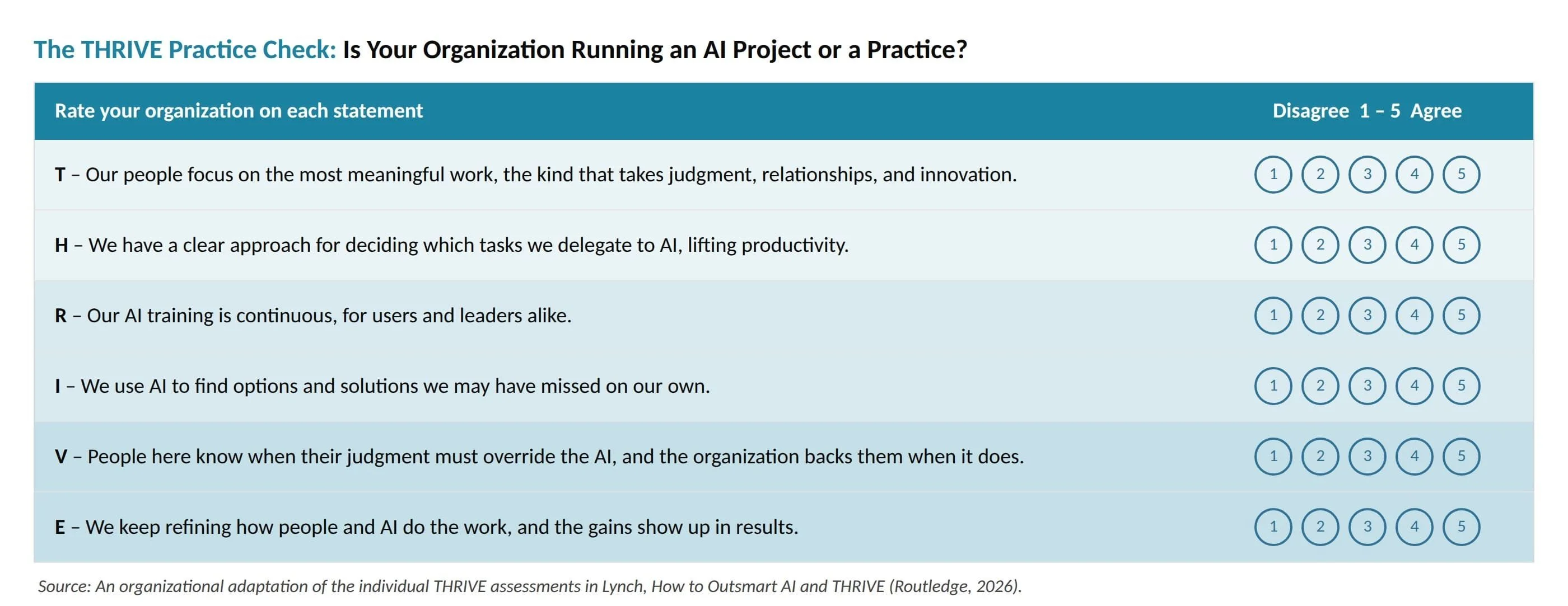
26–30: You are running a practice. Keep the quarterly cadence. 18–25: A practice is forming, but project habits linger. Start with your lowest pair. Below 18: You funded a project. Reread the six questions before the next budget cycle.
Conclusion
Run as a practice, AI turns a flywheel: your people apply AI, the AI takes on more, your people move to higher-value ground. Run as a project, the wheel stops at go-live. THRIVE keeps it turning at every scale: a guide for people working in partnership with AI, a shared language for teams planning adoption, a blueprint for your organization determined to make AI deliver value. This practice has no finish line because the frontier keeps moving. Next quarterly review, ask the six questions, then ask them again next quarter, and the quarter after. You’ll know the practice is working when the answers keep changing while value compounds.
About the Author
 Dr. Patrick Lynch is AI Faculty Lead at Hult International Business School and author of How to Outsmart AI and THRIVE (Routledge, 2026). A TEDx speaker and former Accenture executive, he researches human-AI collaboration and advises organizations on AI strategy, workforce transformation, and the future of work.