

By Bart Tkaczyk
Amid today’s complexity, continuous learning is leadership’s core discipline. This article reframes executive development as enterprise-critical, introducing the “executive learner” archetype—leaders who thrive through reflection, super-flexibility, and dynamic capability. With seven actionable dimensions and tools like “Executive Time-Outs,” it enables leaders to transform daily experience into strategic advantage—or risk obsolescence.
What separates relevant from replaceable in a world that changes overnight? In today’s high-stakes environment, it’s not pedigree—it’s the ability to learn, unlearn, and rewire at speed.
This article is for MBA students and candidates, executives and future executives, HR development professionals, management consultants, entrepreneurs, and business educators shaping the next wave of leadership. If you’re committed to building future-fit organizations—and people—this playbook is for you.
Long considered the gold standard for leadership development and career advancement, the MBA, executive education, and business education more broadly are now undergoing a profound transformation (Birkinshaw, 2024; Chatman, 2025; Dunne & Martin, 2006; Harrison et al., 2025; Hill, 2021; Jack, 2024; Lyons, 2017; Moules, 2016; Schoemaker, 2008; Walsh & Powell, 2020; Watson, 2024). New business realities, shifting stakeholder expectations, and human-centered values are demanding more than credentials—they’re demanding learning super-flexibility—and nothing short of continuing professional development and reflective learning. From theory-heavy training models to immersive, practice-based learning experiences, the executive development landscape is being rewritten—fast.
The critical difference? Training delivers content—it’s commonly activity-based. Learning drives growth—it’s results-driven. Training is typically instructor-led and designed to trigger specific behavior or skill change. It’s often reactive, pre-packaged, content-heavy, compliance-oriented, and box-ticking in nature. There’s still no bulletproof ROI on training—and the truth is, we don’t know if training creates success, or if success just buys more training… Learning, by contrast, is self-directed and work-based. It expands adaptive capacity through developmental experiences like coaching or mentoring. And you cannot pressure people to learn—period. Simply put: trainer-centered, menu-driven training may inform, but only strategically integrated learning transforms.
The learning that matters most does three things: it strengthens personal capability, advances professional capability, and impacts organizational capability.
Bottom line: learning is the new labor—it drives value, agility, and relevance—and it’s the defining edge for modern leaders.
In Response, Meet the Executive Learner: A New Archetype
As seismic shifts in technology, geopolitics, sustainability, and social consciousness reshape the corporate ecosystem, the executive arena, and the fabric of organizational life, a new archetype is emerging: the executive learner—a leader who believes learning never ends and who embodies high learning agility, or what I call “learning super-flexibility”—an elevated, dynamic capability that spans seven vital dimensions:
- Exploratory drive—a proactive desire to seek out new ideas and experiences, energized by a hunger for learning, discovery, and growth.
- Reflective capacity—a disciplined habit of self-reflection that enables individuals to critically analyze their actions, identify blind spots, and recalibrate through internal dialogue, feedback, and lessons learned to improve future performance. It also encompasses meta-learning capacity (learning how to learn)—the ability to consciously monitor and upgrade one’s own learning strategies and processes over time.
- Cognitive range and flex-thinking—the ability to shift mental models and think fluidly across different knowledge domains and contexts. Leaders with high cognitive range can zoom in and out—moving from big-picture systems thinking to granular detail, from analytical logic to creative insight. They flex across disciplines in real time. Harnessing neuroplasticity, it recruits neuro-flexibility—the mental muscle to unlearn outdated patterns fast, relearn with smarter precision, and rewire thinking on demand.
- Relational intelligence and perspective-seeking—seeking out and engaging diverse voices, including those from different generations and cultures, to inform thinking and enable better decisions. It also involves cultivating team learning (teams serve as microcosms of the enterprise)—a disciplined, knowledge-creative practice of aligning group insight, fostering psychological safety, and accelerating collective performance through generative dialogue, strategic cohesion, agile teamwork, and the dynamics of social learning.
- Change confidence—the mindset that views change not as chaos, but as fuel for learning, adaptation, and strategic evolution.
- Strategic execution focus—aligning learning with purposeful, results-driven action that advances individual, team, and organizational goals.
- Personal insight—a clear-eyed understanding of one’s patterns, impact, and areas for growth and development. It also integrates an ethical learning mindset—applying an ethical lens and sound reasoning to the learning process itself.
Operationally, effective executive learners excel in both structured, forward-looking development (planned learning) and in learning opportunistically (adaptive, just-in-time, emergent learning). They acknowledge the tension between fast sense-making and deeper reflection—a dynamic I call the balance of speed and depth. They experiment, reflect, rapidly crack unfamiliar challenges, and consistently convert both success and failure into decisive learning and responsible action (bouncing forward, not just bouncing back).
Critically, to support this kind of behavior at scale, a healthy learning climate empowers all individuals and teams to experiment, test new ideas, learn from experience, and engage in ongoing (self-)development as a shared norm—not an exception.
Zooming out, in organizational terms, a learning organization is a future-fit enterprise that embeds and operationalizes continuing professional development and self-development for all into its culture—turning talent cultivation and individual and collective learning into levers for organizational super-flexibility, energized performance, strategic advantage, and sustained relevance. On the ground, continuous learning fuels creative innovation, supports evidence-based choices that elevate strategic decision-making, and accelerates organizational renewal.
In short, learning is not just a growth strategy—it’s a way of leading.
Future-Fit Executive: From Tradition to Reformation
Gone are the days of solving tidy, linear puzzles with static playbooks. Today’s leaders confront wicked problems: messy, evolving challenges with no clear definition, no single owner, let alone clear solutions. They don’t just manage change—they learn through it, from it, and because of it (Tkaczyk, 2021, 2022a, 2022b). Beyond that, these leaders are not just designers who imagine what could be—they are architects who turn vision into structure, sketching, shaping, and iterating the frontiers of tomorrow in real time. They lead not from behind a desk, but from within the system—reading signals, shaping moves, and powering change as it unfolds.
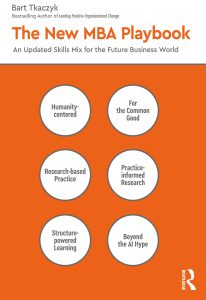 This ethos anchors The New MBA Playbook: An Updated Skills Mix for the Future Business World (Tkaczyk, 2025)—a strategic framework to revitalize executive learning, leadership development, and applied professional practice. But the transformation transcends acquiring new tools or tweaking yesterday’s tactics. This new wave of executive learners is unlearning outdated paradigms and embracing a skillset of dynamic capabilities that are as much about humanity as they are about performance—knowing that continuing professional development builds both confidence and credibility as a modern leader. The new playbook isn’t just an update; it’s a reformation. Ready or not, the future won’t accommodate hesitation, and it certainly won’t reward resistance. The future won’t wait for the unready—nor will it forgive the unwilling.
Beyond the Old Rules: 7 Strategic Shifts for the Executive Learner
Here are seven pivotal lessons from The New MBA Playbook—delivered not as idealized models or in abstraction, but through a kind of fast-cycle learning, often refined in real-world sprints and on-the-ground executive learning environments—that define this new breed of positive leadership. These lessons are crafted to bridge insight and execution, helping leaders—and their teams—apply what they learn in the heat of action through individual reflection and team learning alike. They also serve as catalysts for evolving not just leadership skills, but leadership identity itself.
Before diving into the seven shifts, a note on reflective learning is in order: skill-building and continuing professional development aren’t “one-size-fits-all.” Reflective practice helps leaders tailor their learning approach to what best fits their personal growth and organizational context.
Too often overlooked, reflective learning builds individual ownership of growth—shifting the focus from organizational responsibility to individual agency. Its real value lies in turning everyday experiences into strategic learning assets for future impact.
Take a strategic pause: consider maintaining a reflective learning journal (or log) to support intentional learning and sustained development. A well-kept learning and development journal not only facilitates growth toward competence and personal mastery—reinforcing your leadership learning discipline—it also provides tangible evidence of progress over time.
Such developmental rigor underpins the Executive Time-Outs: Learning Logs and Reflections ahead—strategic tools intended to turn experience into insight, and insight into action. Each shift is paired with a Time-Out: a structured reflection mechanism designed to help leaders learn both retrospectively and opportunistically from real-time events. This dual-track approach encourages reflection during action—adjusting and course-correcting “in the moment”—as well as after action, extracting learning intelligence to refine future thinking and behavior.
Together, these practices form a critical learning loop that sharpens judgment and enables executive learners to continually self-develop and lead from a place of elevated thinking and informed perspective in complex, fast-moving environments.
Lesson 1: From Models to Meaning: Behavioral Economics and Heart-Based Leadership
Leadership has long relied on rational models, forecasts, and metrics. But the modern executive learner understands that people do not always act rationally—and neither do markets. Behavioral economics has illuminated the biases and emotional drivers behind decision-making (think, for example, confirmation or self-serving bias). But where data ends, heart-based leadership begins.
Kindness; positive, productive energy; generosity; psychological safety; co-active followership; and trust are no longer soft skills—they are strategic assets. These leaders build positive psychological capital—optimism, hope, confidence, and resiliency—drawing from the science of positive organizational behavior to fuel innovation and sustained performance. The best executive learners don’t just ask, “What’s the ROI?” They ask, “What’s the human and social impact? Are we becoming happier, healthier—not merely wealthier?”
Increasingly, legacy economic systems, once driven primarily by survival instincts (and, at times, unchecked greed!), are now being fundamentally redefined to reflect human-centered frameworks and ideals—honoring human dignity, organizational virtuousness, and insights from both positive organizational scholarship and humanistic management. These shifts advance principles like the economy of communion, the common good, and universal betterment—moving far beyond narrow self-interested benefit.
Executive Time-Out 1: Learning Log and Reflection
How well do you balance data-driven decision-making with positive leadership and followership rooted in a people-first mindset? Are you actively energizing your workplace? Consider one way you could more meaningfully create and sustain high-quality connections at work—especially in moments of pressure—to lead with heart—then clarity, trust, and lasting impact.
Lesson 2: Liberating Workplaces: Blending Dialogic Organization Development and Generative Change
Command-and-control leadership is no longer the only—or the most effective—approach. Executive learners today embrace organizations as living systems—fluid, complex, and co-creative. Instead of robotically prescribing change from the top down, they initiate dialogic processes: open conversations rooted in inquiry that invite participation, spark collective intelligence, and foster design thinking and design innovation.
Using tools like positive organizational energy, collective sensemaking, and strategic super-flexibility, they foster cultures where transformation and organizational renewal emerge organically. These aren’t just change initiatives or programs —they’re movements with intent and momentum.
Executive Time-Out 2: Learning Log and Reflection
What’s one shift you can make to move from directing change to co-creating it? In your next initiative, how might you spark dialogue rather than issue directives? And how are you engaging your team in sustained, collective inquiry—examining the assumptions, mental models, and habitual processes that shape how learning unfolds in your everyday work and leadership? How can you even more intentionally cross-fertilize thinking and ideas across teams, functions, or stakeholder groups to unlock richer insight and nurture generative change?
Lesson 3: Helping Genuinely: Coaching and Consulting that Scale Positive Leadership
In parallel, the coaching revolution has moved beyond buzzwords and pop psychology. Today’s high-impact executives view coaching not as a remedial fix—coaching catalyzes positive developmental spirals over time. Grounded in evidence-based methods and organizational psychology, modern executive coaching is both rigorous and deeply human—but it’s only part of the equation.
Executive learners also rely on strategic, human-centered consulting that draws on deep expertise, integrative thinking, and a focus on long-term value. This new approach isn’t about stopgap measures or glossy presentations—it’s about partnering with the organization to solve complex challenges in sustainable, strength-based ways.
Whether through one-on-one, team or group coaching, or enterprise-level consulting, executive learners seek professional support that aligns with their purpose, values, and strategic goals. They invest in positive human resource and organization development that delivers not just improved performance, but also mindset shifts that stick and cultures that thrive.
In this model, organizational helping is not hierarchical—it’s collaborative, grounded, and growth-focused. Coaching or consulting, the goal is the same: real impact, not rhetoric, that resonates across culture and performance.
Executive Time-Out 3: Learning Log and Reflection
Are you deliberately prioritizing your own continuous development and self-development as a leader? Have you built a consistent discipline around it—one that supports sustained growth in both mindset and practice? Are you fully leveraging the executive coaching and human resource development consulting resources available to you? Consider whether your current learning ecosystem and developmental structures meaningfully challenge and stretch you in ways that align with your strategic goals. Can you demonstrate the link between human resource development practices and the organization’s capacity for continuous improvement through learning culture metrics?
Lesson 4: Ethics in Action: Designing for Behavioral Integrity
Why do well-educated, well-intentioned leaders sometimes cross ethical lines? Behavioral ethics provides the answer: we often act against our own moral compass not because we are bad, but because we are human—susceptible to bias, pressure, and blind spots.
Executive learners recognize this paradox. They create systems and cultures that support ethical behavior under stress, amid ambiguity, and in gray areas. They don’t point to ethics—they design for it. Transparency, accountability, and values-driven decision-making are embedded into operations, not relegated to the HR handbook. In doing so, they move beyond compliance and toward building the good enterprise—one where ethical clarity, human dignity, social consciousness, and business performance reinforce each other.
Executive Time-Out 4: Learning Log and Reflection
Think about a recent tough decision—how did organizational culture influence your ethical reasoning in that moment? Which systems or cues could you strengthen to make ethical behavior the default in complex situations? Any signals you might have overlooked? Consider how learning by self-insight—honest reflection on your motivations, triggers, biases, assumptions, and decision patterns—can deepen ethical awareness and support better leadership choices, especially when navigating moral tension in the future.
Lesson 5: Winning the Global Game: Developing Cultural Intelligence and Born Global Thinking
Today’s business world is borderless from day one. Future-ready executive learners understand that global success is not just about scale, but also about sensitivity. They cultivate cultural intelligence (CQ)—the ability to comprehend, adapt, connect, and lead across diverse contexts.
To grow internationally, they embrace “born global” strategies, using digital platforms, blitzscaling tactics, and agile frameworks. But their real advantage lies in their mindset: open, curious, and attuned to the nuance of local realities—where they often find unexpected inspiration, including through reverse innovation.
Executive Time-Out 5: Learning Log and Reflection
Where are your cultural blind spots as a leader? Identify one market, team, or stakeholder group where deeper cultural understanding could drive better outcomes.
Lesson 6: Amplifying Branding: High-Energy Stories that Resonate
Similarly, in an era saturated with noise, the strategic executive learner becomes a storyteller-in-chief and a narrative thinker. High-energy brands don’t just sell products—they integrate into valued activities or lifestyles and convey purpose. These leaders craft narratives that are genuine, resonant, and emotionally compelling—for example: heritage, contemporary, vision, or folklore stories.
They understand that brands today must be cool not for coolness’ sake, but because they reflect a vibrant organizational soul. Storytelling becomes a form of strategy—humanizing data, contextualizing mission, and mobilizing communities.
Executive Time-Out 6: Learning Log and Reflection
What story is your leadership telling—intentionally or unintentionally? Reflect on how you communicate your purpose and whether it resonates with your audience.
Lesson 7: Thinking Unbound: Reimagining Strategy Beyond the Plan
Perhaps most importantly, executive learners are reimagining what it means to strategize. The classical era prized stability and control. Today’s leaders must thrive in paradox, volatility, and disruption.
Planning, in the old sense, is obsolete. In its place comes strategizing: a continuous, proactive and adaptive process rooted in learning, disciplined creativity, critical thinking, and courageous choice-making. The boundaryless executive learner balances bold aspiration with agile execution, often working in focused sprints that test, learn, and pivot rapidly. Ultimately, they know that the best strategy is often the one that emerges—not the one that was drafted long ago.
Executive Time-Out 7: Learning Log and Reflection
Do you use a learning approach to strategy? Are your processes for strategy formation, execution, evaluation, and improvement deliberately designed as learning experiences? How agile is your strategic thinking? Revisit one area of your business where you’re still locked into outdated planning—and experiment with a more adaptive, learning-driven strategizing approach. Try exploring a key priority initiative using a sprint model to test assumptions and accelerate learning.
Always in Beta: The Executive Who Never Stops Learning
The executive learner is not defined by titles, certificates, or case studies. They are defined by curiosity, humility, and a deep commitment to learning and development—always striving to become better, so that their teams, their organizations, and the world can become better too.
They are integrative thinkers (and doers!) and soul-searchers. They are boundary-crossers and bridge-builders. Most importantly, they are relentless learners—because in the frontier age, continuous learning isn’t a phase. It’s a continuous discipline; it’s powerfully a way of leading (Tkaczyk, 2015).
To that end, they operate in perpetual prototype mode—always iterating, always evolving, never assuming the current version is the final one. To them, “done” is a dangerous illusion.
Fittingly, The New MBA Playbook makes clear this new leadership DNA isn’t a luxury—it’s a necessity. Clearly, the leaders of what’s next are already here. They don’t just hold MBAs or executive MBAs—they embody them: redefined, reimagined, and relentlessly human.
Make no mistake: this isn’t just a shift in theory; it calls for a bold rethinking of established executive human resource development and management practices—pushing boundaries to excel in a future shaped by breakneck change and radical innovation. That means breaking silos, updating mental models, and architecting knowledge-centric cultures where organizational learning and transformation are embedded—not episodic—and where learning and (self-)development opportunities and resources for all are normalized—not rationed.
Here’s the hard truth: yesterday’s expertise is tomorrow’s liability. In a world where change never clocks out, there’s simply no excuse for standing still. Standing still is not just risky—it’s irresponsible.
Let that sink in: the most effective leaders aren’t the ones with all the answers—they’re the ones who simply refuse to stop learning.
Because they are—and must remain—Always in Beta…
To Learn More
This article draws from The New MBA Playbook: An Updated Skills Mix for the Future Business World (Routledge, 2025). Extend your impact through these resources:
- Access the Book to explore a full strategic framework for reimagining MBA, executive learning, and future-fit leadership: routledge.com/9781032805559
- Watch the Micro-Learning Video to gain a fast-track executive briefing on the playbook’s essential insights: https://youtu.be/Xrq34Jj2NMQ?feature=shared
- Download the free Poster (sized for A1 printing) to energize your workplace and team spaces with a visible culture of continuous learning: https://s3-eu-west-1.amazonaws.com/s3-euw1-ap-pe-ws4-cws-documents.ri-prod/9781003508274/The%20New%20MBA%20Playbook_Poster_Sized%20for%20A1%20Printing.pdf
About the Author
 Bart Tkaczyk (DrBTkaczykMBA), Fulbright Scholar (UC Berkeley), Executive Member (AOM), and Managing Member of ENERGIZERS LLC, advises global executives on strategy, leadership, and transformation. An award-winning strategic HRD consultant, executive coach, and keynote speaker, he delivers impact where it matters most—boardrooms, executive classrooms, and transformation zones. His acclaimed books with Routledge include Leading Positive Organizational Change and The New MBA Playbook.
References
-
Julian Birkinshaw, “Leadership Imperatives in an AI World,” Ivey Business Journal, July/August 2024.
-
Jennifer Chatman, “A Celebration of Our Haas Culture: 15 Years and Counting!,” UC Berkeley Haas Dean’s Speaker Series, audio podcast, February 18, 2025, Podbean, https://berkeley-haas-deans-speaker-series.podbean.com/e/deans-speaker-series-a-celebration-of-our-haas-culture/ (accessed September 15, 2025).
-
David Dunne and Roger Martin, “Design Thinking and How It Will Change Management Education: An Interview and Discussion,” Academy of Management Learning & Education, 2006, volume 5, issue 4, pp. 512–523.
-
Ann Harrison, Michele de Nevers and Katherine Baird, “Transforming Business Education for Sustainability,” California Management Review, 2025, volume 67, issue 2, pp. 40–57.
-
Andrew Hill, “Crisis Could Be the Mother of Reinvention for Business Schools,” Financial Times, May 6, 2021, www.ft.com/content/6e3cf7b8-f203-4568-a290-836eef41b515 (accessed September 15, 2025).
-
Andrew Jack, “Balancing Theory and Application in Business School Research,” Financial Times, November 8, 2024, www.ft.com/content/8a354695-0ed9-44eb-bd22-b017a4f1cbbe (accessed September 15, 2025).
-
Richard Lyons, “Economics of the Ed Tech Revolution,” California Management Review, 2017, volume 59, issue 4, pp. 49–55.
-
Jonathan Moules, “The Art School MBA that Promotes Creative Innovation,” Financial Times, November 14, 2016, www.ft.com/content/3f956802-a4e8-11e6-8b69-02899e8bd9d1 (accessed September 15, 2025).
-
Paul J. H. Schoemaker, “The Future Challenges of Business: Rethinking Management Education,” California Management Review, 2008, volume 50, issue 3, pp. 119–139.
-
Bart Tkaczyk, “Leading as Constant Learning and Development: The Knowledge-Creative Enterprise,” Design Management Review, 2015, volume 26, issue 3, pp. 38–43. [Special issue on Organization Development and Design Management.] Related microlearning resource: www.youtube.com/watch?v=lZP00tpAQKw (accessed September 15, 2025).
-
Bart Tkaczyk, Leading Positive Organizational Change: Energize – Redesign – Gel, Routledge, London and New York, 2021. Related microlearning resource: www.youtube.com/watch?v=6bOo1q2hYt4 (accessed September 15, 2025).
-
Bart Tkaczyk, “Energizing, Redesigning, and Gelling: Super-Flexible Capabilities for Leading in the Face of Unanticipated Change,” California Management Review (Insights), September 6, 2022, cmr.berkeley.edu/2022/09/energizing-redesigning-and-gelling-super-flexible-capabilities-for-leading-in-the-face-of-unanticipated-change/ (accessed September 15, 2025).
-
Bart Tkaczyk, “Positive Organization Development: Design-Inspired Strategizing for Co-Creating Positive Organizational Change,” Design Management Review, 2022, volume 33, issue 4, pp. 12–17. [Special issue on Barriers, Supports, & Celebration of Good Design.]
-
Bart Tkaczyk, The New MBA Playbook: An Updated Skills Mix for the Future Business World, Routledge, London and New York, 2025. Related microlearning resource: www.youtube.com/watch?v=Xrq34Jj2NMQ (accessed September 15, 2025).
-
Anita Walsh and Philip Powell, “Re-Imagining the MBA: An Arts-Based Approach,” Higher Education Pedagogies, 2020, volume 5, issue 1, pp. 148–164.
-
Thomas Watson, “Hope Inspiring Leadership,” Ivey Business Journal, November/December 2024.