By Paras Shah
There is a particular kind of pain one only learns from by living through it: a defect that surfaces at 11 pm on the bench, two weeks before a customer demo, in a build whose author left for a vacation that morning. I have been there more than once! Across twelve years of embedded validation work, the single variable I have watched bend project timelines more than any other is the lag between when a bug is born and when somebody actually notices it. The shift-left has always been the textbook answer to that lag. What is different in 2026 is that AI finally makes the textbook practical at the scale most product teams actually ship at
Why is now the right moment for using shift-left?
Anyone who has run a V-model program knows the rhythm. The coding stage lasts for months, then the integration, and then starts the long climb up the right side of the V. By the time integration and system test begin, the original requirement was written so long ago that the engineer who interpreted it has moved teams!
In firmware that pain compounds. Hardware availability is limited; climate chambers sometimes get double-booked, and tools like JTAG pods are not always available when needed. In addition, reproducing timing-related issues can take a significant amount of time and may consume a large part of the day.
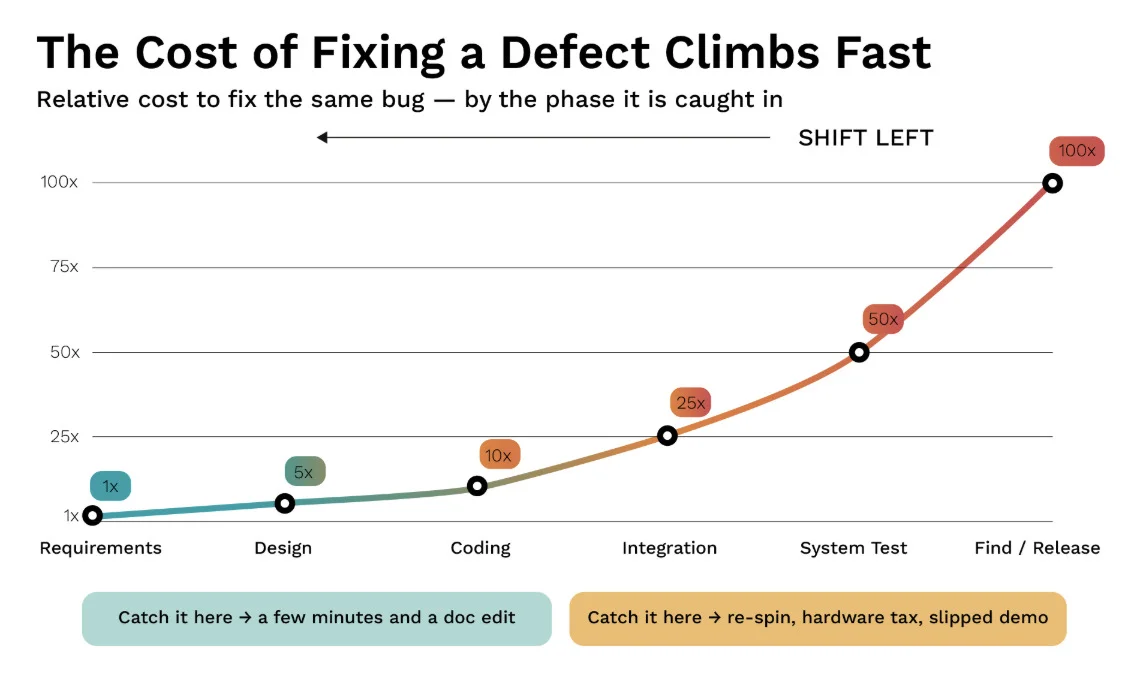
Based on the experiences across multiple embedded and automation projects, fixing an issue during the requirement phase takes minimal effort, while the same issue becomes significantly more expensive and time-consuming if identified during system testing or after release.
The idea of testing earlier is not new. The early reading on the other hand is. Five years ago, the only honest way to review a 200-page requirements document for ambiguity was to put two senior validation engineers in a room for a week. Today, artificial intelligence makes shift-left practical for modern software testing and quality assurance in embedded teams: it is possible to paste the same document into an LLM, ask it to flag every untestable phrase, every hidden assumption and every requirement that lacks an acceptance criterion, and have a triage list before lunch; 81% of development teams now use AI in testing workflows. The output is not gospel; about a third of what comes back has to be set aside. However, the two-third output that survives review is genuinely useful, and it lets the senior engineers spend their day on the calls that actually need a human in the loop.
What “Shift-Left With AI” actually looks like for Embedded Systems Teams
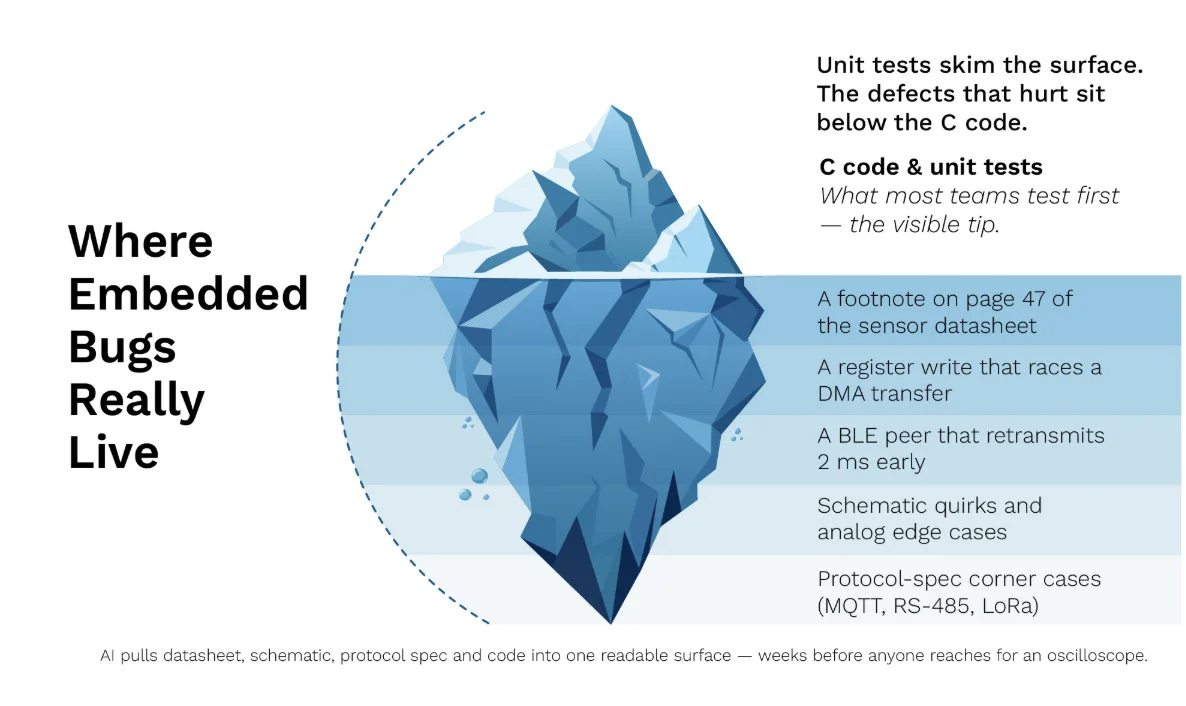
A lot of teams reduce shift-left to a single phrase: write more unit tests, sooner. In firmware that misses most of the iceberg. Across the development cycle, and the overall development process, the bugs that hurt embedded products tend to live below the C code, a footnote on page 47 of a sensor datasheet, a register write that races a DMA transfer, a BLE peer that retransmits two milliseconds earlier than the spec said it would. AI is genuinely useful here because it pulls those layers, datasheet, schematic, protocol spec, code, into a single readable surface, and automated testing supports earlier feedback than manual testing alone, weeks before anyone reaches for an oscilloscope.
Concretely, this is how it shows up in everyday work in my projects. Automated testing increases efficiency, accuracy, and test coverage; the automated testing market is projected to reach USD 55.2 billion by 2028, 78% of successful businesses use it in deployment, it can reduce test cycle duration by over 50%, and average ROI can reach 600%.
- Every new requirement gets a first pass from an LLM that asks two questions on my behalf: is this testable, and does it map back to a hazard in our ISO 14971 file, with static analysis helping surface issues before execution begins?
About 15–20% come back needing rewording before a human even sees them. Shift-left testing improves collaboration between developers and QA teams, though shifting left can still require a team culture change.
- Architecture diagrams and the early FMEA table go in next, and the model’s job is to point out which subsystems are carrying the most weight. We still own the final FMEA, but we no longer start it from a blank page on a Monday morning.
- Unit and integration test scaffolding is drafted by an ai system and reviewed by an engineer, which supports test creation, test generation, and test case generation, instead of the older flow where the engineer typed all of it from scratch and the reviewer skimmed it on a Friday afternoon.
- Virtual targets, QEMU, Renode, vendor simulators, sometimes a hand-rolled Python harness over a CAN-utils stub get exercised with ai generated scenarios long before the first PCB lands on the bench. This is where ai testing tools help generate tests from existing tests, improve test maintenance, and handle self healing tests that cut down on flaky tests. They also help with automatically generating test cases, refining test scenarios, updating test scripts, and focusing execution on relevant tests with the right test data.
- The mountain of nightly logs, which used to drown the on-call engineer, is clustered automatically. We see five distinct test failures instead of five hundred lines of red, and the noisy-but-harmless ones get pushed to the bottom of the queue. Earlier validation improves software quality and leads to a more stable final product. Continuous testing in CI/CD catches regressions from code changes earlier.
- LLM-assisted review is useful for exploratory testing and broader ai testing, especially when generative ai and ai models are automatically generating coverage ideas that manual testers or other human testers may not think to try first. In practice, ai driven testing reduces manual effort and expands coverage, but QA teams and senior reviewers still need to provide oversight.
The Practical Test Automation Pipeline
What follows is not a reference architecture pulled from a whitepaper. It is a working pipeline for AI-driven testing that I have reused, with small variations, on a continuous-glucose monitor, two factory IIoT gateways and one smart-manufacturing controller in the past three years. None of the individual steps are clever on their own. The win comes from running them every single day, not just as a launch checklist.
1. Requirements and risk, before any code is touched
Each new or changed requirement passes through the test of two questions:
- Can a tester actually verify this on real hardware?
- Which hazard from the risk file does it close, if any?
The model proposes wording fixes and a first cut at acceptance criteria. A senior engineer then keeps, edits, or trashes each one. The whole loop typically takes 30–40 minutes per requirements batch, against the day-and-a-half that it used to consume earlier.
2. Code generation, with the safety net wired in
Two house rules apply whenever an AI tool is involved in writing production code.
- If a model touches a safety-classified module, the same must be added or extended to all the tests. That includes unit testing and integration testing, plus test generation from code or spec inputs where the first draft is thin. It also includes test case generation, with the model automatically generating test cases or test scripts from the relevant inputs and expanding existing tests where they improve coverage.
- The engineer accepting the suggestion must be able to explain, in plain English, why it does what it does. If they cannot, the suggestion goes back to the chat.
Both rules exist for one reason. When it is time for the IEC 62304 audit, the trail of who decided what, and why, must read as cleanly as if a human had written every line by hand.
3. Protocol testing, especially the messy parts
Most of the products I work on speak some combination of MQTT, RS-485, BLE GATT and LoRaWAN. For each of them the routine is as follows:
- The relevant section of the spec is fed to a model, and the first pass of normal-path test cases comes back.
- On top of that, an AI-tuned fuzzer hammers the boundaries: malformed CONNECT packets, out-of-order BLE notifications; RS-485 frames that just barely violate inter-byte timing. It also drives exploratory testing with edge scenarios and test data that go beyond the obvious paths.
We routinely catch interoperability bugs in week two of a project that, on older programs, would have first surfaced during the field pilot.
4. Virtual hardware, so the bench is not the bottleneck
We do not wait for the EVT board to start exercising firmware. Instead:
- QEMU, Renode or a vendor simulator runs the same binary that will eventually go with the hardware.
- An LLM drafts the realistic scenarios like packet storms, sensor dropouts, brown-outs, late ACKs that historically only a senior tester would have thought of scripting.
The result is that developers run something resembling a full system test on their laptop, every push, before the first hardware revision is even back from the fabrication. Self-healing tests can reduce test maintenance by adapting to UI or workflow changes automatically, but manual testers still review the outputs.
5. Failure triage, so that the nightly runs stay actionable
When the nightly suite finishes, two things happen automatically.
- Failures with similar stack traces or error fingerprints are clustered into a single ticket.
- A short root-cause hypothesis is attached to each cluster, so the engineer who picks it up in the morning does not start cold. AI testing tools also help surface test failures and flaky tests faster.
The practical effect is that the same flake does not get rediscovered for three mornings in a row, and CI stops being the most expensive on-call rotation in the building.
Keeping The Whole Thing Auditable with AI Testing Tools
Usually, no notified body has a problem with AI in the loop. Its inputs and outputs are logged, its version is recorded, and a named, qualified engineer signs off on what makes it to the build or the relevant tests in the team’s test automation framework.
Under IEC 62304
- If an AI tool can influence either production code or its tests:
- It is treated as a software development tool, identified in the tool list with everything else.
- The basics of name, version, what it is used for, and where we already know it falls short, are recorded.
Under ISO 14971
- Risks in the model surfaces do not get a parallel file of their own. They go into the same risk-management process every other hazard goes through.
- In other words, AI is an input to risk thinking, not a new compartment of it.
Under ISO 13485
- Every engineer who uses these tools has a small competency record, what they were trained on, when, and for what they are cleared to use it.
- Nobody touches an AI suggestion in a regulated module before they have sat through the internal training session and the code-review walkthrough.
Closing Thoughts
Shift-left has been the right answer for twenty years. AI did not invent it, and AI on its own will not be the thing that finally delivers it. At eInfochips, AI is leveraged as an enabler that strengthens shift-left engineering practices by accelerating development and validation workflows. What AI does, very specifically, is take the dull middle layer off the work, the parsing of long requirements, the boilerplate scaffolding, the log-grepping, and the recurring why-did-this-fail-again rituals, then hand those saved hours back to the people who actually move the product: the senior reviewers, the firmware leads, and the validation engineers who can spot a timing bug from thirty paces. In embedded systems development, where every late defect carries a hardware tax that nobody enjoys paying, those reclaimed hours become a meaningful advantage. By combining deep engineering expertise with AI-driven automation, eInfochips helps organizations improve efficiency, accelerate product development, and enhance overall product quality.
Frequently Asked Questions
Q1. Isn’t “shift-left with AI” just code for writing more unit tests earlier?
Not really. In firmware the bugs that hurt me aren’t in the C code they’re in a datasheet footnote, a register racing a DMA transfer, a BLE peer that fires two milliseconds early. AI lets me read the datasheet, schematic, spec and code together, weeks before the board hits my bench, so unit testing starts from clearer assumptions and integration testing doesn’t wait for late surprises. Shift-left was always about timing; AI just made the early reading affordable.
Q2. Where do you let AI work, and where does a human stay in charge?
AI does the boring middle reading long specs, flagging weak requirements, drafting test scaffolding, sorting through logs. It doesn’t decide anything. My rules are simple: touch a safety module and the tests get written too (no tests, no merge), and whoever accepts a suggestion has to explain it in plain English. About a third of what the model gives me gets bound anyway.
Q3. How do you keep this defensible when the auditor shows up?
I don’t build a separate process for AI that’s what gets you in trouble. The tool just sits in the IEC 62304 tool list with its name, version and known gaps. Anything it flags goes into the same ISO 14971 risk file as every other hazard, and under ISO 13485 nobody uses it on a regulated module without training first. The test: the trail should read as if a human wrote every line.
Q4. How do you test MQTT, RS-485, BLE and LoRa before you have hardware?
Two passes. A model drafts the normal-path cases from the spec, then an AI fuzzer goes after the edges malformed packets, out-of-order BLE, RS-485 timing violations. It all runs on QEMU or Renode, in controlled testing environments, on a laptop, every push, then gets checked again on actual hardware when the boards arrive. That’s how I catch interoperability bugs in week two instead of at the field pilot.
Q5. Doesn’t all that testing just bury you in failures nobody reads?
It would, so triage is the last step, not an afterthought. After the nightly run, similar failures get folded into one ticket with a quick root-cause guess attached, which helps QA teams sustain test automation without adding hours. So you see five real failures in the test results, not five hundred lines of red and the same flaky tests stop showing up three mornings in a row.
 Paras Shah