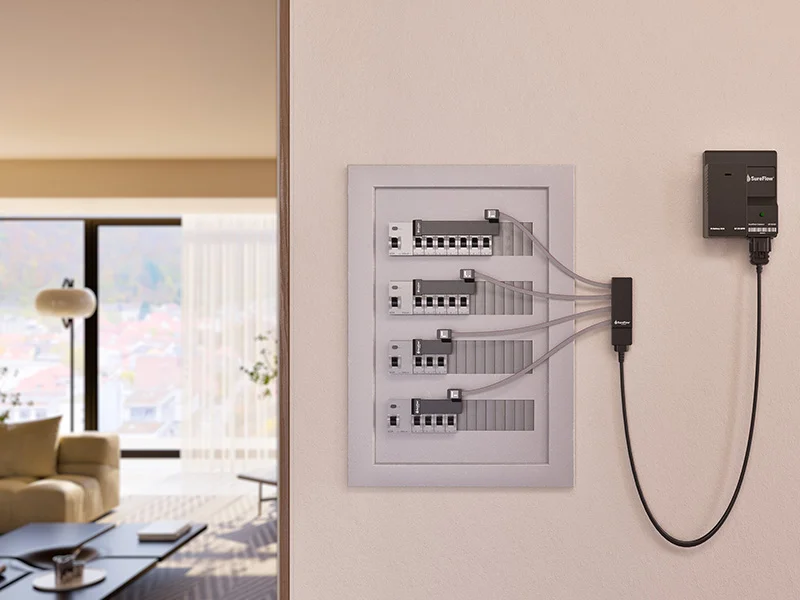
An insight into SureFlow’s Electrical Hub Kit, which uses adhesive, self-install sensors and AI-powered technology to bring circuit-level energy monitoring to homes without an electrician or panel modification.
Residential energy monitoring has long depended on professional installation, panel intervention, and long lead times, and these are barriers that slow adoption just as European households face sustained pressure on energy costs. SureFlow has an answer: the SureFlow Electrical Hub Kit. The kit provides adhesive sensor strips placed directly on top of breakers, connected to a central hub, with no electrician or panel modification required. The result is a monitoring system a homeowner can set up in mere minutes, not weeks, and one that starts learning household consumption patterns immediately.
Installation Complexity: Holds ‘Energy Monitoring’ Back
What stands between a household and real-time electricity data is rarely the technology itself: it’s the logistics of installing it. A qualified electrician must modify the panel and configure everything before a single data point shows up on a screen. That’s days, sometimes weeks, of waiting on a scheduling calendar, plus a labour bill stacked on top. Multiply that by a city trying to roll out monitoring across thousands of homes, and electrician availability alone becomes the bottleneck that stalls the whole program.
SureFlow built the Electrical Hub Kit to sidestep that problem entirely. Here’s how it works:
- Adhesive sensor strips can be installed by the user on the household’s panel and pressed directly onto the breakers, with no modification to the panel itself, and they start working immediately.
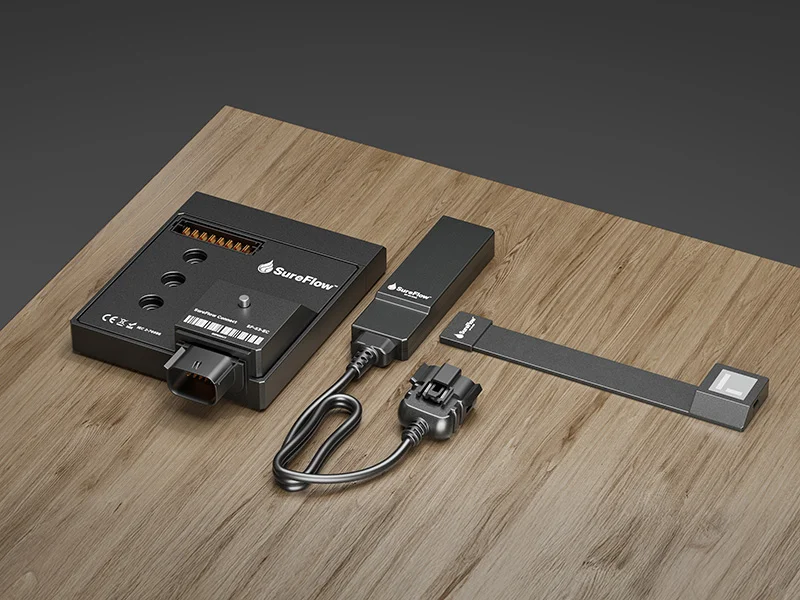
- A central hub connects up to four strips, enough to monitor up to 28 breakers in a single home.
- The readings stream to SureFlow’s servers, where AI learns the household’s consumption habits over time.
By abandoning conventional installation methods, the ceiling on how many homes this program can reach rises accordingly.
Why is the DIY Model a Game-Changer to City-Level Energy Programs?
Convenience is the headline benefit for an individual user. For a city or utility, the stakes are different and higher. Circuit-level monitoring becomes a viable public policy tool only if it can be deployed at scale, and that is where the DIY model earns its relevance.
The self-install system rewrites that equation by removing electrician dependency, lowering costs, shortening timelines, and letting a program reach more households in the same period. The effect is particularly consequential in Europe, where recent years have brought an energy crisis shaped by the continent’s climate and political context:
- Between 2021 and 2025, household electricity prices across the EU jumped by 30%, and gas prices nearly doubled, rising 79%.
That ongoing pressure is why governments and utilities are looking for tools that help households save energy without adding cost or installation complexity.
Sila Egridere, Account Manager, Sustainability, Energy & Building Technologies at Frost & Sullivan, frames the adoption challenge this way:

Achieving national sustainability targets requires more than ambitious policies; it requires meaningful household participation. Fiscal incentives and other public support mechanisms can provide an important starting point, but lasting impact depends on whether people can integrate energy-saving technologies into their homes easily and confidently.
From an adoption perspective, this is where SureFlow’s DIY approach becomes particularly significant. By removing the need for electrical-panel intervention and professional installation, the Electrical Hub Kit reduces one of the main barriers to residential energy monitoring. It transforms circuit-level energy intelligence from a specialist installation into an accessible household tool, with the potential to accelerate adoption and improve the scalability of city- and national-level energy-efficiency programs.
Data to Real Savings: The Features That Let Households See and Act
Installation, though, is just the front door. The real value of SureFlow’s Electrical Hub Kit comes from what happens once data starts flowing: four core features turn circuit readings into something a household can act on.
- The Electrical Panel Monitoring is the foundation of the product. It provides a historical view of every monitored breaker, alongside panel-level totals and trend analysis across day, week, and month. It gives households the baseline picture of where electricity is going, rather than a single aggregate number on a monthly bill.
- Numbers alone don’t always tell the fastest way to spot a problem, but the Energy Consumption Heat Map does. The heat map maps the consumption intensity into a visual layout across the panel and the home, making high-draw zones immediately legible; a household can see where energy is concentrated without reading a single figure.
- The Augmented Reality Breaker View lets users view each physical breaker’s percentage and history, along with its label, through the phone camera. This feature does double duty: it is used first during installation to label the panel accurately, then becomes a permanent diagnostic view for identifying which breaker is drawing power at any given moment.
- The feature that ties it all together is Smart Saving Recommendations. This is where the AI layer is most visible to the user. The system learns each household’s consumption pattern and compares it with the household’s tariff structure, generating recommendations to improve consumption habits and set specific monthly budget goals.
SureFlow v/s the Status Quo: A Comparison
| Factors | Traditional Metering Solutions | SureFlow Electrical Hub Kit |
| Installation | Requires a qualified electrician | DIY installation, no electrician needed |
| Panel modification | Often requires wiring the panel | No panel modification required |
| Installation time | Days to weeks (schedule dependent) | Minutes, same-day activation |
| Circuit coverage | Varies by system | Up to 28 breakers per hub |
| Data intelligence | Varies; often basic usage totals | AI-driven, household-specific consumption analysis |
| Scalability for city programs | Limited by installer availability | Higher, due to abandonment of professional install bottleneck |
Convenience for Homes, Scale for Cities: What’s the Takeaway?
For individual households, the practical appeal is straightforward: circuit-level visibility, actionable recommendations, and a setup process that doesn’t require booking a technician or complicated panel modification.
Key takeaways for households:
- Monitoring up to 28 breakers per hub gives a detailed view of consumption across most residential panels.
- The AI layer’s value grows over time, as recommendations are built on learned household consumption patterns.
- The Augmented Reality Breaker view doubles as both an installation aid and an ongoing diagnostic tool.
- Removing electrician dependency is as much a program-scalability lever as it is a convenience feature.
For cities and utilities, the appeal runs deeper; it’s structural. SureFlow packages its capabilities into ‘Programs’: a bundle of capabilities, each one to hit a specific goal. Today, SureFlow offers 28 Programs across 7 categories. The ones built around electricity cover goals from reducing fire risk to managing grid load and so on. SureFlow goes a step further by offering a pilot program, giving a chance to test the model at a smaller scale first.
Key takeaways for cities and utilities:
- SureFlow’s “Do It Yourself” approach: Removes the technician bottleneck and labour costs, enabling scale to thousands of homes.
- Core features: Panel monitoring, heat maps, breaker view, and AI-driven recommendations deliver granular, household-level visibility.
- SureFlow Programs: Built around major objectives that cities and utilities juggle, this initiative lets sponsors pick one or several aligned with existing priorities.
- Pilot program: Cities and partners can test the model at a smaller scale first, before committing to a city-wide rollout.
- Cost and timeline advantage: Lower cost per household, faster rollout, more homes reached per budget cycle.
The Bigger Picture
Peel back the technology, SureFlow’s real achievement is simpler: it made energy monitoring as accessible as a weekend task. That’s what wins in terms of innovation and scalability.

Mr. Sebastien Dui, SureFlow’s visionary founder, sees it going even further. His vision is to have SureFlow as the “invisible layer of intelligence behind every city and every building, which is accessible to all.” The point, he says, is proximity: “bringing this technology closer to people… particularly in the most vulnerable communities.” And that’s the real bet.
As Europe’s energy-cost pressures persist, SureFlow’s DIY model points to where energy-efficiency policy is heading fewer dependencies, faster rollouts, and monitoring that fits directly into a household’s daily life, which in turn helps solve the crisis.