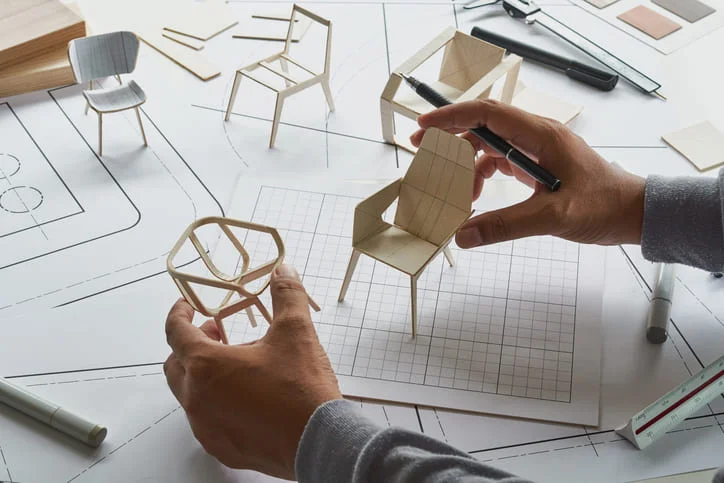
The core issue in product design activities lies in resolving the relationships among various systems—such as the product and people, the product and the environment, the product and culture, and the product and economic benefits to achieve practical, economical, beautiful, safe, comfortable, and environmentally friendly new products. Among these, elements such as aesthetics, safety, and comfort belong to perceptual analysis factors, which require physical experience to be evaluated and further modified and perfected in the design scheme. Product prototyping is the work process carried out for this exact purpose.
What is A Prototype?
A prototype is known in the industry as a sample part. This is a crucial step in the product design workflow. In the later stages of product design, prototypes are primarily used to verify the appearance and structural design of the product, while also providing production data for mass production processes like mold making and injection molding.
The product design and R&D capabilities of enterprises have significantly improved, leading to the gradual increase and expansion of prototyping companies. The demand for talent familiar with prototyping materials, processes, methods, and technologies continues to grow. Currently, this field has heavily penetrated the R&D of industrial products such as aerospace, automotive, electrical appliances, and furniture.
Learning prototype making holds significant value on multiple levels:
- Personal Professional Learning: It helps us become familiar with product structures and learn how to translate product designs from 2D drawings into 3D physical objects.
- Personal Career Development: It meets the strong demand for talent from professional prototyping companies, filling the vacancy for industrial design prototyping professionals.
- Industry Development: It elevates the professional standard of the entire prototyping industry, pushing China’s product design and R&D capabilities to the forefront of the world.
Significance of Product Prototyping
Verifying product appearance design: Because the product prototype is not only visible but also tangible, it can intuitively reflect the designer’s creativity in physical form, avoiding the pitfall of looking good on paper but looking bad in reality.
Verifying product structural design: Since the product prototype is assembled after individual components are manufactured, it can intuitively reflect whether the product structure is reasonable and how difficult the installation is. This helps designers discover structural design issues early on.
Avoiding the risks of direct mold making: Mold manufacturing costs are extremely high; larger molds can cost hundreds of thousands or even millions. If structural flaws or other issues are only discovered during the mold development process, the losses are unimaginable. Creating a prototype before opening the mold can prevent such losses and reduce mold-making risks.
Significantly advancing Time-to-Market: To shorten the R&D cycle and accelerate market entry, many enterprises will use prototype models to participate in product exhibitions, conduct various product promotions, or even initiate preliminary pre-sales concurrently with official product manufacturing.
Overview of Product Prototyping Classifications
Product prototyping is generally divided into three main categories: Manual prototyping, CAD/CAM prototyping, and rapid prototyping.
Manual Prototyping
Many industrial designers and teachers believe that traditional manual prototyping has lost much of its practical significance, and they are even dismissive of creating rough creative models. However, practice has proven that ignoring the role of models in reconciling the contradictions between rationality and perception, as well as visual and tactile senses in a product scheme, will inevitably affect the outcome and efficiency of the design. Therefore, in the conceptual R&D design stage, manual prototyping is necessary. A well-crafted model provides the best evaluation basis for designers and project evaluators. Manual prototyping can generally be divided into 3 types:
Concept Model
The prototype of a product idea, focusing on the overall form and volume relationships without getting overly entangled in details. The characteristic is making it while thinking, expressing ideas in the fastest way possible, and being easy to modify. The creative model stage is the most convenient, fastest, and most effective model-making stage, making it a critical phase in design. It helps designers think thoroughly and materialize their concepts into physical forms. It is generally made directly with materials like foam or plaster.
Working Model
A physical object that focuses on demonstrating the functional design of the product. While a large amount of design work is reflected in 2D drawings through views, a working model is needed to verify whether the structure and function, the function and form, and the detailed functional treatments are reasonable. It is generally made of materials like ABS or modeling clay.
Prototype Model
The final stage of product design, this model fully demonstrates the appearance, structure, and function of the product. It must not only possess a realistic visual effect but also demonstrate the product’s usability. In the design of large-volume products like home appliances and vehicles, a 1:1 large-scale prototype model is usually required, commonly made of materials like ABS or modeling clay.
CNC Machining
The cutting tools used are no different from ordinary mechanical processing. The difference lies in the fact that the materials milled are primarily plastics like ABS, PC, and PMMA. After 3D data is programmed via CNC machining software and output to the CNC machine, the required semi-finished products can be processed. These semi-finished products then undergo processes like polishing, painting, and electroplating to complete the final sample. CNC machining is the best approach for displaying and verifying appearance and functionality, and the results can rival the official final product.
Vacuum Casting
It is also known as a vacuum mold. This is the process of defoaming, stirring, preheating, and casting the pouring material under vacuum conditions, followed by a secondary curing process in a constant temperature oven at 60~80°C for 2 to 3 hours. It is suitable for small-batch trial samples with relatively complex structures, uniform wall thickness, and certain functional requirements during the product development process. It is mainly divided into silicone casting prototyping and resin casting prototyping.
Reaction Injection Moulding
This is a new process applied to rapid mold product manufacturing. It mixes two-component polyurethane materials and injects them into a rapid mold at room temperature and low pressure. The product is formed through chemical and physical processes such as polymerization, cross-linking, and curing of the materials. It boasts advantages of high efficiency, short production cycles, simple processes, and low costs. It is suitable for the trial production of small batches of simple structural covers, as well as large thick-walled or uneven wall-thickness products.
Rapid Prototyping
Rapid Prototyping technology emerged in the late 1980s. Based on the material accumulation method, it is a high-tech technology considered to be a major achievement in manufacturing over the past 20 years. It integrates mechanical engineering, CAD, reverse engineering, layered manufacturing, numerical control, materials science, and laser technology. It can automatically and accurately transform design ideas into functional prototypes or directly manufacture parts, thereby providing a highly efficient and low-cost implementation method for part prototyping and the validation of new design concepts.