
Player support now sits on the front line of gambling compliance. In 2025 to 2026, Great Britain’s licensed operators recorded 20,497,383 customer interactions, which the Gambling Commission counts as cases where a licensee has identified that a customer might be experiencing gambling-related harm. Ninety-six percent of those interactions were indirect rather than direct. Many of these moments start in a support chat, so the software behind that chat now carries regulatory weight.
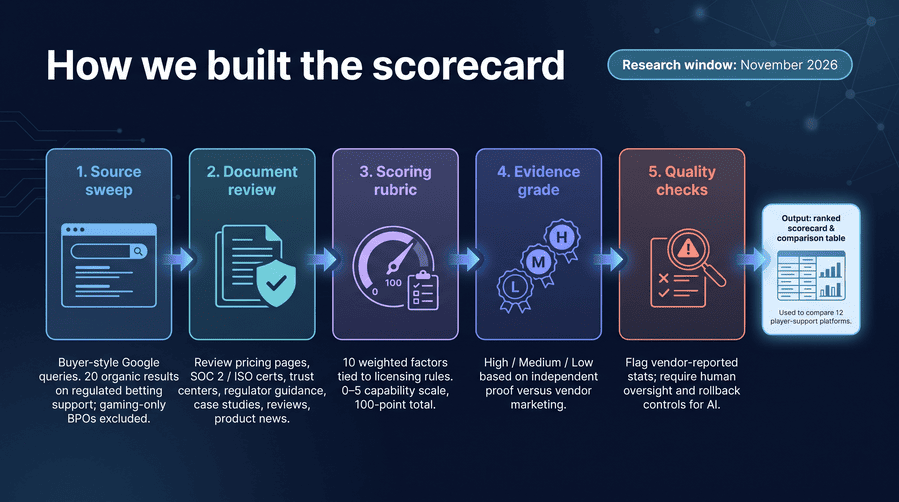
This guide compares six platforms that operators shortlist for player support. For each one we checked the vendor’s own pages in November 2026 for channels, AI capability, compliance claims and published pricing, and we flag where a figure is the vendor’s own claim rather than independent evidence.
How we compared the platforms
We looked at each vendor’s own product, pricing, security and gaming pages in November 2026. Prices are in US dollars per agent per month on annual billing unless we say otherwise. Where a performance figure comes only from the vendor, we say so, because two platforms can look alike on paper yet differ sharply in how much independent proof sits behind their claims. Treat the comparison as a shortlist, not a verdict: your own proof of concept and legal review should finish the job.
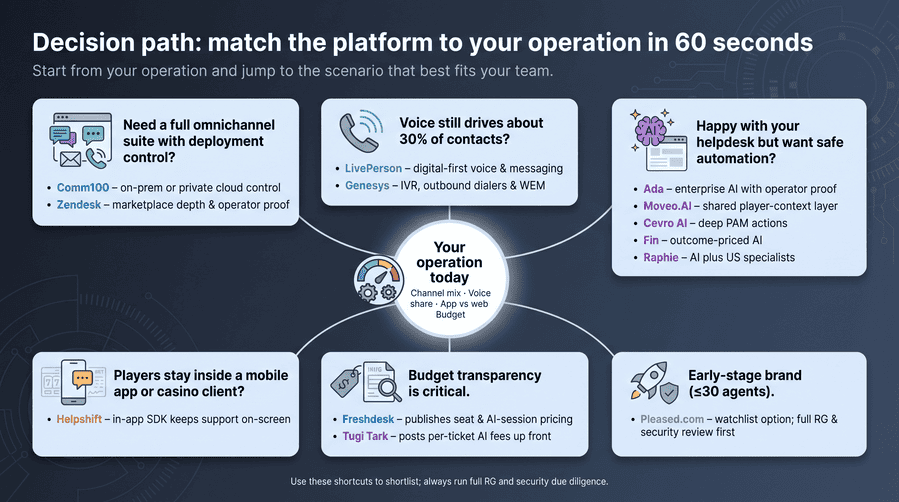
Four product camps operators buy
Search for “iGaming support software” and you will find very different products side by side. In practice, operators choose from four categories:
- Full-suite helpdesks. Comm100, Zendesk and Freshdesk bundle live chat, ticketing, email and messaging in one console, with AI options on top.
- Enterprise conversational platforms. LivePerson focuses on large-scale messaging and voice, orchestrated with AI agents.
- AI overlays. Cevro and Fin (formerly Intercom) put an AI agent in front of player queries and hand the rest to human agents.
- Embedded in-app tools. SDKs that keep support inside a mobile app; useful for app-first brands, but outside the scope of this shortlist.
Placing vendors in a camp first prevents unfair comparisons. A 20-agent operator choosing between a helpdesk and an AI overlay is really deciding whether to replace its current desk or extend it.
Quick comparison
| Platform | Camp | Best for | Published pricing |
| Comm100 | Full-suite helpdesk | Regulated operators that want deployment control and iGaming-specific AI | Live chat seats yes; AI by quote |
| Zendesk | Full-suite helpdesk | Teams that want a large app ecosystem and built-in AI agents | Yes |
| Freshdesk | Full-suite helpdesk | Budget-conscious teams that want every rate published | Yes |
| LivePerson | Enterprise conversational | High-volume messaging plus voice | No, custom quotes |
| Cevro | AI overlay | iGaming-specific automation on top of an existing desk | No, outcome pricing by quote |
| Fin (formerly Intercom) | AI overlay | Outcome-priced AI for digital-first teams | Yes |
Comm100: regulated omnichannel control
Comm100’s AI player support for online gaming operators puts an AI Agent in front of routine questions about deposits, withdrawals, account balances and account verification, and escalates complex cases and high-value players to live agents with the player’s context attached. Negative sentiment also triggers an escalation to a live agent.
Why it’s on the shortlist. Live chat, email, SMS, WhatsApp and Telegram run through one agent console, and operators can choose cloud hosting or a full on-premises deployment. Comm100 lists SOC 2 Type II, ISO 27001, PCI DSS and GDPR among its certifications and compliance programmes, and says it supports more than 1,200 iGaming operators.
Responsible gambling support. On its gaming page, Comm100 says AI Insights flags responsible gaming indicators such as distressed language and mentions of financial stress, and AI Copilot gives agents responsible gaming compliance prompts. Its AI Quality Assurance scores chats against the operator’s own rubric, and the operator decides how much of the chat volume gets reviewed. Every score comes with an explanation, and a QA result can become a coaching item with one click.
AI that stays on script. Comm100 says its AI Agent answers only from the operator’s verified knowledge sources rather than from a pre-trained model’s memory, and hands a conversation to a human with a summary when it is not confident. For iGaming, it names integrations with Optimove and Realtime Gaming, alongside CRM tools such as Salesforce and HubSpot, and offers cloud data centres in the US, Canada, Germany and Singapore.
Pricing. Live Chat Startup costs $39 per agent per month, or $31 billed annually; Plus costs $69, or $55 annually. The AI products, ticketing and voice are priced by quote.
Watch for. Comm100 puts AI Agent resolution at 60 to 80 percent of routine inquiries in iGaming. Treat that as a vendor benchmark to test in your own pilot. Comm100 is also a partner of Cevro, profiled below, so the two can be combined.
Zendesk: ecosystem depth with built-in AI agents
Why it’s on the shortlist. Zendesk Suite brings chat, email, social messaging and voice into one workspace, with a large marketplace of integrations. In March 2026 Zendesk completed its acquisition of Forethought and now sells the technology as Forethought AI Agents by Zendesk, covering chat, email and voice.
Pricing. Suite Team costs $55 per agent per month billed annually ($69 monthly) and includes five automated resolutions per agent each month. Suite Professional costs $115 annually ($149 monthly) and includes ten. Extra automated resolutions cost $1.50 each on a committed plan or $2.00 pay as you go. Copilot is a $50 per agent add-on, billed annually, on Professional and above.
Watch for. The admin centre is powerful but takes time to configure for multi-brand operations and responsible gambling rules. With the Forethought products now folding in, confirm feature names and availability in writing before you sign.
Freshdesk: transparent pricing for cost-conscious teams
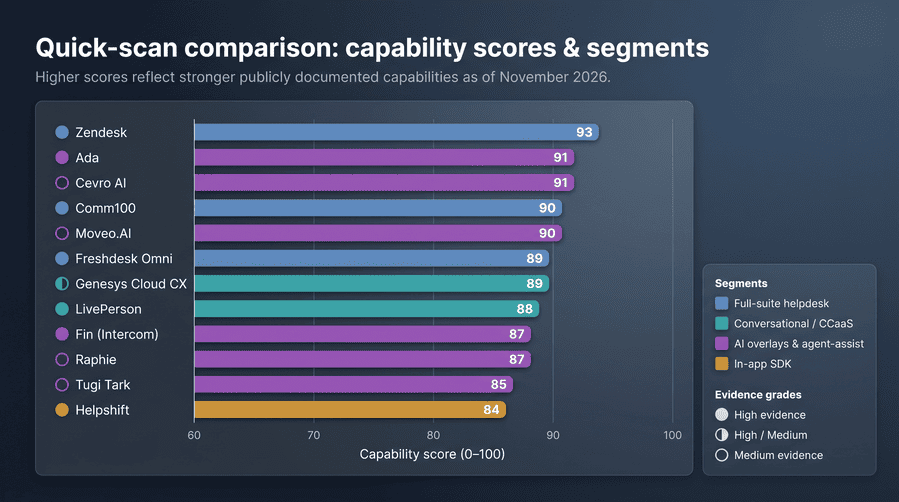
Why it’s on the shortlist. Freshdesk publishes its prices before you book a demo, which is still rare in this market. Its plans combine ticketing, multichannel inboxes and Freddy AI, which makes budget forecasting easier for smaller operators.
Pricing. Growth costs $19 per agent per month billed annually, Pro $55 and Enterprise $89. Each plan includes the first 500 Freddy AI Agent sessions; after that, every 100 sessions cost $49. Freddy AI Copilot is $29 per agent per month on Pro and Enterprise.
Watch for. Freshdesk is a general-purpose helpdesk, so licensed operators should expect to build their own withdrawal, verification and responsible gambling workflows. Ask exactly how an “AI session” is counted during a long multi-message chat before you model costs.
LivePerson: enterprise messaging with voice
Why it’s on the shortlist. LivePerson is built for high-volume conversations and says it handles more than a billion messages a month. It brings voice and messaging together and orchestrates AI and human agents across channels. Operators can bring their own large language model, and its Syntrix tool simulates thousands of customer interactions to validate AI agents before launch. SoundHound AI completed its acquisition of LivePerson on September 4, 2026.
Pricing. LivePerson does not publish prices; quotes depend on volume and channel mix. Push for line-item clarity on voice minutes and AI usage.
Watch for. LivePerson says it maintains compliance with regulations such as GDPR, HIPAA and PCI DSS, but its homepage does not list certifications, so request audit reports during due diligence. With the SoundHound integration under way, confirm the product roadmap for the length of your contract.
Cevro: iGaming-specific AI automation
Why it’s on the shortlist. Cevro builds AI agents specifically for iGaming support. Its agents handle KYC, payment and responsible gambling queries, resolve what they can and escalate the rest, and the company says the platform plugs into all major player account management systems. Cevro is a Comm100 partner: the two announced their partnership in January 2026, with Cevro supplying autonomous AI agents and Comm100 the AI-assisted human support layer.
Data handling. Cevro states that its platform is SOC 2 Type II audited, that player data is processed in real time and then discarded, and that it does not train models on player data. Sensitive player data is obscured, replaced or encrypted.
Pricing. Cevro describes outcome pricing by ticket volume and does not publish figures.
Watch for. Cevro’s own site gives two automation figures, up to 90 percent of inquiries resolved and up to 80 percent of player requests handled end to end. Ask which definition applies to your traffic and request operator references in your jurisdictions.
Fin (formerly Intercom): outcome-priced AI
Why it’s on the shortlist. Fin charges for its AI agent only when it delivers an outcome, which appeals to operators worried about runaway AI costs. An outcome is counted when a customer confirms the issue is resolved, stops asking for help after Fin responds, or Fin completes a workflow, and each conversation is charged once. Salesforce agreed in June 2026 to acquire Fin for about $3.6 billion and completed the deal on September 10, 2026.
Pricing. Seats cost $19 (Essential), $85 (Advanced) or $132 (Expert) per user per month on annual billing. Fin costs $0.99 per outcome, and Fin Voice is available through sales at $1.99 per voice outcome. Copilot is $29 per agent per month billed annually.
Watch for. Outcome pricing scales with success, so a major sporting weekend that doubles resolutions also doubles the AI bill. With the Salesforce deal pending, ask how contracts and product plans will carry over.
Pricing and total cost of ownership
Seat licences look tidy on a spreadsheet, but every platform adds four cost buckets on top: AI usage, channel usage, implementation and ongoing admin.
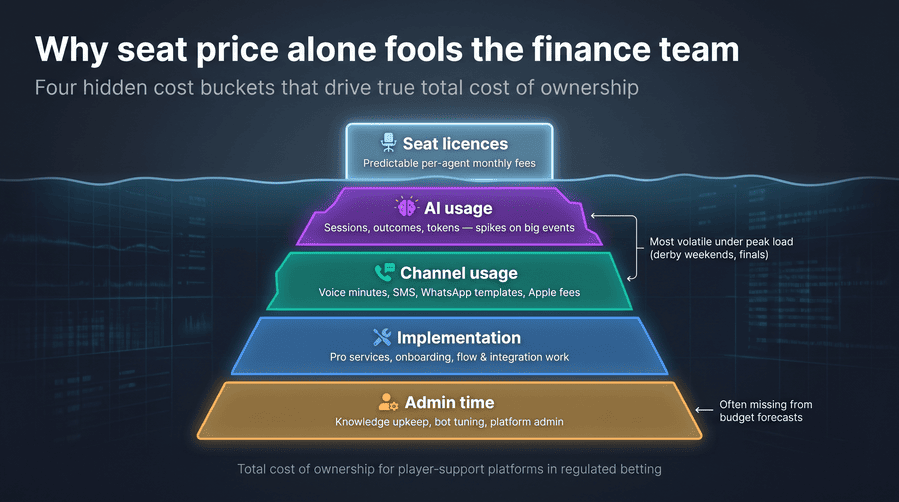
AI usage is the most volatile. Vendors bill by session, outcome or resolution, and those units behave differently under load. A long withdrawal query may count as one session at Freshdesk, one outcome at Fin or one automated resolution at Zendesk. Model an average month, a major-event month and a worst case before you sign.
Channel usage comes next. Voice minutes, SMS and WhatsApp templates carry carrier fees that many rate cards leave out.
Implementation is rarely free. Enterprise platforms charge professional-services days, and AI overlays need clean knowledge content and working API connections to payment and account systems.
A simple example shows how fast usage changes the picture. A 20-agent team on Zendesk Suite Team pays 20 × $55 = $1,100 a month in seats, which includes 100 automated resolutions. If AI resolves 1,000 conversations in a month, the other 900 cost 900 × $1.50 = $1,350 on a committed plan, for a total of $2,450. The same team on Fin Advanced pays 20 × $85 = $1,700 in seats plus 1,000 × $0.99 = $990 in outcomes, or $2,690. Double the AI volume for a major tournament and the AI line roughly doubles too.
Admin time is the hidden salary cost. Every AI agent needs a knowledge owner and every workflow a maintenance plan, so budget people, not just licences.
Regulatory and security checklist
Regulators now ask whether your tools know when to escalate. Great Britain’s licence conditions include a social responsibility code on remote customer interaction, and the Gambling Commission’s guidance, in effect since October 31, 2023, expects operators to identify, act on and evaluate signs of harm, and to show that their approach works. Requirement 12 looks at whether individual interactions changed a customer’s gambling, and Requirement 13 at whether the operator’s overall approach is effective, with outcomes it can demonstrate. In the EU, the AI Act’s transparency rules under Article 50 apply from August 2, 2026, so people must be told when they are dealing with an AI system.
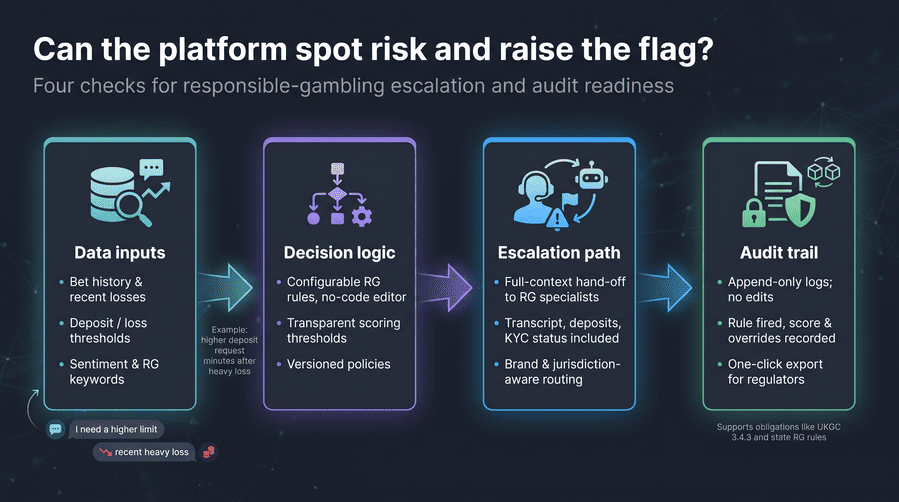
Test every shortlisted platform against four questions:
- Data inputs. What player data can the platform see, such as payment status, deposit limits and previous interactions? A tool that sees only the current chat will miss the pattern.
- Decision logic. Can your responsible gambling team edit escalation rules without an engineering ticket?
- Escalation path. Does the hand-off carry the full transcript, account status and any previous responsible gambling notes?FF
- Audit trail. Can you export a record of what the system did, which rule fired and who overrode it, and keep it for as long as your strictest licence requires?
How to choose
- Need one console with deployment control and iGaming-specific AI? Start with Comm100, and add Cevro if you want a dedicated AI agent layer.
- Want a broad ecosystem with built-in AI agents? Look at Zendesk.
- Need every price published? Freshdesk and Fin publish their AI rates up front.
- Running high messaging and voice volumes? LivePerson is built for that scale.
- Want to pay only for AI outcomes? Compare Fin’s per-outcome model with your expected resolution volume.
- Operating in several regulated markets? Weight deployment options, data residency and audit exports above feature count.
Put the same five questions to every vendor on your shortlist:
- What exactly is billed? Ask for the AI unit in writing (session, outcome or resolution) and how a conversation that starts with AI and ends with a human is counted.
- What happens at peak? Ask for a written cost model for an average month and for your busiest event month.
- Where does player data live? Confirm hosting regions, retention settings and whether any data is used to train shared models.
- How does escalation work? Watch a live hand-off from AI to a human and check what context the agent receives.
- What can you export? Ask to see a full conversation record, including automated steps and human overrides, exported in the format your compliance team uses.
Then run a proof of concept on redacted real tickets that include a delayed withdrawal, a failed verification and a responsible gambling cue, and check the audit trail at the end. The platform that handles all three cleanly, at a cost you can forecast, deserves the contract.
FAQ: quick answers to common operator questions
What is player support software for sports betting and gaming operators?
It is a helpdesk, messaging and AI stack configured to handle withdrawals, verification, responsible gambling checks and regulator-ready records.
How does it differ from a standard helpdesk?
A standard desk logs tickets. A player support setup also needs access to account status, deposit limits and responsible gambling history, and must escalate and record high-risk conversations.
Can AI safely handle responsible gambling conversations?
Only with guardrails. The AI should disclose that it is AI, detect risk cues, hand off to a human with full context and log every step.
What does player support software cost?
Published seat prices among these six run from $19 to $132 per agent per month on annual billing, before AI usage. AI adds per-session, per-outcome or per-resolution fees, for example $0.99 per Fin outcome or $1.50 per extra Zendesk automated resolution on a committed plan.
Which of these platforms work as an overlay on an existing helpdesk?
Cevro and Fin can sit in front of an existing desk. Comm100, Zendesk and Freshdesk are full helpdesk platforms, and LivePerson is an enterprise conversational platform.
Disclaimer: This article contains sponsored marketing content. It is intended for promotional purposes and should not be considered as an endorsement or recommendation by our website. Readers are encouraged to conduct their own research and exercise their own judgment before making any decisions based on the information provided in this article.