


By Akihiko Morita, Ph.D., PCC
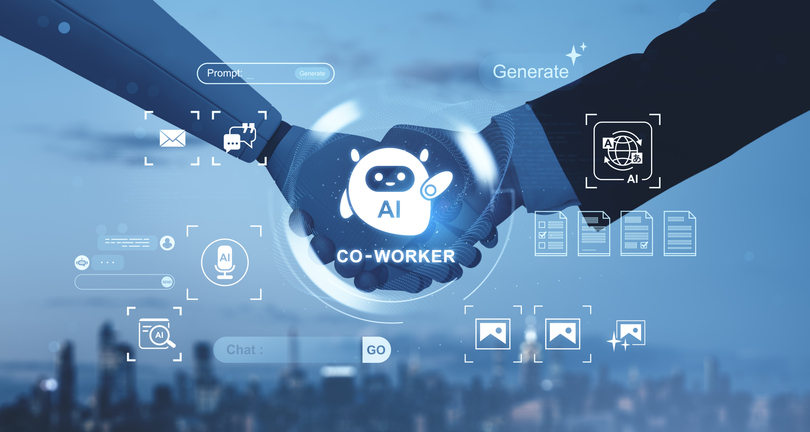
As AI becomes part of organizational decision-making, leaders must rethink not only how work is divided, but also how different forms of intelligence can belong together.
From Redesigning Work to Redefining Organizations
The next frontier of AI-driven organizational transformation may not be the redesign of work, but the redesign of belonging.
As artificial intelligence moves beyond automating individual tasks, organizations are beginning to reconsider how responsibilities, decisions, and accountability should be distributed between humans and intelligent systems.
In her recent article, From Task Change to Organizational Change: AI and the Redesign of Work, Jennifer Mayo proposes examining AI’s organizational impact at five interconnected levels: task, role, workflow, team, and operating model.
Her framework captures a fundamental transition. AI is no longer merely improving the efficiency of existing organizations. It is challenging the assumptions upon which those organizations were designed.
Yet a deeper question is emerging: What happens when AI is no longer experienced simply as a tool, but increasingly as a participant in the organizational community?
When an AI Clone Disagrees with Its Human Original
An intriguing example comes from NEC Corporation in Japan.
NEC has been pursuing a transformation toward becoming an AI-native company. Its initiatives include an AI-based representation of President and CEO Takayuki Morita, developed using information derived from his statements and employed to provide management-oriented feedback.
In August 2026, NEC also announced the establishment of an experimental AI-driven organizational unit in which AI agents assume roles ranging from department head to employee, while humans retain final decision-making and governance responsibilities.
During an online seminar introducing NEC’s initiatives, I was particularly struck by an executive’s observation that the CEO’s AI clone sometimes expressed opinions different from those of the human CEO. Rather than regarding these differences merely as errors, the executive described them as interesting.
This raises a provocative possibility.
If the purpose of an AI clone is to reproduce the thinking of its human original, disagreement might appear to indicate imperfect replication. But if AI is regarded as a potential collaborator, disagreement may become a source of value.
The significance is not that AI has necessarily developed independent consciousness or intentions. Differences in output can arise for many technical reasons.
Rather, the opportunity lies in what happens when those differences become the starting point for dialogue.
A human leader may reconsider an assumption, discover an alternative, or reach a judgment that neither the human nor the AI would have produced alone.
This is what I call co-generation: the emergence of new understanding, judgment, or possibilities through interaction.
From Collaboration to Belonging
There is another dimension to this transformation that deserves greater attention.
Imagine employees beginning to regard an AI colleague not simply as a sophisticated system, but as a different kind of intelligence participating in their shared organizational life.
The AI is not human. It may have no subjective experience. Its legal status, accountability, and capacities differ fundamentally from those of human employees.
Nevertheless, people may begin to experience it as part of their working community.
Two seemingly contradictory perceptions can coexist:
You are different from us. Yet you belong with us.
This does not establish that AI possesses moral personhood or rights equivalent to those of humans. Nor does it require resolving the philosophical question of machine consciousness.
It points instead to an emerging social phenomenon: humans may develop new forms of organizational relationships with non-biological intelligence.
I propose extending the conversation about organizational redesign through a sixth dimension:
Community and Relational Identity: Who are we, and who belongs to the organizational community?
This dimension goes beyond allocating tasks or designing workflows. It concerns the organization’s shared identity, culture, and understanding of participation.
It suggests a possible evolution toward what we might call the Relational Organization: a community in which different forms of intelligence contribute to collective learning and decision-making while remaining fundamentally different.
The Paradox of Inclusion
However, this possibility introduces a profound challenge.
Diversity does not automatically produce inclusion.
Human history demonstrates that differences in identity, status, culture, and perceived interests can generate exclusion as readily as cooperation.
People who experience economic insecurity, declining social status, or a loss of control may respond to expanding diversity by seeking stronger boundaries around familiar communities.
AI could intensify these tensions.
Unlike many previous forms of organizational diversity, AI may be perceived not only as different but also as directly competing with humans for their jobs, professional identities, and opportunities.
A professional who has invested decades in acquiring expertise may understandably question their value when an AI system performs similar work more rapidly.
For such an individual, being told to welcome AI as a new colleague may feel less like an invitation to inclusion than a demand to accept displacement.
This reveals an essential principle:
The inclusion of non-human intelligence may depend on how successfully organizations secure human belonging.
Without dignity, meaningful participation, economic fairness, and a sense of agency, appeals to human–AI coexistence may prove unconvincing.
Organizations must therefore address not only technological adoption but also the distribution of its benefits, the protection of human decision-making, and the legitimacy of change.
Belonging cannot simply be declared by management. It must be experienced through relationships and supported by institutions.
A New Mission for Human Coaching
This transformation also suggests an emerging role for human coaches.
At the EMCC Global Annual Conference in 2026, I proposed three areas in which human coaching could contribute to an AI-shaped society: supporting individuals experiencing identity crises, facilitating human–AI coexistence, and cultivating the values needed for AI-supported digital public spaces.
These responsibilities can be understood through three interconnected forms of transformation.
Personal Transformation concerns helping individuals reconsider their identity, dignity, and agency as AI changes the meaning of professional competence and contribution.
Relational Transformation concerns developing the capacity to engage constructively with fundamentally different intelligence, transforming disagreement and uncertainty into opportunities for dialogue and co-generation.
Community Transformation concerns facilitating organizational cultures characterized by participation, fairness, inclusion, and collective learning.
These roles do not require coaches to persuade people that AI adoption is inherently desirable. Indeed, responsible coaching must preserve the freedom to question or oppose organizational decisions.
Nor can coaching substitute for fair labor practices, accountable leadership, or institutional protections.
Its distinctive contribution lies in enabling people to participate consciously and meaningfully in transformations that might otherwise be imposed upon them.
In this sense, human coaching may evolve from supporting individual performance toward facilitating personal, relational, and community transformation.
Toward Organizations of Diverse Intelligences
The future of organizations will not be determined solely by how efficiently human and artificial intelligence divide their responsibilities.
It will also depend on whether organizations can cultivate relationships in which differences become sources of learning rather than threats to identity.
This does not imply treating AI as human or prematurely attributing consciousness to it. It means recognizing that the social consequences of human–AI interaction deserve attention alongside technical capabilities and economic performance.
The fundamental leadership question may therefore shift.
Not simply: How should we organize work between humans and AI?
But also: How can fundamentally different forms of intelligence participate in a shared community without undermining human dignity, agency, or belonging?
Our ability to answer that question may shape not only the next generation of organizations, but also the kind of society we become.


