Energy procurement has grown too complex for most businesses to manage alone, but a broker only earns its fee by proving its numbers.
In a market with 65 active suppliers and pricing few in-house teams have time to unpick, 60% of all UK small businesses use an energy broker to buy power and gas. John Haw, chair of the Energy Consultants Association, explains how brokers earn their place by replacing guesswork with market access and negotiating leverage. The catch is that value has to be provable, whether the claim concerns fees or environmental credentials.
Why do business need broker expertise?
The UK’s non-domestic energy market’s many suppliers each offer different rates, contract lengths and add-on services – not a straightforward landscape to navigate even in calm conditions. This summer made that harder still: in September, UK gas prices hit the highest levels since 2022 as the conflict in the Middle East and disrupted shipping through the Strait of Hormuz continues. It’s a reminder that business energy pricing can shift sharply with little warning.
A YouGov survey of over 1,000 UK SME decision-makers, commissioned by Octopus Energy for Business and published in September 2026, found that 47% believe they could save money if energy pricing and contracts were easier to understand, while only 27% feel confident they understand how their own bill is calculated. Just 18% trust their supplier to offer fair pricing, and 46% describe the market as confusing or unfair.
Negotiation matters too, and most businesses aren’t doing it. Research from npower Business found that three-quarters of UK SMEs don’t negotiate with their energy supplier before signing a contract, yet 93% of those who do negotiate say they see clear value in it.
This is where brokers step in, bringing market access, supplier relationships and negotiating leverage most businesses can’t build in-house. Ofgem estimates there are at least 2,000 TPIs, working with around 60% of larger non-domestic customers and 25 to 30% of smaller businesses. Comparing quotes properly, across standing charges, pass-through costs and exit terms, can take days rather than hours for a business without a dedicated energy manager.
Where does broker value turn into risk?
Commission is a normal and fair way for brokers to get paid, and it’s how the vast majority of the sector operates well. It lets a business access broker expertise without paying a separate advisory fee upfront. The only time it becomes a problem is when it isn’t disclosed.
Most brokers aren’t paid directly by the business. They’re paid commission by the supplier, usually folded into the unit rate the business pays for every kilowatt hour of energy it uses across the life of the contract.
That structure only works fairly if the business knows what it’s paying for. The same Octopus Energy for Business survey found that 25% of SME decision-makers don’t know brokers may receive commission at all, rising to one in three among micro-businesses. Some 77% said broker commission should be clearly disclosed.
Ofgem’s own market review, has looked at where standards can slip, including mis-selling, pressure selling and lack of transparency in parts of the sector. Brokers welcome that scrutiny. Higher standards across the board are good for the businesses using brokers and good for the brokers doing it properly.
Green claims carry a similar risk. A broker marketing a supplier’s tariff as green or 100% renewable is repeating a claim it needs to be able to back up. Under the Competition and Markets Authority’s Green Claims Code, environmental claims have to be accurate, substantiated and clear about what’s actually being purchased, whether that’s Renewable Energy Guarantees of Origin, a direct power purchase agreement, or something else entirely. A broker that can’t explain the difference is passing on a claim it hasn’t tested itself.
What makes a good energy broker?
Businesses should treat broker selection like any other high-value supplier decision. That means running the same due diligence they’d apply to hiring an accountant or a legal adviser, before signing anything.
Before appointing a broker, businesses should:
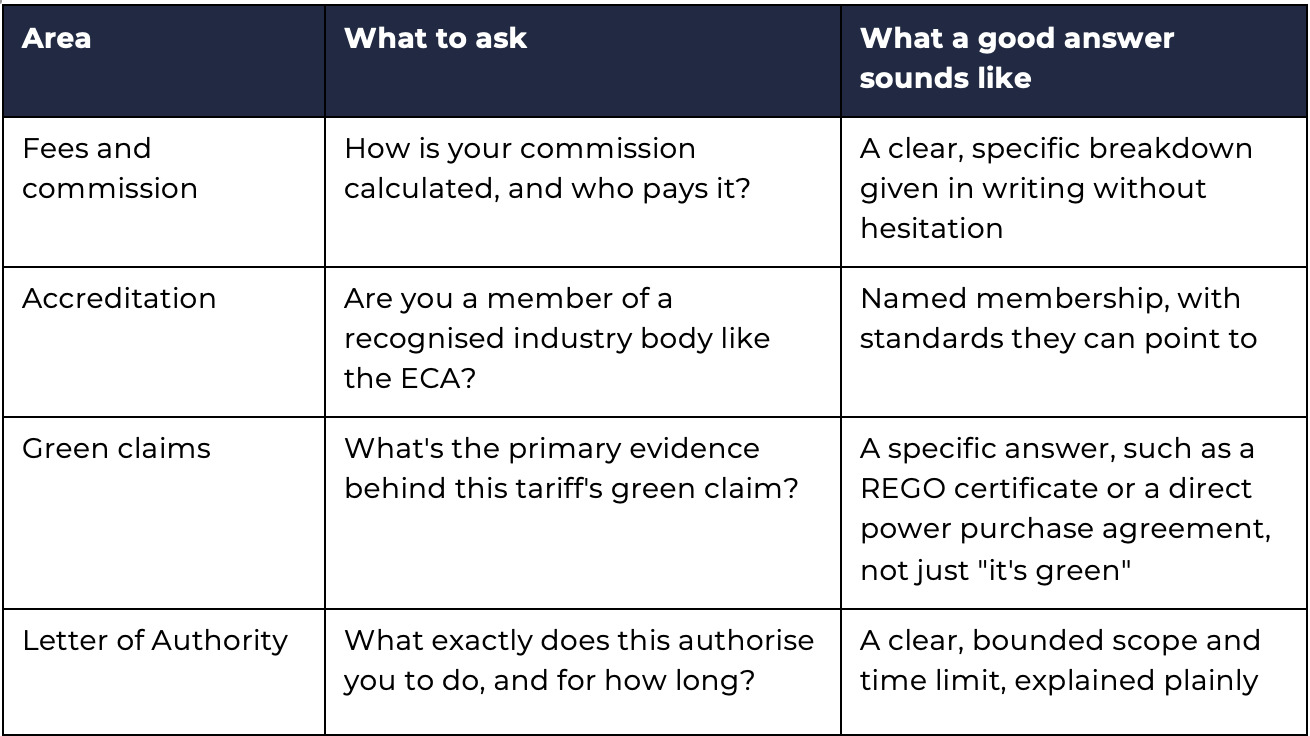
Ask for the full fee or commission structure in writing, including how it’s calculated and who pays it
Ask whether the broker is a member of a recognised industry body like the ECA. Reputable trade associations vet members against standards on transparency, conduct and fee disclosure, and membership is a reasonable signal that a broker takes those standards seriously.
Read the Letter of Authority carefully before signing it, since it sets out exactly what the broker can do on the business’s behalf, and for how long
Ask for the primary evidence behind any green or renewable claim, rather than accepting the label at face value
Request references from existing clients of a similar size and sector
Confirm the broker’s FCA credit broking status where finance or leasing forms part of the deal
A broker confident in its own value can answer all of this without hesitation. One that can’t should raise questions before any contract is signed.
What good broker practice looks like
What does Ofgem’s TPI Review mean for businesses?
That scrutiny is about to become formal. Ofgem’s review runs in three stages: evidence gathering over summer 2026 is complete, analysis through autumn is ongoing, and a final report due in winter 2026/27. That report will shape a further consultation on the design of a full regulatory regime, including how TPIs are authorised and funded.
Until that regime is in place, there’s no formal licensing requirement for energy brokers. The great majority of brokers already operate to a high standard, and accreditation schemes, voluntary codes and a business’s own due diligence help maintain that, particularly among brokers who hold themselves to a recognised industry standard such as ECA membership.
For businesses weighing up whether to use a broker now, that points toward more scrutiny rather than less. The businesses asking the hardest questions today are best placed for whatever regulatory regime Ofgem eventually designs.
Conclusion
Energy brokers exist because business energy procurement is complicated, and that complexity isn’t going away. Used well, a broker saves a business time, money and the risk of a bad contract. Used carelessly, the same broker can cost a business more than it saves.
Regulation is coming, but it’s still a year or more away. Until then, the businesses that treat their broker relationship with the same scrutiny they’d apply to any other supplier are the ones protecting themselves best, whatever Ofgem eventually decides.
John Hawis chair of the Energy Consultants Association (ECA), the UK’s industry body for energy consultants, brokers and third-party intermediaries, working to raise standards and transparency across the sector. He is also chief executive of Fidelity Energy.
The European Business Review uses cookies to improve site functionality, provide you with a better browsing experience, and to enable our partners to advertise to you. Detailed information on the use of cookies on this Site, and how you can decline them, is provided in our Privacy Policy and Terms and Conditions. By clicking on the accept button and using this Site, you consent to our Privacy Policy and Terms and Conditions. ACCEPT Reject
Privacy & Cookies Policy
Privacy Overview
This website uses cookies to improve your experience while you navigate through the website. Out of these cookies, the cookies that are categorized as necessary are stored on your browser as they are essential for the working of basic functionalities of the website. We also use third-party cookies that help us analyze and understand how you use this website. These cookies will be stored in your browser only with your consent. You also have the option to opt-out of these cookies. But opting out of some of these cookies may have an effect on your browsing experience.
Necessary cookies are absolutely essential for the website to function properly. This category only includes cookies that ensures basic functionalities and security features of the website. These cookies do not store any personal information.
Any cookies that may not be particularly necessary for the website to function and is used specifically to collect user personal data via analytics, ads, other embedded contents are termed as non-necessary cookies. It is mandatory to procure user consent prior to running these cookies on your website.