
By Jacques Bughin
What European retailers can learn from the SaaS reinvention playbook.
Agentic AI is reshaping digital commerce, shifting retail advantage from websites and traffic toward trusted data, execution, governance, and control of the transaction.
The argument
Retail has already moved online. The next disruption is not simply more ecommerce; it is the migration of discovery, comparison, and eventually purchase into AI-mediated interfaces. The strategic risk is that a retailer becomes a passive supplier of stock while a consumer agent, a marketplace or a payment platform controls the relationship, the recommendation and the data.
European retailers should not respond by trying to build a universal personal agent. Their task is to become indispensable to the agents that bring demand. That requires a different strategic question: which parts of the retail stack remain under the retailer’s control when the human-facing website and app are no longer the only front door?
European retailers should not respond by trying to build a universal personal agent. Their task is to become indispensable to the agents that bring demand.
The answer comes from the recent SaaS transition. In enterprise software, agentic AI is eroding value attached merely to the user interface and the per-seat workflow. Durable advantage is relocating toward trusted state, execution authority, orchestration, governance and outcome-based monetisation. Retail is now entering the same structural shift. Its interface is contestable; its product truth, merchant rules, fulfilment capability and settlement record can become stronger.
Online retail was the preparation not the destination
Europe has already crossed the threshold at which ecommerce is a mainstream consumer habit. Eurostat reports that 78 percent of EU residents bought or ordered goods or services online in 2025, up from 62 percent in 2015 [1]. Yet the capability base remains uneven. In 2025, 46 percent of large EU enterprises reported e-sales, compared with 23 percent of SMEs [2]. The next shift will amplify this difference because agentic commerce rewards reliable data, interoperable systems and disciplined execution rather than a well-designed website alone.
The new customer journey begins with an objective rather than a visit: “find a compatible replacement,” “replenish this product under a budget,” or “book the best option that arrives before Friday.” An agent can translate that objective into a shortlist, interrogate product data, compare merchants and initiate a transaction. Shopify reports rapid growth in AI-referred traffic and orders across its merchant base, although these company figures should be treated as early adoption signals rather than a market forecast [3]. The commercial fact is more durable: the retail interface is becoming multi-surface and increasingly programmable.
This does not mean that retailers lose their role. It means that digital retail needs a second transformation. The first digitalised the shop. The second makes the retailer executable by an authorised machine.
The SaaS lesson The moat moves
The useful lesson from SaaS is not that every incumbent is doomed. It is that inherited barriers must be separated from reconstructed barriers. An attractive interface, accumulated traffic and a familiar brand can remain useful, but they are increasingly contestable when an agent can bypass the screen. The stronger post-agentic barriers are assets that an agent cannot safely replace: trusted data, permissioned action, workflow authority, reconciliation, accountability and a record of what happened.
For retail, the equivalent migration is from website and app access toward product truth, inventory accuracy, merchant policy, payment authority, fulfilment, returns and the post-purchase record. A retailer that exposes these capabilities in a governed way can welcome many agents without surrendering the transaction. A retailer that exposes only a product feed risks becoming a price-compared commodity.
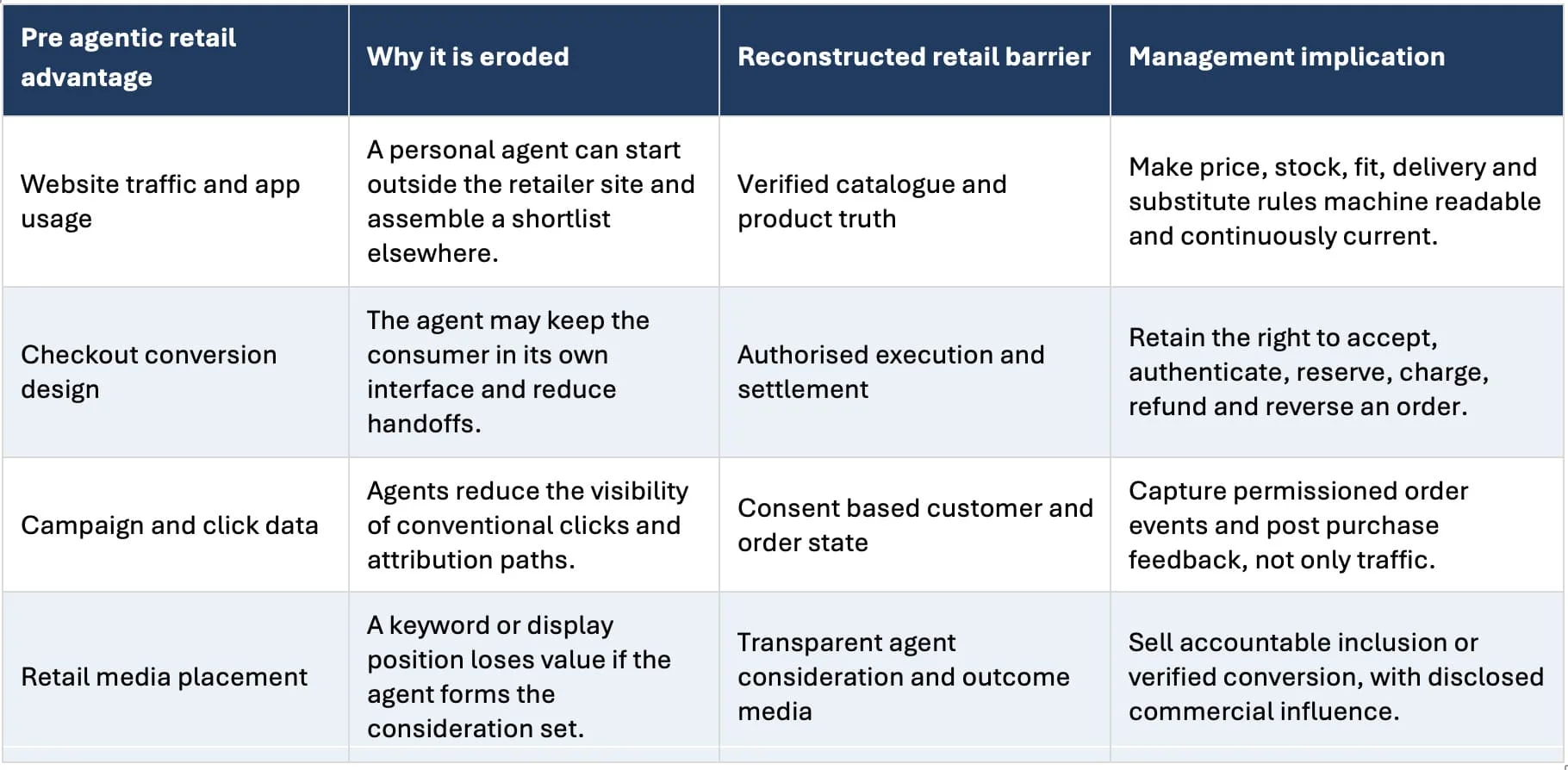
From online seller to agent ready retailer
An agent-ready retailer does four things well. First, it makes the offer legible: a machine can understand the product, price, stock, constraints and service promise. Second, it makes the transaction executable: the agent can request a quote, reserve an item, seek approval and complete a purchase under pre-defined rules. Third, it makes the result auditable: the retailer knows who acted, under what authority, and how the order can be changed or reversed. Fourth, it learns from completion: returns, substitution, delivery and satisfaction feed the next recommendation.
This is a protocol problem as much as a user-experience problem. Current agentic-commerce infrastructure is being built around discoverable catalogues, delegated checkout, tokenised payments and fraud controls [4, 5]. The merchant should preserve a right to accept or decline an agent-originated order using its own fraud and fulfilment signals; this is not a technical detail but a condition for retaining merchant-of-record responsibility [5].
Choose the right strategic posture
Retailers should not make the same investment. The appropriate posture follows from their assets, not from enthusiasm for AI. The key distinction is whether the company can credibly own the transaction record and execution layer, or should participate through a neutral infrastructure provider while protecting its data and customer economics.
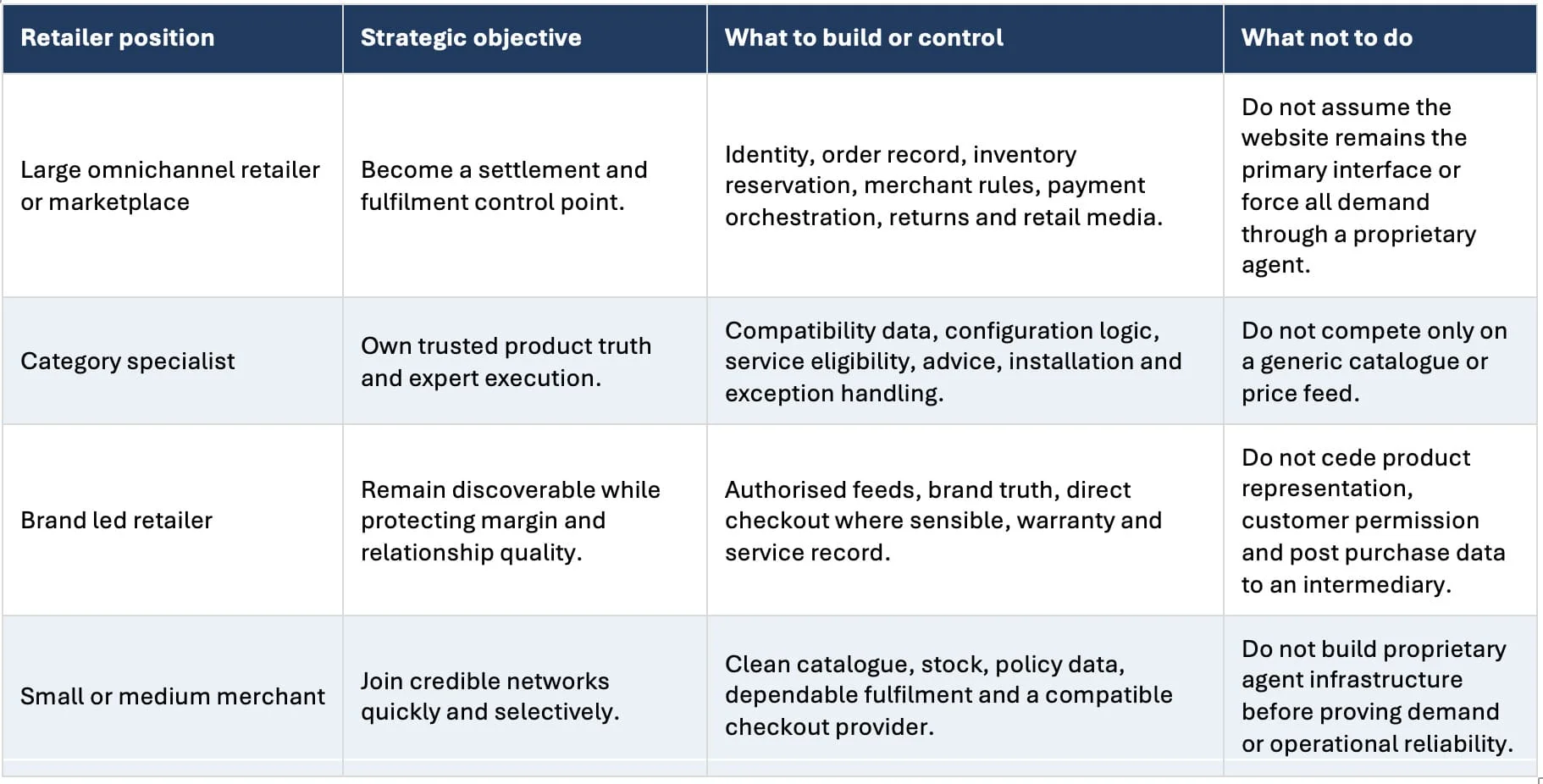
Muse makes the retail agent war concrete
Meta’s Muse makes the change visible. It is a personal action agent, not another shopping chatbot: with the consumer’s permission, it can work across apps, compare offers and, after the required approval, initiate payment and purchase. In commercial terms, Meta is seeking to own the originating moment of intent: the instruction to buy, rather than the retailer visit that has traditionally initiated the funnel [12].
Shopify has chosen a different, and strategically astute, position. Rather than trying to own the consumer’s personal agent, it makes the agentic world executable: Muse can search Shopify catalogue data and complete checkout through Shop Pay. Shopify is therefore seeking to be portable transaction and settlement infrastructure across whichever consumer agents win [13].
Amazon’s decision to block Muse from purchasing on its platform makes the conflict explicit. Amazon is not merely protecting near-term sales. It is defending on-site discovery, advertising, recommendation data, checkout control, and the direct customer relationship against being reduced to fulfilment for another company’s agent. The emerging war is consequently a contest over the commercial control points, not a conventional contest to sell more retail software [14].
What retail learns from ChatGPT Cursor and SaaS
For content, this is a ChatGPT moment. The customer begins with a language objective and expects an answer or a shortlist, rather than a set of pages to browse. Product descriptions, images, and merchant claims cease to be only persuasive material; they become evidence on which an agent forms and explains a recommendation. Retailers must therefore turn content into verified, structured and current product truth.
For commerce, it is closer to a Cursor moment. Cursor changed software work because the agent can retain task context, plan a sequence across tools, and execute against a governed codebase. Muse applies the same logic to a consumer goal: it can turn “find and buy” into a multi-step workflow. The relevant retail capability is no longer just an attractive front end. It is a secure action layer through which an authorised agent can ask, receive a bounded permission, execute, and be held accountable.
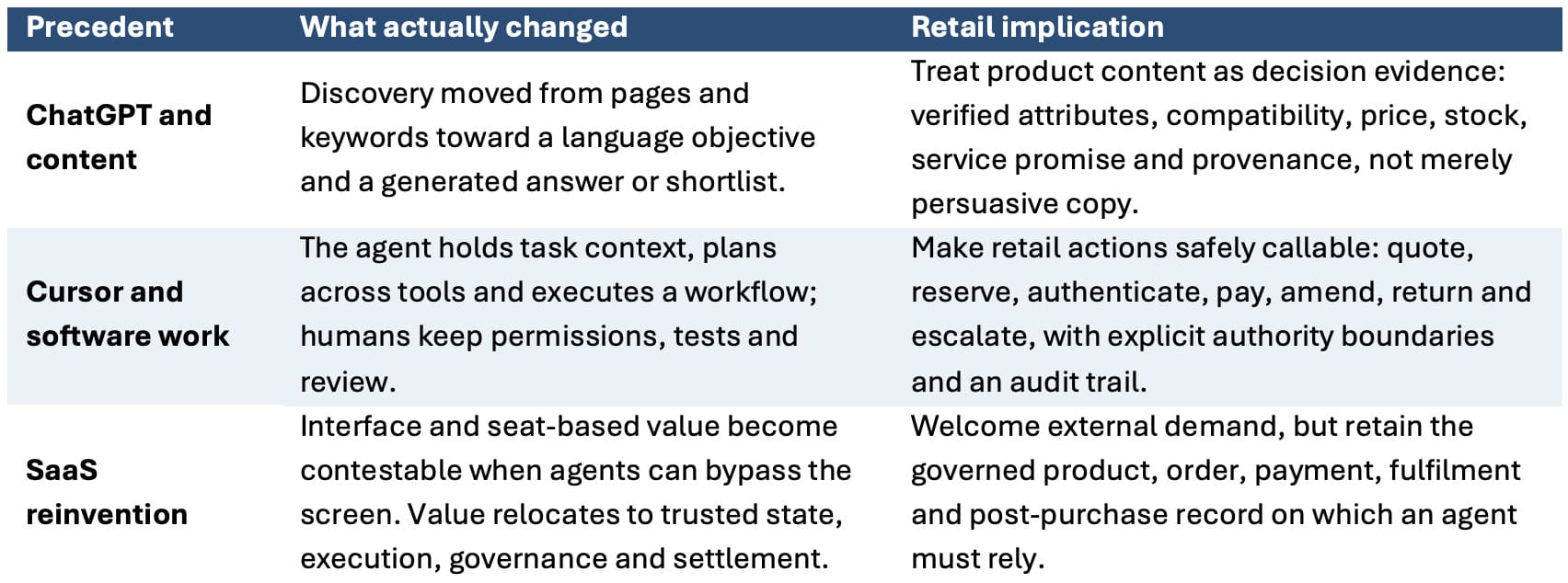
The SaaS lesson gives the strategic answer. Defence without reinvention is insufficient. A retailer can rightly refuse an unapproved agent, as Amazon has done, but blanket closure will not preserve the old interface if demand migrates elsewhere. The retailer should defend the non-negotiable rights: truthful representation, price and inventory commitment, order acceptance, payment authority, returns, redress and the learning record of the fulfilled transaction. It should reinvent the exposed layer: machine-readable catalogue, governed action interfaces, delegated permissions and outcome-based commercial terms. This is controlled openness, not surrender.
Six management moves
1 Create a product truth layer. Establish a single governed source for product identifiers, attributes, variants, availability, promised delivery, returns, warranties and permissible substitutes. The purpose is not merely better search-engine optimisation. It is to let an external agent reach a correct commercial decision without hallucinating terms or presenting a product that cannot be fulfilled.
2 Separate discovery from settlement. Welcome demand from AI channels, marketplaces, voice interfaces and third-party agents. But insist that the retailer controls order acceptance, inventory reservation, merchant terms, fraud decisions, refunds, and the post-purchase record. The agent may originate the intent; it should not silently rewrite the commercial contract.
3 Build delegated authority carefully. Define what an agent may do without further approval: search, compare, reserve, reorder, apply a loyalty benefit, return a low-value item, or pay within a limit. For every action, record customer permission, agent identity, time, price, product, and decision rule. Escalate higher-value, ambiguous, or irreversible actions to the customer.
4 Convert retail media from clicks to accountable consideration. As agents form shortlists, retailers should create transparent commercial mechanisms for verified merchant access and outcome-based conversion. Sponsored inclusion must be labelled and subordinate to the consumer’s stated constraints. A hidden paid ranking may improve short-term media yield while destroying the trust on which delegated purchasing depends.
5 Move pricing toward execution and outcomes. The SaaS warning is clear: a legacy monetisation unit can become detached from value. Retailers should test fees and services tied to fulfilled order flow, merchant services, logistics, identity, assurance and conversion outcomes, rather than relying only on clicks, display positions or a website visit.
6 Make trust a commercial capability. The European regulatory setting makes this especially important. The EU AI Act is now broadly applicable, with relevant transparency obligations applying from August 2026 [6, 7]. Retail leaders should treat disclosure, consent, explainable sponsored treatment, auditability and redress as product and margin architecture, not a late compliance review.
The new retail operating model
Agentic retail cannot be owned by a digital innovation team alone. It requires a joint operating model across merchandising, ecommerce, payments, supply chain, customer service, risk, legal and data. The chief commercial officer should own the proposition and P and L; the chief digital or technology officer should own the product truth, interfaces and reliability; risk and legal should own delegation thresholds, audit policy and redress; operations should own the promise that makes the data credible.
The most useful dashboard is not “number of AI features launched.” It measures: share of demand arriving through agentic channels; agent-originated conversion; margin after media, payment, fraud and return costs; order acceptance and exception rates; fulfilment accuracy; share of orders retaining the retailer’s customer and transaction record; and repeat purchase after an agent-mediated experience.
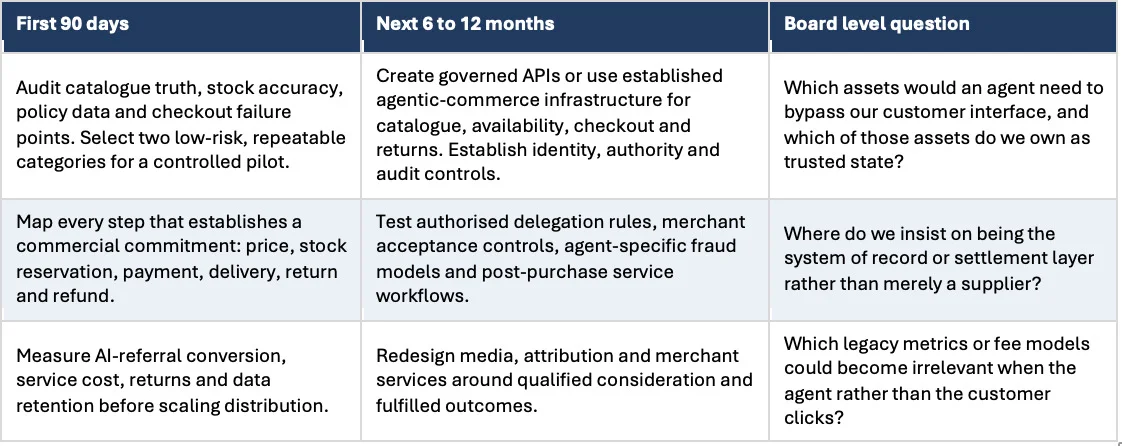
Europe can compete through trustworthy execution
European retailers should not respond by trying to build a universal personal agent. Their task is to become indispensable to the agents that bring demand
Europe is unlikely to win by replicating a single closed consumer super-app. Its opportunity is to build a dense, trustworthy commerce layer across retailers, brands, payments, logistics and consumer protection. The region’s diversity of languages, product rules, payment methods, delivery patterns and consumer rights is a burden for a generic interface but an advantage for firms that can turn complexity into verified execution.
This is why the agentic retail war should not be framed as a race to own the chatbot. The agent interface will often be contested and multi-homed. The more durable prize is the ability to make the merchant’s offer true, executable, accountable and learnable. Retailers that become trusted systems of settlement can profit even when another company owns the conversation.
Conclusion
The first generation of ecommerce rewarded traffic, interface design and conversion optimisation. The next generation will reward retailers that can accept delegated intent without losing control of the commercial relationship. The lesson from SaaS is not defensive closure. It is controlled openness: expose the capabilities that agents need, but reconstruct the moat around trusted state, execution authority, orchestration, governance and settlement.
European retail managers should start now with a practical objective: let any credible agent bring demand, but ensure that no agent can misrepresent the offer, commit inventory, take payment, resolve a dispute, or learn from the completed transaction without the retailer’s governed participation.
 Jacques Bughin