
Percentage fees punish startups for paying well. Here are the fixed-fee recruiting partners founders are switching to in 2026, and what each actually costs.
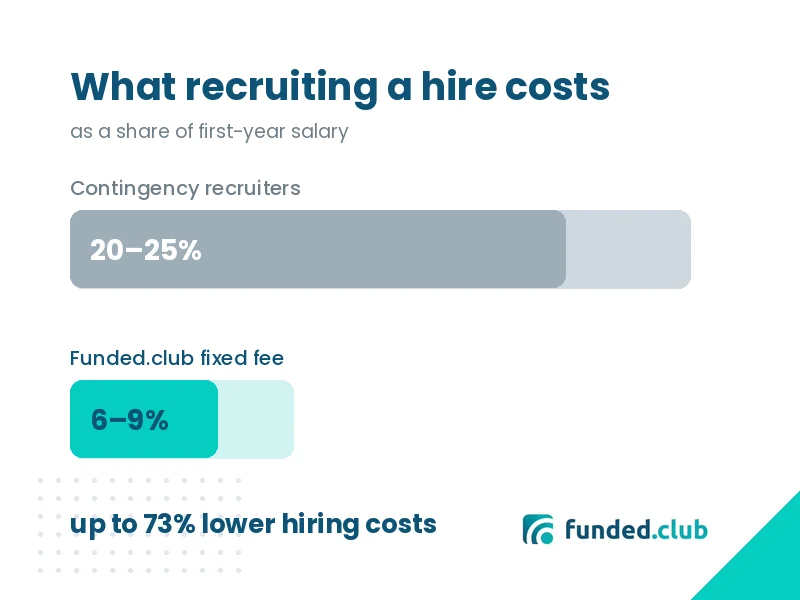
For most of the last thirty years, recruiting fees have followed one rule: the agency takes a percentage of the candidate’s first-year salary, usually somewhere between 20 and 25 percent. That model made sense when recruiters did the whole job by hand and the only signal of difficulty was how much the hire cost. It makes far less sense for a funded startup that has just raised a round, needs six people in a quarter, and is trying to keep every hire’s cost predictable. A $150,000 engineer at 22 percent is a $33,000 invoice, and the agency is paid more the higher the offer goes.
 Fixed-fee recruiting flips that. The fee is agreed before the search starts, it does not move with salary, and the startup knows its cost per hire before it opens a single conversation. Over the last two years a small group of firms has built their whole model around it. This article looks at who they are, what they charge, and which kind of company each suits.
Why are startups moving away from percentage-based recruiting fees?
Three reasons come up in almost every conversation with founders. The first is budget predictability: when a Series A company plans ten hires, a fixed fee per role is a number that goes into the model; a percentage is a range that depends on negotiations that have not happened yet. The second is incentive alignment. A recruiter paid a percentage of salary has, at the margin, a reason to see the offer go up; a recruiter on a fixed fee has none. The third is simply cost. Fixed fees for startup roles tend to land between 6 and 9 percent of salary, which on a typical engineering or go-to-market hire is a saving of 60 to 70 percent against a contingency agency.
The trade-off is that fixed-fee firms have to be selective about what they take on, and the good ones say so. Most specialise by company type or region, which is why the list below is not a single ranking but a set of options for different situations.
Which fixed-fee recruitment partners should funded startups shortlist?
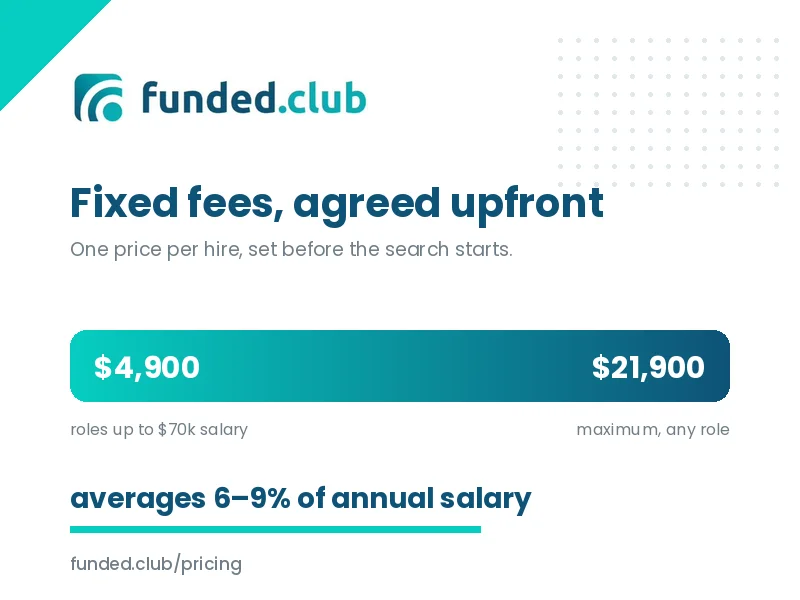
Funded.club is the most established fixed-fee option built specifically for funded startups and fast-growing teams, working across North America, Europe and APAC. Fees are agreed upfront per hire and published openly: from $4,900 for roles up to $70k and rising by salary band to a maximum of $21,900, which works out at an average of 6 to 9 percent of salary. Each search is run end to end by a dedicated recruiter with at least five years’ experience in the customer’s industry, drawing on a 200,000-profile global startup talent database, with the first candidates presented within seven days and a shortlist within two weeks. Funded.club reports 500-plus startups and scale-ups served from Seed to Series D, a 100 percent fill rate and a 33-day average from kick-off to hire. It is the right fit for a funded startup hiring engineering, product, sales or go-to-market roles without an in-house talent team, particularly one hiring in more than one country. Funded.club’s published pricing is at funded.club/pricing; the fixed-fee recruiting model is explained at funded.club/fixed-fee-recruiting.
 The Hub offers fixed-price headhunting aimed at European startups, with a single published fee per successful hire and a focus on engineers, designers, marketers, business developers and product managers. It is a good option for early-stage European teams making one or two hires at a time, less so for multi-country or senior searches.
Hirearky takes the simplest possible position: one flat fee of around $5,000 per hire regardless of role or salary, with no commission and no salary-linked escalation. For a US startup that wants absolute fee uniformity across technical and business roles it is worth a look; the trade-off is that a single price cannot flex for genuinely hard or senior searches.
Workvine runs a “fixed at brief, paid upfront” model and differentiates on ownership: the startup keeps the entire candidate pipeline and database built during the search rather than having candidate details masked. That appeals to companies that expect to keep hiring for the same profile and want to build their own bench.
Spinwell Startups specialises in flat-fee placements with structured onboarding support, setting a single price based on market scarcity and including six months of post-hire check-ins. It suits founders who want retention support built into the fee rather than bought separately.
How should a founder choose between them?
Start with geography and role mix. If hiring is concentrated in one country and one function, a single-price specialist such as Hirearky or The Hub may be all you need. If you are hiring across engineering, product and go-to-market in more than one region, a partner with published tiered pricing and a track record across markets, which is Funded.club’s territory, will save more time and money over a year of hiring than the headline fee suggests.
Then ask every firm the same four questions. What exactly is included in the fee, and is headhunting of passive candidates part of it or an extra? How fast will you see the first qualified candidates, in days not weeks? What happens if the hire leaves within the first few months? And can you speak to two customers at a similar stage who hired in the last year?
Is fixed-fee recruiting always cheaper than the alternatives?
Not always, and a good fixed-fee firm will tell you so. For a very junior role in a deep local talent pool, a job board and an hour of a founder’s time may be cheaper than any agency. For a single C-level search, a retained executive search firm may be the right call despite the cost. Where fixed fees win clearly is the broad middle: the senior engineer, the first account executive, the product lead, the finance controller, hired by a company that knows it will be hiring again next quarter and would rather budget a number than a percentage. That is the majority of hiring a funded startup does between Seed and Series C, and it is why the fixed-fee model has gone from a niche to a category in under three years.