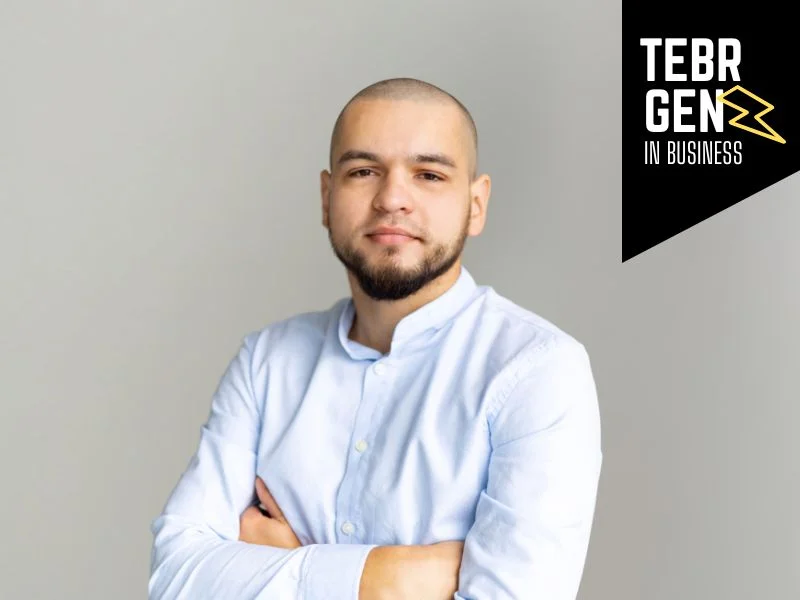
Interview with Dmytro Horilyk
For Gen Z entrepreneurs, global growth requires cultural fluency, financial discipline, resilience, and the willingness to make difficult decisions early.
Building a global business takes more than a strong product or an ambitious vision. For Gen Z founders, lasting growth depends on understanding different markets, developing commercial discipline, adapting to cultural differences, and making difficult decisions when necessary. Dmytro Horilyk, CEO and co-founder of DrugCard, has built an AI-powered pharmacovigilance platform serving clients across 146 countries. In this interview, he shares lessons from international expansion, AI-driven healthcare, acquisition, leadership, and building a business that combines financial sustainability with a meaningful purpose.
You started your entrepreneurial journey at a young age and have since built a business with an international footprint. What was the defining moment that gave you the confidence to think bigger than your local market?
Honestly, it wasn’t a moment of confidence so much as a moment of necessity. My co-founders and I believed strongly in the product we were building, but our local market simply wasn’t adopting it, despite regulatory frameworks that were largely harmonized with European standards. That forced us to ask hard questions: was enforcement simply less consistent locally, did we lack the commercial skills to sell effectively, or was the product itself not meeting a real need?
What ultimately gave us the confidence to expand wasn’t certainty of success; it was recognizing that staying local wasn’t sustainable.
We were confident the product had genuine value; automating literature monitoring was ahead of its time for the industry, so the answer became clear once we looked honestly at ourselves: none of us had real sales experience. Once we accepted that, the path forward was straightforward in principle, if not in execution: go where the market and regulatory environment support the product, and build the commercial skills we were missing. I made a personal commitment to learn sales, and that decision became the foundation for our move into international markets.
What ultimately gave us the confidence to expand wasn’t certainty of success; it was recognizing that staying local wasn’t sustainable. At the time, I didn’t picture us eventually operating across European countries; I simply knew there was no other direction to take. That sense of necessity, more than any grand vision, is what pushed us to build what has become an international business.
Many Gen Z entrepreneurs want to build global businesses from day one. What lessons have you learned about growing across different countries and cultures that you wish you had known earlier?
The clearest lesson has been that international growth depends as much on cultural fluency as on strategy. Early in our expansion, we approached certain markets, the Nordic region in particular, with the same direct, fast-paced communication style that had worked well for us domestically. It generated promising early interest, but ultimately cost us opportunities, because that same directness read as pressure in a business culture that values a more measured approach.
The broader takeaway is that any business is, at its core, about working with people, and working with people internationally means understanding their culture before you understand their market: communication norms, business etiquette, local customs, and even practical rhythms like response times that vary meaningfully from one country to the next. My advice to founders entering new markets is to treat cultural research as a core part of market entry, not a secondary consideration. It shapes how relationships, and ultimately revenue, actually get built.
Healthcare is changing rapidly as AI becomes part of everyday work. Which changes do you believe will have the biggest impact on the industry, and how should young entrepreneurs prepare for them?
I like to think of AI as a genie that’s already out of the bottle, there’s no putting it back. It has become deeply embedded in daily healthcare and life sciences work, often ahead of formal governance structures. Regulation is still catching up, and in the meantime, adoption is happening organically across the industry, including in pharmacovigilance, frequently ahead of full institutional visibility or formal validation processes.
I see that as both a responsibility and an opportunity for entrepreneurs building in this space. Rather than competing directly with large, general-purpose AI providers, the more durable strategy is to build deep expertise around specific, well-defined professional workflows. As AI capability becomes increasingly accessible to everyone, the real competitive advantage shifts to the depth and specificity of domain data a company can bring to a narrow use case, rather than the underlying technology itself. Founders who specialize early, rather than building broad general solutions, will be far better positioned as the industry and its regulatory landscape mature together. Trying to ignore or resist that shift, rather than building around it, is, in my view, simply the wrong instinct for anyone entering this space today.
Your recent acquisition marked a new chapter in your growth. How did that experience reshape the way you think about innovation and building a business for the long term?
It reinforced two things clearly. First, that strategic acquisitions are more achievable than many founders assume, even for a relatively young company. Second, that this kind of growth path requires deliberate capital planning, since integrating an acquired business is resource-intensive.
More fundamentally, it reshaped how we think about expansion itself. For much of our growth, we approached the market primarily through a competitive lens, positioning against other service providers. This experience opened a complementary path: growth through partnership and integration rather than competition alone, bringing established expertise and client relationships into our platform. It’s an approach we intend to keep exploring as part of our long-term strategy.
Gen Z is often described as the most entrepreneurial generation yet. What mindset do you believe separates those who build lasting businesses from those who give up too soon?
In my experience, the founders who succeed in building lasting businesses are the ones willing to commit to a period of intense, focused effort early on, often lasting a few years, during which the business demands a disproportionate share of their time and energy. I know this isn’t necessarily the message younger founders want to hear, especially a generation that rightly prioritizes wellbeing and balance, but nearly every founder I know who reached long-term stability went through a comparable stretch.
That period involves real trade-offs, but it’s often what allows a company to reach a level of stability where it can sustain itself. A more balanced rhythm can, and should, follow once the business matures. What separates those who persist from those who give up too early is largely a willingness to treat that early period as a temporary, necessary investment rather than a permanent state.
Success often comes with setbacks that people rarely see. What has been one of the most difficult decisions you’ve had to make as a founder, and what did it teach you about leadership?
Some of our most difficult moments have been internal rather than market-facing, particularly around personnel decisions. Early on, we tended to give underperforming team members multiple chances to improve, hoping the situation would resolve itself, but that often prolonged difficult situations rather than solving them.
It taught me that effective leadership means making timely, sometimes uncomfortable calls and owning them fully, rather than avoiding short-term discomfort at the cost of longer-term clarity.
Over time, I adopted a clearer principle: when it becomes evident that a role or fit isn’t working, acting decisively serves both the company and the individual better than delaying the decision. It taught me that effective leadership means making timely, sometimes uncomfortable calls and owning them fully, rather than avoiding short-term discomfort at the cost of longer-term clarity. As the company has grown, we’ve also evolved this approach structurally, giving direct managers, who have the closest visibility into day-to-day performance, ownership of these decisions rather than centralizing everything at the founder level.
Many members of Gen Z want to build companies that create lasting impact, not just financial success. What advice would you give to young founders who want to lead with both ambition and purpose? What advice would you give to young founders who want to build something that lasts?
The first responsibility of any business is to generate profit. If a company isn’t generating revenue, it isn’t really a business; it’s closer to a nonprofit or charitable structure. Without a higher mission attached to it, a purely revenue-generating company essentially functions like a financial institution, which isn’t a bad thing in itself; that’s simply the core objective of that kind of structure.
A mission beyond profit, in our case, contributing meaningfully to healthcare, matters because it gives the people working within the company a sense that they’re building something beyond simply generating income for the founders, that they’re helping make things a little better. Defining that mission clearly isn’t easy, so my honest advice is to build around something you genuinely care about.
Practically, I’d tell young founders to first assess whether their ambition and long-term goals can realistically sustain the business financially. Only after that should they think about purpose, and a useful test is asking: what would actually change in the world if this company disappeared? If the honest answer is nothing, there likely isn’t a distinct purpose yet. If something meaningful would be missing, that’s a purpose worth building around. Building a company purely around purpose, without regard for financial sustainability, only really works in a nonprofit or charitable model. Otherwise, ambition and financial thinking need to move together, not one instead of the other.
 Dmytro Horilyk