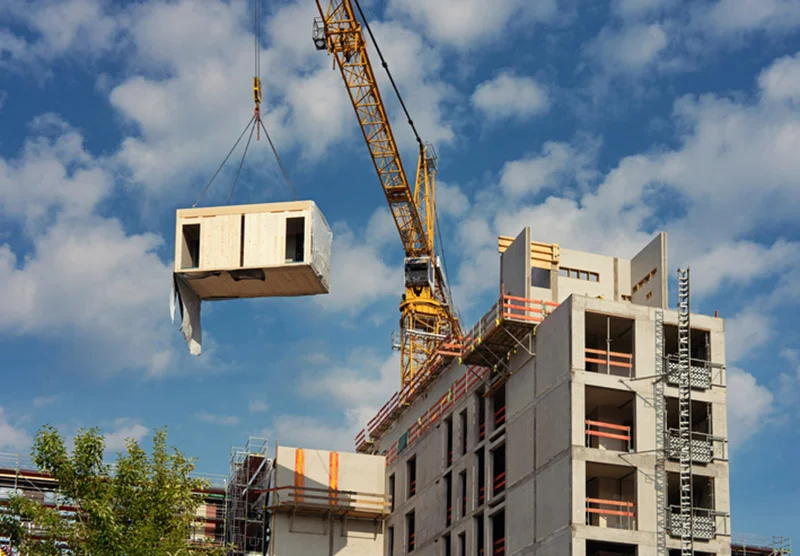
European industry is operating under conditions that punish slow capital deployment. Energy prices remain elevated, order books swing quarter to quarter, and reshoring decisions often need production capacity in months rather than years. Against that backdrop, modular and semi-permanent industrial buildings have moved from a niche option into a serious line item on manufacturers’ capital plans, reshaping how factories, warehouses and support facilities are financed and built.
Why Manufacturers Are Rethinking Fixed Assets
Foreign direct investment data confirms the pressure on European industry. According to the EY 2025 European Attractiveness Survey, FDI into Europe fell 5% in 2024 to its lowest level in nine years, with manufacturing projects down 9%. At the same time, defense, semiconductors, EV production and pharmaceutical facilities are absorbing large blocks of new capacity in Poland, Spain, France and the Nordics. That mix, contraction in some segments and rapid buildout in others, favors construction methods that can be scaled up or reversed without stranding capital in permanent structures.
Modular building suppliers have adjusted to that reality. Manufacturers such as Spantech International design turnkey structures for warehouses, production halls, aviation hangars and studios, installed within weeks and dismantled or extended as demand shifts. The commercial logic is straightforward. Match the useful life of the building to the useful life of the production programme it houses.
Speed, CapEx and the Economics of Modular
The difference in productivity when using modular versus traditional construction has been established. McKinsey states in their study (Modular Construction : From Projects to Products) that modular building techniques can increase speed of completion of buildings by 20 to 50% while reducing cost by 10 to 20%. Combining these two statistics gives an estimate of approximately $22 Billion dollars per year in total savings across all European and US markets. Approximately 80% of labor time is reduced by moving the work into a factory setting, thus eliminating most of the issues associated with labor shortages and bad weather.
As a result, this means a plant manager who is being delayed due to lack of additional warehouse space will have a shorter period of lost revenue. As a result, it also means the financial officer of a company will have a different capital expenditure profile. A permanent building depreciates over a period of twenty to forty years and restricts the companies’ balance sheet to one physical location. A modular hall can be rented, leased with an option to buy or purchased outright and in many cases are considered mobile assets, and therefore qualify for accelerated depreciation under IFRS guidelines. When coupled with faster start-up times, the internal rate of return on new capacity increases without the need to alter demand forecasts.
Examples in the industry illustrate the trend. Volkswagen used 9,750 square meters of insulated modular units to temporarily house seat covers made at a facility while the factory was transitioning. Royal Huisman expanded its shipbuilding capacity for a single yacht project without having to add any permanent space to their facility. In each case, the use of the modular unit was limited to the specific program and did not represent a thirty-year real-estate investment decision.
Circularity, Compliance and the EU Taxonomy
Sustainability rules are also pushing manufacturers toward modular options. The EU Taxonomy Regulation sets technical screening criteria for activities that contribute to circular economy objectives, including design for disassembly and reuse of building components. Modular steel structures, bolted rather than welded and dismountable at end of life, align with those criteria more easily than cast-in-place concrete. A World Economic Forum analysis on modular construction and circularity points out that factory-based production reduces material waste and enables higher rates of component reuse across project cycles.
For companies preparing disclosures under the Corporate Sustainability Reporting Directive, that matters. Scope 3 emissions tied to capital goods sit high on many manufacturers’ inventories, and documented reuse of structural elements across sites strengthens the reporting position. It also supports internal carbon pricing decisions, where building-related emissions are being costed alongside operational ones.
What to Check Before Choosing a Modular Partner
Not every provider offers the same engineering depth. A short due diligence list tends to separate serious partners from resellers. Relevant checks include CE marking of structural steel under EN 1090, execution class EXC2 or higher for load-bearing components, welding certification to ISO 3834, and quality management under ISO 9001. Wind and snow load calculations should follow Eurocodes EN 1991 for the specific site zone, not generic assumptions. Insulation values, fire ratings under EN 13501, and roof drainage capacity should be documented in the technical file delivered with the building.
Reference projects in comparable use cases, such as aviation hangars, cold storage and film production, are a stronger indicator than headline square-metre counts. So is the ability to provide a full turnkey package covering permits, foundations, MEP and dismantling, since split responsibility on a modular project often erodes the schedule advantage that made the option attractive in the first place. Buyers who treat the building as a production asset, with a lifecycle plan and clear exit options, tend to capture the full economic upside.