
An up-to-date comparison for organisations selecting travel experiences distribution infrastructure for product and technology roadmaps spanning 2026 and 2027.
The travel experiences market is entering a new phase of digital growth.
Research from Arival and Phocuswright published in February 2026 valued tours, activities, and attractions at $271 billion in 2025 and projected the sector to reach $342 billion by 2029. With online channels accounting for 33% of experiences gross bookings in 2025, the category offers considerable headroom for digital distribution to expand alongside rising traveller demand.
This opportunity is part of a broader shift towards online travel commerce. Phocuswright projects that global travel gross bookings will exceed $1.8 trillion by 2027, with two thirds of travel booked online by then. For companies adding experiences, this means customers will increasingly expect tours, activities, and attractions to be discoverable and bookable within the digital journeys they already use.
If your organisation is planning its technology roadmap across 2026 and 2027, the infrastructure priority is clear. Bringing more experiences into digital customer journeys requires dependable connections between inventory, availability, pricing, booking, payments, fulfilment, and cancellations.
HBX Group’s 2026 move to acquire Bridgify reinforces a broader market shift: experiences distribution is becoming a core part of travel infrastructure, not just an ancillary add-on.
This guide compares six leading B2B platforms that help companies distribute bookable tours, activities, attractions, events, and related experiences. It does not include flight APIs, hotel APIs, global distribution systems, metasearch providers, or tour operator reservation software.
Start With the Distribution Architecture
Before you compare providers, define the distribution architecture your organisation actually needs. Every platform in this guide can help companies offer bookable tours, activities, attractions, or events, but each occupies a different position within the experiences technology stack.
A multi-source infrastructure layer brings inventory from several suppliers or aggregators into one connected environment. This model is relevant when your company wants broader supply while reducing the need to maintain a separate technical connection, product mapping, and distribution process for every source.
A B2B experiences commerce platform provides the technology required to launch and operate an experiences proposition. Depending on the provider, this may include an API, a branded marketplace, booking functionality, or several deployment routes.
A marketplace partnership model gives your company access to the inventory and commercial framework of one established consumer marketplace. It can provide a direct route to a recognised catalogue, although your company generally operates within that marketplace’s access, booking, branding, and servicing structure.
A specialist distributor concentrates on a defined part of the market, such as museums, ticketed attractions, excursions, or selected tour products. This approach can be effective when depth within one category matters more than sourcing inventory from several networks.
Your choice should reflect more than the number of products available. Consider how many inventory sources you need, how much of the customer journey you want to control, where transaction responsibility should sit, and how your experiences proposition may develop through 2027.
Six Decisions to Make Before Shortlisting a Platform
Before you review demonstrations or technical documentation, answer these six questions with your product, engineering, commercial, and operations teams.
1. How broad does your inventory need to be?
Decide whether one marketplace or specialist catalogue can support your proposition, or whether you need inventory drawn from several sources.
Focus on coverage in the destinations and categories that matter to your customers. A large global inventory figure has limited value when relevant products are unavailable in your priority markets.
2. How much of the customer journey do you want to control?
A fully embedded API can give your company greater control over discovery, design, personalisation, checkout, and customer data. A white-label or hosted route may reduce development requirements and support a faster launch.
Some organisations begin with a ready-made marketplace and move towards a deeper API integration after demand and commercial value have been demonstrated.
3. Where should transaction responsibility sit?
Confirm who will collect payment, act as merchant of record, issue confirmations and vouchers, manage refunds, and support the traveller.
These responsibilities can vary significantly between affiliate, merchant, distributor, and infrastructure arrangements. They should be agreed before your team finalises the technical architecture.
4. Which booking and servicing functions does your company need?
Evaluate the complete operational journey, including:
- Availability and price validation
- Participant and ticket requirements
- Booking confirmation
- Voucher and QR-code delivery
- Traveller cancellations
- Supplier-initiated changes
- Refund information
- Webhooks and status updates
- Reporting and reconciliation
An integration that creates a booking but cannot reliably manage later changes may increase customer support and operational work.
5. Can the platform support your priority markets?
Review destination coverage, languages, currencies, ticket types, time zones, booking cut-off rules, cancellation policies, localisation, and duplicate-product handling.
A technically capable travel API may still be a poor commercial fit when its inventory or operating model does not match your audience.
6. Can the architecture scale beyond your first release?
Consider production approval, rate limits, monitoring, account support, commercial flexibility, and the ability to introduce new destinations, inventory sources, customer journeys, or transaction models later.
Your provider decision should reflect the operating model your organisation expects to need, not simply which platform produces the fastest proof of concept. Moving to another architecture later may require inventory mappings, booking logic, reporting processes, customer support workflows, and commercial arrangements to be rebuilt.
6 Leading Travel API Integration Platforms to Evaluate for 2026–2027
1. Bridgify– Best for Consolidating Multi-Source Experiences Distribution
Role in the distribution stack: Multi-source B2B2C experiences infrastructure.
Bridgify combines supply aggregation, distribution rails, and AI-powered personalisation within one platform. It provides enterprises with access to more than 1 million experiences and events across multiple suppliers and aggregators.
Partners can distribute that inventory through a unified API, an optional branded white-label marketplace, or an AI-powered personalisation layer using traveller intent, profile, and trip context.
The platform is designed to reduce the need for an enterprise to maintain separate supplier connections, inventory mappings, and distribution technologies. It serves travel brands, banks, credit-card providers, loyalty programmes, fintechs, mobility platforms, and super-apps that want to embed experiences within customer journeys they already own.
Bridgify operates as an infrastructure and intelligence layer rather than a consumer OTA or an operator reservation system.
Best suited to: Enterprises seeking multi-source experiences inventory with a choice of API, white-label, and AI-led distribution.
Due-diligence priority: Required inventory mix, localisation, ownership of the customer journey, and the appropriate affiliate, merchant, or blended commercial model.
2. Holibob– Best for GraphQL-Led Experiences Integration
Role in the distribution stack: B2B experiences commerce and distribution technology.
Holibob’s GraphQL API allows authorised partners to query products and associated availability and to create and confirm bookings. Its documentation also describes signed authentication, sandbox access, partner-administration tools, and consumer-facing white-label sites.
GraphQL allows development teams to specify the data fields required for a particular interface rather than receiving a fixed response. This can support a customised front end, although its practical fit will depend on your team’s technical architecture and familiarity with GraphQL.
Best suited to: Developer-led companies building a customised experiences discovery and booking journey.
Due-diligence priority: Authentication, rate limits, payment configuration, relevant inventory, live-booking approval, and the route from testing to production.
3. Viator Partner API-Best for Affiliate and Merchant Integration Models
Role in the distribution stack: Tours-and-experiences marketplace with partner API access.
Viator supports several API partnership structures. Depending on the approved arrangement, your company may use an affiliate route or operate a more deeply embedded transaction as the merchant of record.
The distinction affects more than checkout. Merchant partners are responsible for financial transactions, customer support, cancellations, and refunds. In a full-booking affiliate arrangement, Viator remains merchant of record and manages booking communications and servicing. Transactional implementations are also subject to certification before launch.
Post-booking workflows deserve particular attention. Viator’s guidance describes API processes for synchronising supplier-driven cancellations and amendments, with different communication responsibilities depending on the partner model.
Best suited to: Platforms seeking access to an established experiences marketplace with affiliate and merchant routes.
Due-diligence priority: Approved partner level, merchant-of-record responsibilities, checkout ownership, certification, customer support, cancellations, and traveller-data requirements.
4. GetYourGuide Partner Solutions– Best for Access to One Marketplace Ecosystem
Role in the distribution stack: Consumer experiences marketplace with B2B partner connectivity.
GetYourGuide Partner Solutions gives approved partners a route into its tours-and-activities marketplace.
Its partner model can support automated availability and pricing updates, booking processing, and voucher-related workflows. This makes it relevant when your company wants to distribute one defined marketplace catalogue rather than combine several independent inventory sources.
Best suited to: Brands seeking access to the GetYourGuide marketplace through an established partner programme.
Due-diligence priority: Partner eligibility, available functions, catalogue fit, checkout route, branding requirements, and responsibility for post-booking support.
5. TUI Musement– Best for Curated B2B Experiences Distribution
Role in the distribution stack: Tours-and-activities provider with B2B distribution capabilities.
TUI Musement distributes excursions, activities, attraction tickets, transfers, and selected tour products through API connections and other partner routes.
Its model combines a curated experiences portfolio with digital distribution and in-destination capabilities. It is relevant to travel agencies, tour operators, airlines, hotels, technology platforms, and other organisations seeking an established B2B experiences relationship.
Best suited to: Travel sellers looking for a curated portfolio of excursions, attractions, transfers, and related products.
Due-diligence priority: Geographic and category coverage, commercial onboarding, booking functionality, customer servicing, and compatibility with your existing retail journey.
6. Tiqets– Best for Attraction-Focused Integration
Role in the distribution stack: Attraction-led distributor and partner API.
Tiqets is particularly focused on museums, landmarks, attractions, and other ticketed venues. Its Distributor API documentation covers real-time product information, live availability and pricing, booking creation and cancellation, webhooks, and booking-change notifications.
The model is relevant to OTAs, corporate-benefits platforms, destination applications, and other organisations for which attraction tickets are central to the proposition.
Best suited to: Platforms building an attraction-led offering around museums, landmarks, and ticketed venues.
Due-diligence priority: Relevant attraction coverage, transactional access, checkout ownership, voucher delivery, booking changes, and cancellation support.
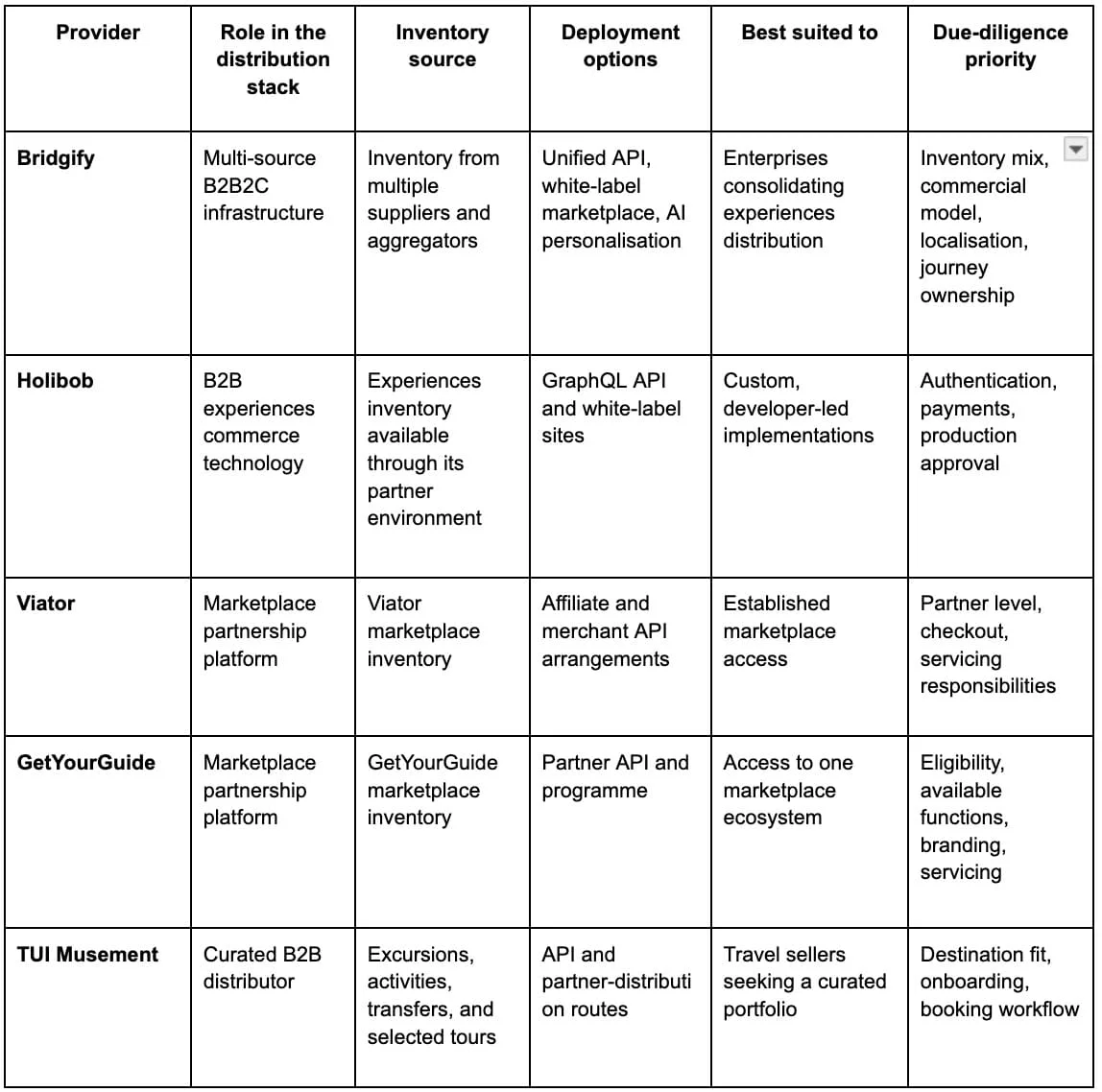
Travel API Integration Comparison for 2026–2027
What Your Integration Must Support in Production
Consistent Inventory Structures
Products from different sources may use different destination names, categories, participant types, descriptions, images, and cancellation terms.
Your integration should present this information consistently enough for travellers to search, compare, and book within one journey. This is particularly important when your inventory comes from several sources.
Availability and Price Validation
Your team should determine how availability is checked, when prices are reconfirmed, and what happens if either changes during checkout.
Testing should include currencies, time zones, participant categories, booking cut-off times, sold-out products, and delayed supplier responses.
The term “real-time availability” should also be examined carefully. Confirm whether availability is requested during search, refreshed at defined intervals, or reconfirmed immediately before booking.
Clear Transaction Ownership
Your technology must reflect the commercial arrangement. Before development begins, agree who controls checkout, collects payment, issues confirmations, manages refunds, supports customers, and owns the traveller relationship.
These responsibilities should be reflected in both the technical workflow and the customer-facing experience.
Post-Booking Operations
A production-ready activities booking API may also need to manage supplier changes, traveller cancellations, refund details, booking-status updates, webhooks, reporting, and reconciliation.
Your team should test these workflows with the same rigour as product discovery and successful booking creation.
Operational Controls
Sandbox access is only the starting point. Your production review should cover authentication, rate limits, certification, monitoring, error handling, retry logic, incident escalation, and technical support.
What Will Shape Travel API Integration Through 2027?
Four capabilities are likely to become increasingly important.
Multi-source consolidation: As your platform expands across destinations and categories, you will need to control the technical and operational work created by additional supply relationships.
Complete servicing workflows: Discovery and checkout must connect with fulfilment, supplier changes, cancellations, refunds, and customer communications.
AI connected to bookable inventory: Personalised recommendations create more value when they lead to products with current availability, accurate pricing, and a functioning booking path.
Flexible deployment models: Your organisation may begin with a white-label environment and move towards deeper API integration. Alternatively, it may introduce merchant inventory after launching with an affiliate structure.
The right architecture should support both your first customer journey and the next stage of your distribution strategy.
Bottom Line: Build for the Current Market and the Next Stage of Distribution
Travel API integration in 2026 should be evaluated against both your immediate launch requirements and the way your experiences proposition is likely to develop through 2027.
Viator and GetYourGuide provide marketplace-connected routes. TUI Musement offers curated B2B distribution. Tiqets specialises in attraction-led connectivity, while Holibob provides a GraphQL-based integration model.Bridgify is designed as multi-source experiences infrastructure that consolidates inventory, distribution, and AI-powered personalisation within a single platform.
The strongest integration is the one that supports more than your first search and booking. It must continue to perform across payment, confirmation, fulfilment, changes, cancellations, customer support, and future expansion.