
By Dr. Jinju Heo
How luxury executives can navigate market complexity without sacrificing brand legacy
In an industry built on stability and tradition, luxury brands face an unprecedented challenge: how to adapt to radical uncertainty while preserving the very heritage that defines them. The answer isn’t choosing between legacy and innovation; it’s mastering the art of strategic oscillation.
When Hermès reported 8.5 percent sales growth during the 2008-09 financial crisis1 (a period when global luxury demand contracted sharply), industry observers attributed this resilience to the brand’s unwavering commitment to timeless quality over trend-chasing. Meanwhile, Gucci’s transformation under Alessandro Michele demonstrated the opposite path: radical creative reinvention that rejuvenated a heritage brand through contemporary disruption.
Both succeeded. Both took fundamentally different approaches. And both offer critical lessons for luxury executives navigating today’s volatile landscape.
The uncomfortable truth about luxury strategy
The luxury sector operates under a dangerous assumption: that the strategies which built enduring brands over decades will continue to serve them in an era of geopolitical tensions, climate urgency, and generational consumer shifts. They won’t.
For luxury brands, this creates a paradox: success requires both preserving legacy and embracing adaptability.
Traditional luxury strategy emphasizes equilibrium (long-term planning, controlled narratives, exclusive distribution). But complexity science tells us that industries facing genuine uncertainty benefit from dynamic recalibration, not rigid structures. For luxury brands, this creates a paradox: success requires both preserving legacy and embracing adaptability.
Consider the pressures converging on luxury today:
Generational disruption
Gen Z and Millennials now drive luxury growth, yet their expectations clash fundamentally with traditional luxury codes. They demand transparency over mystique, sustainability over scarcity, digital accessibility over exclusivity. These aren’t preferences but they’re prerequisites for relevance.
According to Bain & Company’s 2023 luxury study, Gen Z consumers are expected to account for roughly a third of luxury purchases by 2030.2 Yet EY’s 2025 survey shows that craftsmanship and heritage remain central purchase drivers, with 62 percent of luxury clients ranking material quality and 48 percent ranking brand heritage among their top purchase criteria.3 This creates a paradox: younger consumers want innovation and relevance, while the broader market still values timeless tradition. Brands must serve both simultaneously.
The sustainability imperative
Luxury consumers increasingly expect carbon neutrality, ethical sourcing, and circular business models. Brands like Stella McCartney and Gucci have integrated sustainable materials into their core offerings, but this shift demands balancing exclusivity with the scale required for meaningful environmental impact.
The tension here is fundamental. Sustainability often requires transparency about supply chains, production volumes, and material sourcing. Yet luxury has historically thrived on mystique and scarcity. How do you disclose your supply chain without revealing the scale that might undermine perceptions of exclusivity? How do you implement circular fashion without suggesting that your products are anything less than eternal heirlooms?
Some brands are finding innovative solutions. Hermès, for instance, frames sustainability as an extension of craftsmanship, emphasizing repair services, leather regeneration programs, and the longevity of their products. This positions environmental responsibility not as a concession to activism but as consistent with their century-old commitment to quality and durability.
Digital acceleration
Luxury brands spent centuries controlling their narratives through curated physical experiences. Now, social media influencers, e-commerce platforms, and the metaverse force engagement in digital spaces while maintaining exclusivity. Louis Vuitton and Balenciaga have entered virtual fashion and NFTs, adding complexity to an already delicate brand equation.
The digital challenge extends beyond simply having an online presence. It’s about maintaining the carefully constructed aura of luxury in environments designed for accessibility and viral spread. When anyone can screenshot your runway show within seconds and share it globally, when influencers can create their own narratives around your brand, when digital natives expect immediate access, how do you preserve the sense of earned access that has defined luxury for generations?

Economic volatility
Pandemics, trade restrictions, and inflation can rapidly alter high-net-worth purchasing power and disrupt production cycles. The 2008 financial crisis, COVID-19 pandemic, and recent supply chain disruptions have demonstrated that even ultra-wealthy consumers adjust spending during uncertainty. Resilient operational models are no longer optional; they’re survival mechanisms.
Yet traditional luxury strategy emphasizes long production cycles, specialized suppliers, and carefully controlled distribution. These structures create vulnerability during disruptions. The question becomes: how much operational flexibility can you build without compromising the artisanal processes that justify premium pricing?
The challenge isn’t simply adapting to these forces. It’s knowing when to uphold tradition and when to recalibrate (what we call strategic oscillation). More critically, it’s understanding that different parts of your organization may need to operate at different speeds simultaneously.
Strategic calibration: A framework for navigating uncertainty
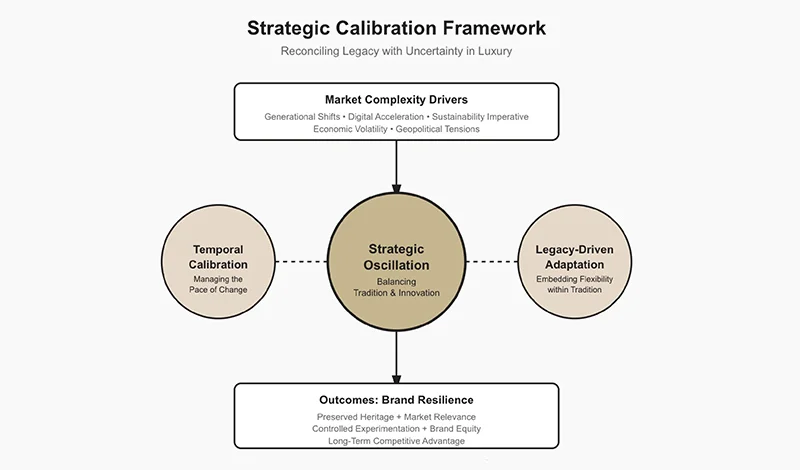
Luxury executives need a structured approach to reconciling uncertainty with legacy. The Strategic Calibration Framework offers three interdependent mechanisms:
Figure 1: The Strategic Calibration Framework illustrates how luxury brands reconcile market complexity through three interdependent mechanisms centered on strategic oscillation.
1. Temporal Calibration: Managing the pace of decision-making
Temporal calibration is the ability to align decision-making speed with market signals while preserving long-term brand equity. Luxury firms traditionally operate on extended time horizons, valuing heritage and craftsmanship. Yet digital transformation and shifting consumer expectations demand faster adaptation.
The key is modulating responsiveness without undermining core identity.
Swiss watchmakers exemplify this balance. Patek Philippe and Audemars Piguet maintain meticulous handcrafting processes to sustain exclusivity while expanding digital storytelling and digitally enabled client experiences to reach evolving consumers. Luxury automotive brands like Rolls-Royce and Bentley embrace electric vehicle technology without sacrificing bespoke craftsmanship.
Temporal calibration also extends to brand communications. Social media demands real-time engagement, yet luxury brands must maintain their aura of exclusivity. Balenciaga successfully leverages ephemeral digital content through time-limited campaigns and high-visibility collaborations, creating urgency and exclusivity in digital spaces. By strategically using ephemeral social formats and WeChat-native activations such as mini-games and collectible digital assets, Balenciaga cultivates scarcity online while adapting to contemporary engagement trends.
Practical implications: Luxury brands should develop capabilities in both domains, maintaining slow-moving heritage production while building agile digital engagement mechanisms. The mistake is choosing one over the other. The opportunity is calibrating between them based on context.
2. Strategic Oscillation: Balancing tradition and innovation
Strategic oscillation captures the iterative movement between tradition and innovation (controlled experimentation that doesn’t erode core brand values).
Strategic oscillation captures the iterative movement between tradition and innovation.
Porsche’s approach to electric mobility illustrates this principle. By introducing electric models like the Taycan while maintaining signature design elements and driving dynamics, Porsche engages with sustainability without compromising its high-performance legacy. The brand sustains authenticity while adapting to contemporary consumer demands and regulatory landscapes.
Digital transformation presents similar challenges. While Louis Vuitton and Dior have entered the metaverse and digital fashion spaces, they’ve done so in ways that preserve exclusivity. Limited-edition NFTs and exclusive virtual experiences ensure that digital expansion aligns with legacy-driven identity rather than becoming mass-market extensions.
This requires curating scarcity and exclusivity in virtual settings. Balmain’s collaboration with Need for Speed Unbound 4 extended the house into digital wearables tied to a tightly designed aesthetic drop. Virtual fashion shows and AI-assisted personalization allow luxury brands to enhance engagement while reinforcing exclusivity.
Practical implications: Innovation initiatives should be evaluated not just on commercial potential but on brand alignment. Ask: Does this enhance our heritage or dilute it? Can we create scarcity and desirability in this new domain? Are we controlling the narrative or surrendering it?
3. Legacy-Driven Adaptation: Embedding flexibility within tradition
Unlike mass-market firms prioritizing scale and efficiency, luxury brands derive value from heritage, craftsmanship and controlled scarcity. Legacy-driven adaptation means using historical values as strategic anchors while selectively embedding flexibility in operational domains.
Sustainability demonstrates this approach. In luxury, sustainability initiatives must align with brand heritage and craftsmanship while addressing contemporary ethical concerns. Integration cannot compromise exclusivity, rarity, or artisanal quality.
Luxury consumers expect sustainability to enhance value propositions, not serve as cost-saving measures. Circular fashion, responsible sourcing, and carbon neutrality have become central to modern luxury strategies. However, brands must frame sustainability as enhancing craftsmanship and exclusivity rather than deviating from tradition.
Digital expansion offers another domain for legacy-driven adaptation. The Aura blockchain consortium’s5 product passports digitize luxury’s core promise such as authenticity and provenance, while Prada’s Timecapsule6 connects limited drops to product-linked NFTs that intensify rarity rather than dilute it. These examples show that legacy-driven adaptation isn’t wholesale transformation. It’s selectively embedding flexibility within domains aligned with evolving luxury dynamics.
Practical implications: Identify operational domains where flexibility enhances brand equity (digital engagement, sustainability) versus those requiring stability (core product craftsmanship, brand narrative). Invest in the former while protecting the latter.
What this means for your organization
The extended timeline for luxury market transformation (driven by generational shifts, sustainability pressures, and digital acceleration) requires fundamentally different strategic approaches. Here’s what executives should focus on:
- Abandon binary thinking. The choice isn’t heritage versus innovation. Successful luxury brands will master oscillation between both, knowing when to emphasize each based on context, product category, and consumer segment.
- Invest in temporal capabilities. Build organizational structures that support both slow-moving heritage processes and agile market responsiveness. This often requires separate teams with different mandates, metrics, and decision rights.
- Curate sustainability narratives. Position environmental initiatives as extensions of craftsmanship rather than concessions to activism. Patagonia’s “buy less” message works for outdoor gear; luxury requires “buy better, keep longer” narratives emphasizing quality, repairability, and heritage.
- Control digital narratives. Don’t surrender brand storytelling to platforms, influencers, or algorithms. Curate digital experiences that replicate (not replace) the exclusivity of physical luxury. Virtual scarcity is achievable but requires intentional design.
- Measure differently. Traditional luxury metrics (brand equity, price premium, customer lifetime value) remain important, but add resilience indicators: How quickly can we adapt to supply disruptions? How effectively do we engage younger consumers while retaining heritage customers? How sustainable is our value chain without compromising quality? What’s our organizational capacity for parallel operations at different tempos?
Consider adding metrics like:
- Adaptation latency: Time from market signal to strategic response across different domains.
- Brand consistency scores: Measuring whether innovations reinforce or dilute core identity.
- Generational engagement balance: Tracking acquisition of younger consumers without alienating core clientele.
- Heritage leverage ratio: How effectively new initiatives draw on and reinforce brand history.
These metrics create accountability for the strategic calibration approach rather than defaulting to pure growth or pure preservation mindsets.
The path forward
The luxury brands that thrive over the next decade won’t be those with the longest heritage or the most innovative products. They’ll be those that master strategic oscillation (moving fluidly between preservation and transformation based on market signals, consumer needs, and strategic priorities).
This requires discipline. Luxury executives face constant pressure to chase trends, expand markets, and accelerate growth. The hardest decisions aren’t about whether to innovate; they’re about when innovation enhances heritage versus when it erodes it.
Hermès’ crisis resilience came from saying no (to discounting, to trend-chasing, to rapid expansion). Gucci’s renaissance came from saying yes (to creative risk, to digital platforms, to cultural provocation). Both were right for their contexts.
Your challenge as a luxury executive is developing the strategic judgment to know which response your brand needs, when it needs it, and how to execute it without compromising what makes you luxury in the first place.
This judgment doesn’t come from frameworks alone. It requires deep understanding of your brand’s DNA, honest assessment of your organization’s capabilities, and courage to make decisions that might sacrifice short-term opportunities for long-term brand integrity.
Consider what this means practically. When a competitor launches in the metaverse, do you follow immediately or wait to understand if this aligns with your brand? When Gen Z consumers demand transparency, do you reveal your entire supply chain or curate selective disclosures that maintain mystique? When sustainability pressures mount, do you rush to carbon neutrality with visible compromises or take longer to achieve it authentically?
These aren’t theoretical questions. They’re the daily reality of luxury management in an era of uncertainty. The Strategic Calibration Framework provides structure for these decisions but, ultimately, luxury leadership is about judgment cultivated through experience, refined through reflection, and executed with conviction.
The luxury paradox isn’t a problem to solve. It’s a tension to manage (perpetually, strategically, and with the same craftsmanship you bring to your products). The brands that master this tension won’t just survive market complexity; they’ll define the next era of luxury.