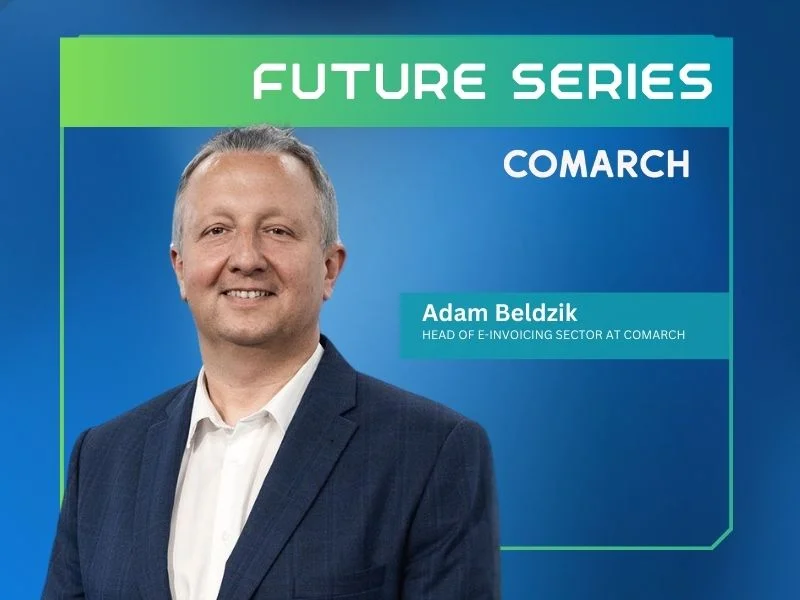
Interview with Adam Beldzik of Comarch
For many business organizations, dealing with changes in global compliance regs is about reaction. But what if it didn’t have to be that way? What if you could predict changes and, thus, turn compliance risk into business advantage?
Thank you for taking the time to meet with us, Mr. Beldzik! To begin, you’ve been working with EDI and e-invoicing for nearly two decades now. How would you describe the biggest structural shift you’re seeing today in the global invoicing landscape?
It’s a pleasure to be here. Global e-invoicing is no longer an optional automation tool; it is a mandatory, real-time trust layer between business and government. Under modern Continuous Transaction Control (CTC) models, unverified transactions technically do not exist. As a global e-invoicing leader, Comarch engineers AI-driven architectures that predict, rather than merely react to, regulatory shifts. By leveraging predictive AI, we anticipate legislative changes, transforming global compliance from a reactive bottleneck into a proactive, strategic advantage.
We anticipate legislative changes, transforming global compliance from a reactive bottleneck into a proactive, strategic advantage.
Also, we focus heavily on how we protect the data throughout its lifecycle. While many still rely on the “visual document” and, indeed, most recipients still expect a PDF for their own records, the underlying reality is that the structured data (like XML or JSON) is what drives the legal and tax validity. We are seeing a global domino effect where the blueprints created in Latin America are being refined into standards like France’s Y-model, Poland’s KSeF, or Peppol PINT framework, now being adopted in Singapore and the UAE. For a CFO, the challenge is ensuring that this deep integration into their ERP remains secure and compliant without disrupting daily operations.
With many organizations responding to new mandates by deploying country-specific e-invoicing solutions, why do you think this localization approach creates long-term risk rather than resilience?
When a new mandate hits in a country like Poland or France, the knee-jerk reaction for a local branch is to find a quick, local fix. But honestly, what we’re seeing across global implementations is that this “patchwork” approach actually creates a massive number of technical problems that eventually stall growth.
When a company has 10 different local vendors, they are managing 10 different security audits, 10 different support levels, and 10 potential points of failure. It’s a fragmentation nightmare.
One of the biggest issues we see at Comarch when talking to CFOs is the “visibility gap.” If your invoicing data is trapped in local silos, you lose that “big picture” of your global cash flow.
This is why we advocate for what we call the Global Trusted Intermediary model. Think of it as a refined hub-and-spoke architecture. Instead of a web of messy, high-maintenance connections, you have one central, high-security hub that acts as your regulatory shield. We provide the CFO with a single point of truth where global data remains untampered with and fully visible in real time.
A global partner should act as a “regulatory shield.” We take the hit of monitoring the constant law changes so the client doesn’t have to. Instead of managing a dozen different security standards, you have one unified, high-level standard across your entire global footprint. It turns compliance from a recurring headache into a streamlined, predictable part of the business.
ViDA is often discussed as a European regulation, but its implications seem much broader. How should global organizations interpret ViDA? As a regional issue or a signal of a wider global shift?
At its core, while ViDA is strictly a European legislative package, global organizations really should interpret it as a primary reference point for the worldwide modernization of transaction-level tax reporting. It mandates a common semantic data model, EN 16931, which establishes a very stringent foundational baseline for cross-border digital reporting.
However, treating ViDA as a universal guarantee is a dangerous architectural oversimplification. ViDA doesn’t magically dismantle domestic clearance platforms like Italy’s SdI or Poland’s KSeF.
Instead, organizations face a bifurcated reality: managing harmonized EU payloads on one side, while navigating hyper-local, intrusive validation on the other. This is where the role of a Global Trusted Intermediary becomes critical.
At Comarch, we provide a secure architecture that acts as a buffer, ensuring that your data remains untampered with and your operations remain unbroken, even as you bridge the gap between standardized reporting and divergent local models.
How does regulatory fragmentation impact data quality and visibility at the executive level, particularly for CFOs and risk leaders?
Regulatory fragmentation is as much a security vulnerability as it is a compliance challenge. For a CFO or a risk leader, it’s a significant challenge, because navigating the complex and changing rollout of mandates, like Poland’s KSeF, means that even a slight compliance misalignment can disrupt an entire supply chain.
It’s the classic “garbage in, garbage out” problem. If your data is fragmented across different systems and local standards, your predictive analytics and cash flow forecasting become little more than guesswork.
Regulatory fragmentation is as much a security vulnerability as it is a compliance challenge.
At Comarch, we act as a global translator, verifying every data stream. On the outbound (AR) side, we ensure that only invoices already meeting government-mandated tax identity requirements ever enter your workflow and are legally cleared the second they’re sent, so you can recognize revenue immediately. On the inbound (AP) side, we focus on seamlessly ingesting pre-validated vendor invoices directly from national government platforms. This ensures that only invoices already meeting government-mandated syntax and tax identity requirements ever enter your ERP’s payment approval workflow.
What we provide is a “Control Tower” view, a single dashboard where a risk leader can monitor the status of every transaction globally from one interface. You can see instantly if an invoice is processed in France, being verified in Saudi Arabia, or cleared in Thailand. It turns a fragmented compliance burden into a centralized strategic asset.
You’ve also spoken about the importance of a Single Source of Truth. What does that concept mean in the context of e-invoicing and compliance, and why is it becoming a board-level concern?
When we talk about a Single Source of Truth today, we are talking about data integrity as a defense mechanism. In an era of AI-driven financial scams, a discrepancy is a security red flag.
In the past, a small discrepancy might have taken months to uncover during a manual audit. Nowadays, a mismatch is a red flag that can automatically halt transaction approvals, increase your organizational risk profile for future audits, or lead to significant financial penalties due to accumulated non-compliance fines.
At Comarch, we ensure that the invoice your customer receives, the copy sitting in your legal archive, and the digital report the government sees all come from the exact same verified data point. By eliminating data translations between these steps, we guarantee absolute semantic parity and zero compliance risk.
If the tax authority’s record doesn’t match your ledger, the government is going to trust their data over yours every single time. That’s why having that one, unshakeable version of the truth is becoming a top priority for leadership.
How does working with a single global partner change the conversation from reactive compliance to proactive risk management?
When you’re juggling local vendors, every new law feels like an emergency landing. Entering a new market like the Middle East or Asia should be a business decision that the technology just supports.
Instead of starting from scratch every time, we leverage the existing data stream we’ve already built for a company and simply activate the “local logic” needed for the new jurisdiction, whether that’s ZATCA’s strict UBL 2.1 requirements in Saudi Arabia or the Peppol PINT in Japan and Malaysia. It’s more like flipping a switch than building a new factory.
Comarch also has a dedicated regulatory team that tracks global e-invoicing mandates and Continuous Transaction Controls legislation, before they hit the headlines. We see the curve in the road before the client does.
But the real game-changer lately has been how we use agentic AI. We have these models working 24/7 to monitor data streams and identify what I’d call “atypical behaviors.” If there’s a sudden deviation in invoice amounts, a duplicate bill, or a weird tax pattern that looks like a systemic error, the AI flags it instantly. The goal is to catch those red flags before they ever reach a government portal.
We’re also seeing a global migration away from legacy EDI at the same time as regulatory pressure is accelerating. How do these two forces collide? What problems does that create for multinational businesses?
The problem is that legacy EDI was designed for B2B efficiency. It wasn’t built for the “real-time reporting” era, where the government wants to sit in the middle of every transaction. So, multinational firms need to modernize their aging infrastructure just as regulatory pressure is at its peak.
What we’re seeing is a desperate need for a hybrid approach. You can’t just flip a switch and turn off your supply chain communications to satisfy a tax auditor. You have to somehow align logistics-heavy EDI and tax-heavy e-invoicing.
In our work at Comarch, we try to make this collision less painful by merging those two worlds into one cloud infrastructure—wrap around the client’s legacy systems instead of ripping them out and replacing them.
Legacy EDI wasn’t built for the “real-time reporting” era, where the government wants to sit in the middle of every transaction.
We can ingest legacy EDI syntaxes, like EDIFACT, directly from the ERP and transform them into the specific format mandated by the tax authority. Upon real-time government clearance, we can route a synchronized dual payload to the recipient—a legally validated e-invoice paired with the same data translated into their preferred B2B standard.
It allows a company to become fully compliant without breaking the supply chain workflows that actually keep the business running. So it’s about evolution rather than a total, risky overhaul.
Agentic AI is starting to enter the workflows as well. Where do you see AI delivering real value in e-invoicing today?
AI has been a buzzword for a while now but, in the world of e-invoicing, we’re seeing it move past the hype into some very practical, high-value territory.
One immediate win is intelligent automation for cost categorization. Instead of a person squinting at a screen to figure out which department an invoice belongs to, the AI analyzes historical booking patterns to suggest the correct GL account, cost center, and tax code. In our experience at Comarch, this typically automates about 80 to 90 percent of routine invoice coding right out of the gate.
But we have to be very clear about how this is deployed. The activation of these AI-driven workflows is entirely opt-in and used strictly at the request of the client to solve their specific operational bottlenecks. As a Trusted Intermediary, Comarch acts as a secure digital shield, guaranteeing that, while we use AI to protect your transactions, your proprietary data remains isolated and untouchable. We take full responsibility for the highest level of data security, guaranteeing strict data isolation so that a client’s proprietary data is never exposed or co-mingled while training these advanced models.
Even when an invoice successfully clears a government CTC platform (like Italy’s SdI or Poland’s KSeF), it often remains incompatible with zero-touch AP automation. Tax authorities validate syntactic schemas and VAT math, not business logic. Consequently, suppliers frequently bury critical routing data, such as purchase order (PO) numbers, within unstructured comment fields.
Upon explicit client request, our AI models extract and remap these orphaned variables utilizing historical data patterns. Crucially, we execute here a dual-payload delivery mentioned earlier, routing an enriched, ERP-ready dataset to your AP system, alongside the untouched original government XML, guaranteeing both automation and audit compliance.
From a C-level perspective, what questions should executives be asking their teams or vendors to avoid future compliance and scalability issues?
If I were sitting in a boardroom today, the first thing I’d suggest is changing the fundamental lens through which we view this. Historically, cost-per-invoice reduction was the primary metric used to justify e-invoicing ROI. But the conversation now needs to be about time to market and risk mitigation.
There are two big questions every executive should be asking their teams:
First, “Is our compliance strategy proactive or reactive?” If you are patching your ERP every time a local law changes, you are risking massive regression and unnecessary downtime. You want a partner who absorbs that legislative complexity outside of your core ERP environment, so your business keeps running smoothly.
The second question is even more strategic: “Are we treating our invoice data purely as a static compliance requirement, or leveraging it as active business intelligence?” These government mandates are actually doing you a favor by forcing your data into high-quality, structured formats like XML or JSON. That structured data is gold. Instead of waiting for month-end reports to see how the business is doing, you should be asking, “How are we using this real-time stream to improve our cash flow forecasting?”
When you have a unified data stream across all your global entities, you suddenly have real-time visibility into your working capital. This opens the door for things like dynamic discounting and much more accurate liquidity planning. You’re taking a mandatory compliance headache and turning it into a tool for growth.
Finally, if you were advising a global enterprise planning its e-invoicing strategy for the next decade, what mindset shift would you say is most critical to future-proofing their operations?
If I had to boil it down to one thing, it’s this: you have to stop seeing compliance as a tax you pay for doing business and start seeing it as the foundation for a truly agile enterprise. Move from a “must-do” mindset to a “want-to-do” mindset.
For a long time, companies viewed these mandates as hurdles. But the reality is that the high-quality, digital data forced upon us by these regulations speeds up everything, from how fast you get paid to how quickly goods move across borders. The winners of the next decade will be the companies that successfully integrate their core ERP systems with agile, scalable middleware to handle dynamic global data flows.
Think about what you can do with clean, real-time data. When you have total visibility into your global invoicing, you’re empowered. You can use that data to negotiate much better terms with your suppliers because you actually know your spend in real time. You can optimize your tax positions globally rather than reacting to them.
Furthermore, this digitized data stream can facilitate access to specific supply chain financing instruments. It opens the door to more efficient programs, as the standardized format of the data accelerates the underwriting of individual receivables. Ultimately, the goal is to build an integrated architecture that allows your analytics, treasury, and procurement teams to identify margin improvements continuously.