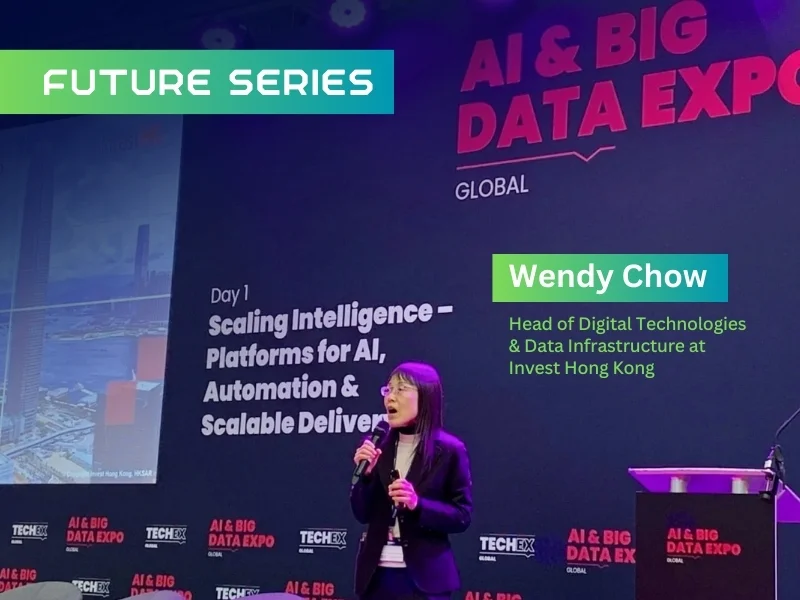
Interview with Wendy Chow of Invest Hong Kong
Artificial intelligence is reshaping how innovation ecosystems develop around the world. In this interview, Wendy Chow from Invest Hong Kong discusses the intersection of technology policy, digital infrastructure, and international collaboration. The conversation explores responsible AI governance, cross-border growth strategies, and the evolving role of governments in enabling sustainable technology development.
Your career spans technology, public policy, and international business. What first drew you into working with digital technologies and data infrastructure, and what has kept you engaged in this space?
My fascination with digital technology and data infrastructure stems from a career spanning transformative cycles that reshaped the global economy. Before joining InvestHK – the government department supporting international and Mainland companies expanding through Hong Kong – I built my professional foundation in the international market development team of a global telecommunications subsidiary.
That era marked the first wave of the internet economy, culminating in the dot-com bubble. Amid rapid, turbulent adoption, business models shifted from traditional profitability to prioritising digital presence and audience reach. From that emerged the e-commerce and infrastructure ecosystems we now take for granted. It showed me technology isn’t just one industry, but the horizontal foundation of modern commerce and society.
In the public sector, I’ve seen government policy grow increasingly central to shaping technology’s development, governance, and deployment. Innovation no longer relies solely on market forces; it evolves within regulatory and societal frameworks requiring careful stewardship.
I built my professional foundation in the international market development team of a global telecommunications subsidiary.
My academic and professional background across literature, communications, business, and mental health has fostered a deep intellectual curiosity suited to technology. The field demands lifelong learning amid relentless change – data architectures from years ago are now redefined by AI and edge computing. Constant adaptation is essential yet rewarding.
In today’s AI era, a leader’s key asset is agility to navigate change and harness AI for real-world challenges. This nexus of technical evolution and human-centred policy keeps me engaged and motivated.
You work closely with founders, investors, and policymakers across different markets. What do you find most rewarding about helping innovation ecosystems develop and scale?
Working with founders, investors, and policymakers across markets, I find the most rewarding part is “connecting the dots” – turning visionary ideas into commercial realities through ecosystem orchestration.
Hong Kong’s unique position as a “super-connector” between global enterprises and Asia’s high-growth markets makes this especially fulfilling. Amid geopolitical tensions, multinationals increasingly use Hong Kong for risk mitigation, leveraging our stable Common Law system and robust IP protection as a strategic hub.
My role is like an architect at strategic intersections. I break down silos between founders developing breakthrough technologies, strategic investors, and policymakers, enabling Greater Bay Area (GBA) scaling. Facilitating the right conversations at the right time strengthens the entire innovation value chain.
It’s deeply rewarding to enable success through others. InvestHK’s impact doesn’t lie in what we do directly, but what we enable the private sector to achieve – for example, startups growing from a small founding team to organisations employing hundreds.
Each deep-tech company we help establish contributes to future-proofing Hong Kong, transforming it from a fledgling entrepreneurial community into a world-class, resilient, knowledge-based hub that attracts global talent.
At the recent AI & Big Data Expo in London, discussions ranged from generative AI to enterprise adoption and responsible use. Which conversations or ideas stayed with you most after the event?
At the AI & Big Data Expo in London, one theme stood out and has remained with me: the “trust gap”. While excitement around generative AI was palpable, the most substantive conversations centred on Responsible AI and how to balance exponential capability with risks like misinformation and algorithmic bias. I came away convinced that responsible governance is not a constraint on innovation, but the steering wheel that keeps it safe and purposeful.
Three ideas particularly resonated with Hong Kong’s policy direction. First, the threat of misinformation in the era of deepfakes and the need for “provenance by design”, recognising that the origin, authenticity, and integrity of data are as critical as the data itself. Second, the “bias trap”, where AI can entrench inequality if diversity and representativeness are not embedded in training data from the outset. Third, the importance of keeping a “human in the loop” for decisions that affect fundamental rights.
Organisations that embed ethics and transparency early are not just managing legal risk; they are building public trust, the defining currency of the AI age. In Hong Kong, the conversation is shifting from “Can we build this?” to “How do we build this responsibly?” This philosophy underpins our guidelines and governance frameworks, including the “Ethical Development and Use of AI” guidance, which provides clarity and business certainty while safeguarding the wider community.
Hong Kong is often described as being in the midst of a technology renaissance. What factors are driving this momentum in AI and big data, and where is the city beginning to stand out globally?
Hong Kong is undergoing a technology renaissance as it transforms into an international innovation and technology (I&T) hub. This momentum is driven by a clear policy framework, including the Hong Kong Innovation and Technology Development Blueprint, which sets out a 5–10 year roadmap. The city’s core advantage is its position as a place where capital meets technology: as the world’s third-leading financial centre, it offers deep liquidity and diverse funding channels that help high-growth tech firms to scale.
Government commitment is another major driver. Since 1999, the Innovation and Technology Fund has received around HKD 53 billion (about USD 6.76 billion). As of December 2025, it had approved over 82,000 projects, with total funding exceeding HKD 55.7 billion (USD 7.1 billion). In addition, generous R&D tax deductions – 300% on the first HKD 2 million (USD 255,000) and 200% thereafter, with no cap – encourage private investment.
Infrastructure is a vital pillar of growth. The Cyberport AI Supercomputing Centre, established in 2024, offers world-class 3,000 PFLOPS of supercomputing power, supported by an HKD 3 billion (USD 383 million) AI Subsidy Scheme that lowers access costs for eligible enterprises.
Finally, Hong Kong’s academic excellence – five universities in the global top 100 and initiatives like the Global STEM Professorships Scheme – ensures a strong talent pipeline. Together, capital, incentives, computing power, and talent position Hong Kong as a standout global destination for AI and big data innovation.
Many companies now think beyond single market expansion from the outset. How does Hong Kong’s integration with the Greater Bay Area shape the way international firms approach regional growth and collaboration?
Hong Kong’s integration with the GBA is reshaping how international firms plan regional growth. Operating under the “One Country, Two Systems” framework, Hong Kong uniquely combines a Common Law system and strong IP protection with direct, preferential access to Mainland China and the GBA’s 87 million consumers. This lets companies enjoy a trusted international legal environment while tapping Mainland scale.
A flagship example is the Hetao Shenzhen–Hong Kong Science and Technology Innovation Co-operation Zone, spanning 387 hectares of Hong Kong and Shenzhen. The Hong Kong Park focuses on life and health tech, AI, and data science, enabling firms to conduct R&D in Hong Kong while using GBA manufacturing for rapid prototyping.
There is also San Tin Technopole, with 210 hectares of new I&T land, which adds further room for scale.
The Hong Kong Park focuses on life and health tech, AI, and data science, enabling firms to conduct R&D in Hong Kong while using GBA manufacturing for rapid prototyping.
Data is a major strategic advantage. Hong Kong’s voluntary GBA Standard Contract, streamlines the cross-boundary flow of personal data from Mainland GBA cities to Hong Kong. Open to all sectors, it allows AI companies to train models on richer datasets within Hong Kong’s secure, international-standard privacy framework.
These frameworks mean firms no longer choose between a secure global hub and Mainland market access – they can build in Hong Kong and scale across the region. Hong Kong serves as the ultimate “Super-Connector” and “Super Value-adder”.
Public-private partnerships are playing a bigger role in bringing new technologies to market. How do these collaborations help organisations test, refine, and deploy solutions at scale?
Public-private partnerships (PPPs) in Hong Kong bridge research and commercialisation. The Research, Academic and Industry Sectors One-plus (RAISE+) Scheme, launched with HKD 10 billion (USD 1.28 billion), is a flagship example. It funds university research teams on a matching basis to commercialise their R&D into successful startups – having supported nearly 50 projects by June 2025, with funding exceeding HKD 2 billion (USD 255 million).
Further down the value chain, the Smart Government Innovation Lab assists government departments in adopting innovative IT solutions from local start-ups and SMEs, enabling them to refine their products in real-world “living lab” scenarios while improving public services. Also, Hong Kong’s InnoHK Research Clusters have successfully set up 30 research centres, involving over 30 world-class institutions from 12 economies, pooling over 3,000 researchers in healthcare, AI, robotics, and sustainable development.
For scale, Hong Kong’s New Industrialisation Funding Scheme supports traditional manufacturing businesses to develop “new industrialisation” with up to HKD 45 million (USD 5.74 million) per firm for smart production lines. Alongside, the New Industrialisation Acceleration Scheme offers up to HKD 200 million (USD 25.5 million) for strategic sectors such as AI and life/health tech.
PPPs have helped around 500 I&T firms establish or expand in Hong Kong, consolidating industry chains. The Hong Kong New Industrialisation Development Alliance, launched in March 2025, further aligns industry and investors for large-scale tech deployment.
As AI and data continue to reshape industries, how do you see Hong Kong’s role evolving in the global technology landscape, and what should international firms be focusing on right now?
Hong Kong is becoming a global stronghold for “new quality productive forces”, where productivity is driven by technological innovation. Under China’s 15th Five-Year Plan, it acts as a platform linking Mainland China and international markets through a “South-North dual engine” layout, combining our established financial prowess and burgeoning I&T sector to drive our future as an international I&T hub.
International firms should prioritise strategic sectors such as life and health technology, AI and robotics, and semiconductors, drawing on support vehicles like the Innovation and Technology Industry-Oriented Fund, launching this year and capped at HKD 10 billion (USD 1.28 billion). The goal is to channel at least HKD 40 billion (USD 5.1 billion) into such strategic industries. The Hong Kong AI Research and Development Institute, also launching in 2026, will spearhead industry applications and expand AI’s use across all sectors.
Equally important is Hong Kong’s push on digital government and data governance: the dedicated Digital Policy Office is spearheading data-driven services and opening-up of data. The “IAM Smart” identity platform – with over 4 million registered users – is being enhanced, and we will launch the Digital Corporate Identity (CorpID) Platform this year to facilitate B2B and B2G transactions.
Firms should focus on building a presence in hubs such as San Tin Technopole and the Hetao Shenzhen–Hong Kong Science and Technology Innovation Co-operation Zone, leveraging strong talent pipelines and a regulatory environment that balances rapid innovation with responsible governance.