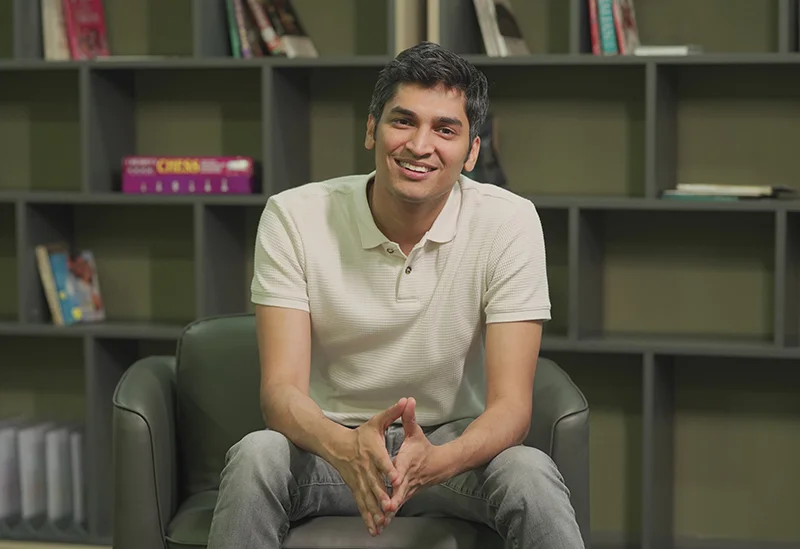
Interview with Pratham Mittal
Higher education is being rebuilt from the ground up. In this interview, Pratham Mittal explains why traditional business schools no longer match the realities of entrepreneurship and AI-driven markets. You will see how learning by launching real ventures reshapes judgment, leadership, and employability for a generation that values outcomes over credentials.
You moved from building one of India’s fastest-growing private universities to creating a new kind of global business school. What personal frustrations or insights pushed you to rethink the traditional higher education model?
“One experience at university changed how I think about learning. I was studying systems science at the University of Pennsylvania under Professor Adam Grant, who taught in a completely different way, less “study for the exam” and more “go and build something real.
A learn-by-doing model where students build ventures in the real world, get feedback fast, and develop judgment through doing the work, not just preparing for tests.”
In that class, we worked on a live problem for the Philadelphia Inquirer. They needed a faster way to update their website, so my co-founder and I built a simple tool to solve it. A class project became a product, then a company.
That experience made the gap in traditional higher education really obvious to me. Most university systems are still built around evaluation cycles such as lectures, exams, grades, and a lot of what students do is optimised for getting through assessments.
Tetr came from wanting to build the opposite: a learn-by-doing model where students build ventures in the real world, get feedback fast, and develop judgment through doing the work, not just preparing for tests.”
Applying a venture-capital mindset to education comes with very different risks and expectations. What assumptions did you have to challenge most when making that shift?
“One assumption is around where trust comes from. In most businesses, you earn credibility by showing what you’ve built. In education, trust often comes from how long your institution has existed – ideally, the longer the better.
With Tetr, we couldn’t rely on history because we didn’t have any. So we focused on what students were actually doing, whether they could launch ventures, raise money, win customers, and operate across different countries. That became the proof. In 2025, our approach was validated in two ways. First, we successfully raised USD 18 million in funding, co-led by Owl Ventures and Bertelsmann India Investments (BII). The investment is our first institutional round and will accelerate the expansion of our experiential “Learn by Doing” model across multiple continents.
Our global B-school model was also recognised academically when we received the QS Gold Award for Innovation in Business Education, which assesses institutions on demonstrable real-world impact, international exposure, and learning outcomes.
Another assumption we had to challenge was about planning versus reality. On paper, you can design a perfect global model. In practice, when students are moving between campuses and markets, things break. You learn very quickly what works and what doesn’t, and you have to fix it fast. That forced us to build Tetr as a working system, not just a concept.”
You have argued that business schools should operate more like venture firms. In practical terms, how does that change the way talent is selected, developed and assessed?
“We look less at how someone performs in a controlled environment and more at how they behave when things are uncertain.
At Tetr, that means paying attention to how students take feedback, whether they act on it, and how they respond when something doesn’t go to plan. Do they talk to customers? Do they change direction when the data tells them to? Do they take responsibility when a project stalls?
We look less at how someone performs in a controlled environment and more at how they behave when things are uncertain.
Assessment comes from what they actually move forward. We’re interested in trajectory: whether their work is getting sharper, their decisions are improving, and their ventures are becoming more real over time.
You can see that in outcomes. Tetr’s first undergraduate cohort launched 44 ventures in its first year, generating more than USD 324,000 in combined revenue, with several attracting external investment. More recently, students in Singapore and Malaysia collectively raised USD 60,000 on Kickstarter in just thirty minutes, which gives us a very direct signal about market response, not just classroom performance.”
“Learning by launching” reverses the classroom-first MBA approach. What differences have you seen in how students think, lead and make decisions?
“The biggest difference is how seriously people take their choices. When students at Tetr are building real ventures, missing a deadline or making a bad call has consequences. You lose a customer, a partner, or an opportunity. That changes how you think about priorities very quickly.
You also see leadership show up earlier. Students start negotiating, managing disagreements, and taking responsibility in their first year, not after they graduate. Over time, they stop aiming to be “correct” and start aiming to make progress, which is much closer to how the real world actually works.”
As AI becomes embedded across every business function, what does it truly mean to be an AI-native entrepreneur or executive beyond simply adopting new tools?
“For me, it’s less about mastering tools and more about understanding what you’re responsible for.
At Tetr, students use AI to research markets, test ideas, and build faster. But the important part is still human judgement, deciding which problem is worth solving, what information matters, and when something looks good in theory but won’t work in practice.”
Employers are increasingly questioning traditional credentials. How do you see the link between higher education and employability evolving in the next few years?
“The hiring conversation is shifting from credentials to evidence. Employers want to see decision-making, initiative and follow-through, not just a degree.
That’s why, at Tetr, students leave with a record of ventures, projects, and market experience, not just a degree and potential. You can look at what they built, who they worked with, and how they handled real world challenges.
In a world where information is easy to access and AI can generate answers quickly, employability is more about how someone operates under pressure, works with other people, and adapts when things change.”
Looking ahead to the end of this decade, how do you expect business education to be structured and valued, and what will distinguish institutions that stay relevant from those that struggle?
“I think business education will become more modular and more tied to outcomes.
The institutions that stay relevant will act more like platforms than classrooms. They’ll combine global exposure, real-world work, and technology in a way that keeps evolving.
At Tetr, we change the programme in real time based on outcomes; what students struggle with, what works in the market, and what actually helps them build. By the end of the decade, I think the strongest schools will be the ones whose graduates don’t need the brand name to speak for them, because their work speaks clearly: what they built, what they learned from the market, and how they performed when things got hard.”