
Business logic doesn’t sit still. Pricing rules change. Eligibility criteria evolves. Fraud patterns shift. Regulatory expectations get tighter. And the more those rules are hard coded into applications, the more every small update becomes a slow, expensive release cycle.
That’s why Business Rules Engines and Management Systems (referred as BRE/BRMS) have become core infrastructure for modern decision automation. In 2026, the most relevant platforms go beyond basic rule execution to support real‑time logic, auditability, and AI/ML ready decisioning where needed.
This article provides a practical comparison of six platforms for real‑time, compliant decision automation: DecisionRules, InRule, Decisions, FlexRule, Drools, and Taktile.
Business Rules Engines and Management Systems: what are they?
A Business Rules Management System (BRMS) helps organizations move beyond manual, static decision processes by managing rules in a structured, maintainable way. A Business Rules Engine (BRE) is the runtime component inside that broader system, the part that evaluates rules to produce decisions that are fast, consistent, and compliant.
Modern Business Rules Engines and Management Systems aren’t just nice to have admin tools, they’re increasingly used as decision infrastructure, supporting real‑time decision intelligence and traceability.
BRE vs BRMS
Business Rules Engines and Management Systems even if they are usually discussed together, they’re not the same thing.
A BRMS is the platform and lifecycle. A BRE is the runtime engine inside it.
Business Rules Engine (BRE)
A Business Rules Engine is the part that executes decision logic at runtime. In other words, it evaluates rule conditions using input data and returns an outcome that is fast, consistently, and (in regulated contexts) in a way you can justify later.
What a BRE typically includes
- A runtime execution engine (the component that evaluates rules)
- A way to access rules (at minimum, stored rule assets the engine can load)
A useful way to think about it:
BRE = execution (run the rules, return the decision).
Business Rules Management System (BRMS)
A Business Rules Management System is the broader environment used to define, govern, test, deploy, and manage rules over time and it’s specifically valuable because it separates business rules from application code.
A useful way to think about it:
- BRMS = management (authoring, testing, governance, versioning, audit trails).
Why should businesses adopt Business Rules Engines and Management Systems in 2026?
When rules live outside application code, organizations typically gain four practical advantages:
- Agility: rules can be updated without redeploying applications
- Transparency: outcomes can be explained and audited
- Consistency: decisions behave identically across systems and channels
- Compliance support: audit trails, versioning, and access controls make it easier to evidence how decisions were made
This is especially important in regulated environments. Companies operating under major frameworks (e.g.: GDPR, HIPAA, SOX, Basel III, Solvency II) often require transparent audit trails, explainability, and version control as non-negotiables.
Key trends shaping Business Rules Engines and Management Systems in 2026
Below are a few key trends that are impacting platform selection:
- Real‑time rule engines and streaming data are becoming standard for competitive sectors (finance, insurance, ecommerce).
- No‑code and low‑code rule authoring continues to expand rule ownership beyond developers.
- Machine learning and decision intelligence integration is increasingly expected (rules don’t replace ML; they operationalize it within guardrails).
- Traceability and governance are moving from compliance “nice to have” to core product requirements.
Core components you should expect in a BRMS
Most full BRMS platforms bundle capabilities that map to the rule lifecycle, including:
- Authoring + governance + versioning (the “where rules are created and controlled”).
- Execution runtime (the “decision server” / runtime layer), and more generally as the BRE layer enabling real-time decisions.
- Testing / simulation / validation to reduce deployment risk explicitly called out in the comparison table below for Decisions.
- Monitoring, dashboards, and analytics to understand decision outcomes and support auditing.
- Reporting and documentation (especially important for regulated industries ). Evaluation criteria explicitly includes reporting/documentation as a compliance consideration.
- Integration mechanisms (APIs/connectors) to plug decisions into enterprise systems for example, “Open APIs” supporting integration with enterprise systems like CRM/ERP.
BRE vs BRMS: key differences
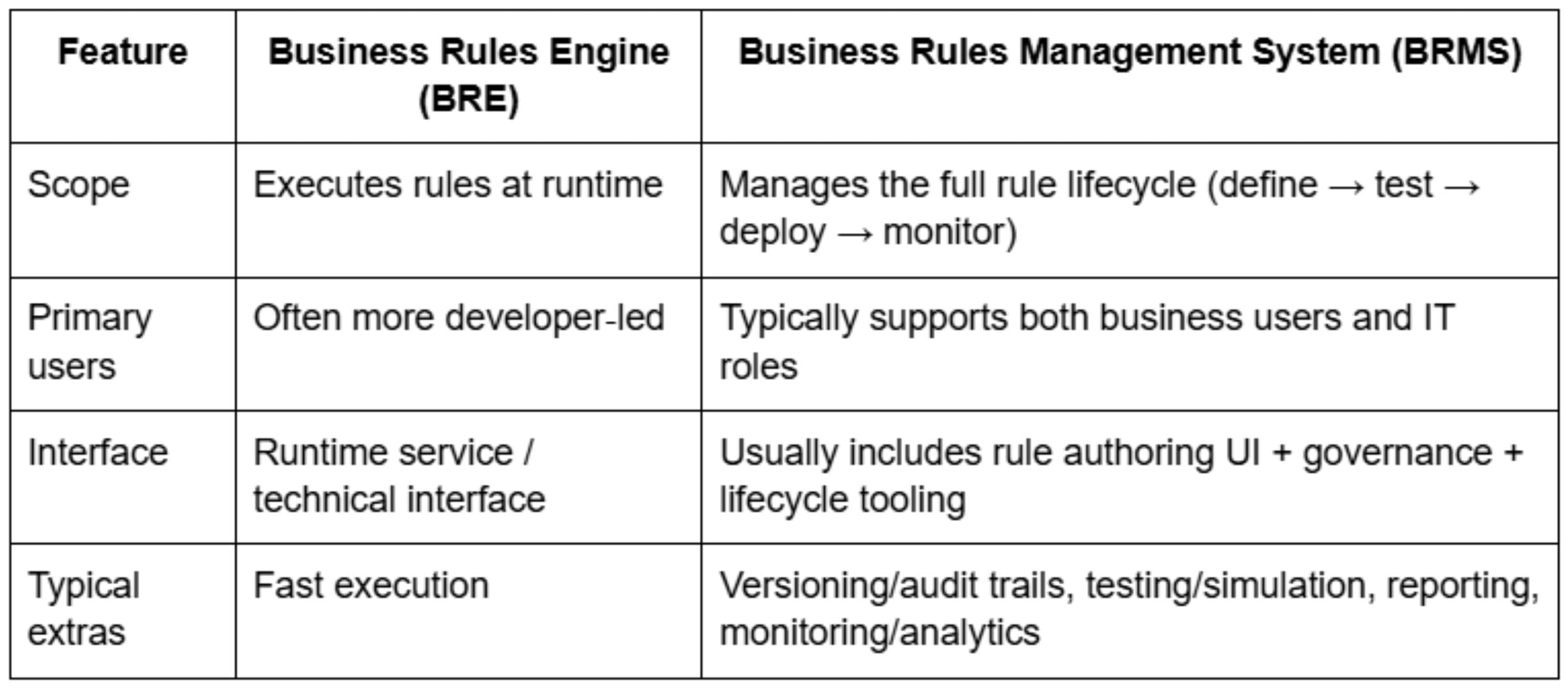
Common use cases for Business Rules Engines and Management Systems
If you’re wondering whether a BRE/BRMS is a good fit for you, it usually becomes relevant when your decisions need to be fast, consistent, and traceable.
Common examples:
- Approving a credit application, calculating a shipping fee, or adjusting an insurance premium
- Loan underwriting, fraud detection, claims automation, and dynamic pricing
How to choose the right Business Rules Engines and Management Systems platform?
Selection starts with business fit, not the number of features. In other words, the right platform depends on your goals, your team’s skill mix, and your industry constraints.
In practice, teams get better outcomes when they decide up front:
- Who owns rules day to day? (business analysts, engineers, or both)
- How strict are compliance and audit requirements? (audit trails, versioning, explainability, access control)
- What’s the delivery model? (cloud, hybrid, on‑prem for data sovereignty)
- How real‑time is “real‑time” for your use case? (API latency expectations, scaling needs)
- Do you need rules + workflows + process tooling, or rules alone?
And then consider all these key features:
- Low‑code/no‑code rule creation & business‑user access
- Real‑time API performance (sub‑100 ms)
- Full versioning & audit trails
- Hybrid cloud or on‑prem deployment options
- AI/ML model integration with rule logic
- Costs and training requirements
A simple, realistic decision process looks like this:
- Choose the top 2–3 platforms that match your governance + deployment constraints.
- Model one real business decision end‑to‑end (e.g., eligibility + pricing + explanation).
- Validate the lifecycle: author → test → version → deploy → audit.
6 top Business Rules Engines and Management Systems platforms compared
1. DecisionRules
DecisionRules is a cloud‑native, no‑code business rules engine designed to model, test, and automate complex decision logic without heavy developer involvement. The platform is described as delivering sub‑100 ms API response times, with full audit trails and versioning, enabling business and technical teams to collaborate on rule changes.
Features:
- No‑code / low‑code rules engine with real‑time API execution (sub‑100 ms)
- Audit logs + versioning for traceability
- Cloud‑native with on‑prem deployment support for strict compliance needs
- AI assistance for generating decision tables
Pros
- Visual rule design that supports non‑developers
- Designed for real‑time decision automation and governance
Cons / considerations
- A learning curve can appear when implementing more complex workflows
- More focused on core decision automation than broad workflow/process‑mining modules
2. InRule
InRule is described as an enterprise BRMS with strong governance, frequently associated with compliance‑heavy workloads (including public sector and healthcare). It’s positioned around complex rule logic and a business analyst‑friendly approach, with support for explainable ML/automation.
Features:
- Visual, business‑analyst‑oriented authoring experience
- Strong governance tooling for regulated environments
- Capacity for machine learning and automation
Pros
- Deep rule logic support for compliance‑heavy sectors
- Established platform with a track record
Cons / considerations
- The platform is aimed more at niche sectors and is not a general business engine rules solution.
3. Decisions
Decisions is positioned as a platform for organizations that need to combine business rules with process automation, going beyond “pure rules” into orchestration, simulation, validation, and process tooling.
Features:
- Visual orchestration tools for workflow + rules
- Testing, simulation, and validation capabilities
- Process orchestration and simulation, with marketed process mining capabilities
Pros
- Process orchestration and simulation, with marketed process-mining capabilities
- Strong fit where decision logic and workflow automation must live together
- Deep feature set for advanced users
Cons / considerations
- The UI and onboarding are described as heavier, especially for smaller teams
- A steeper learning curve for non‑technical users
4. FlexRule
FlexRule is positioned as a platform that blends process + analytics + machine learning, with an emphasis on compliance‑focused decisioning and “situational awareness” in regulated sectors (healthcare, finance, energy).
Features:
- Decision‑intelligence orientation for regulated contexts
- Integrated machine learning and analytics integration
- Learning resources that are often needed for adoption
Pros
- Versatile “bundle” for teams that want rules + analytics/process capabilities together
- Can be powerful in the hands of skilled users
Cons / considerations
- A real learning curve is called out, and some features may be redundant for average business users
- Not positioned as “rules‑only,” which may be a mismatch if you want a simpler BRE/BRMS scope
5. Drools
Drools (Red Hat Decision Manager) is a potent open source rule engine with strong customization potential. It’s repeatedly positioned as best suited for teams that have experienced developers available to implement, operate, and maintain it.
Features:
- Open source rule engine with strong customization and integrations potential
- Community support and longstanding ecosystem presence
Pros
- Highly customizable for developer led implementations
- Attractive for teams that want maximum control over rule execution and integration
Cons / considerations
- Requires significant developer involvement; not positioned as plug and play
- Limited UI tools compared to no‑code platforms
6. Taktile
Taktile is positioned as a modern, agile, UI‑focused decision engine for fintechs and similar high‑tech businesses, with an emphasis on speed and usability. It’s described as cloud only and relatively lightweight, with governance trade offs for regulated enterprises.
Features:
- AI-driven fraud prevention
- 100% cloud infrastructure
- Focused on fintech use cases like credit/fraud/payments
Pros
- Strong fit for startups and scaleups that prioritize agility and usability
- Well‑designed UI
Cons / considerations
- Governance features exist (audit trails, versioning, access control), but the platform is primarily optimized for financial risk decisioning rather than broad, enterprise-wide BRMS governance.
- May be too lightweight for large enterprises needing advanced growth features
Comparison Table of Business Rules Engines and Management Systems
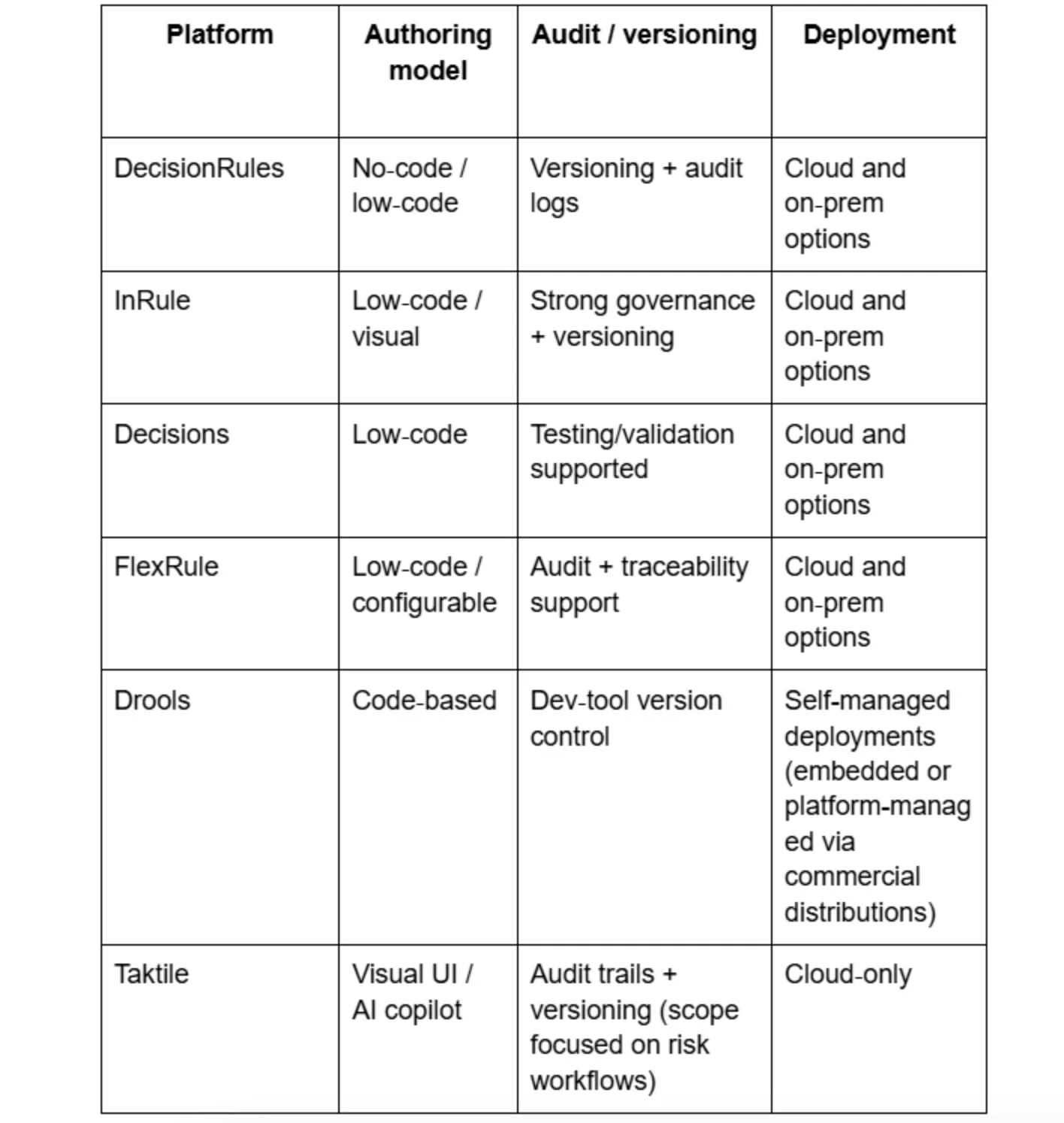
Conclusion
In 2026, Business Rules Engines and Management Systems are less about “running if/then logic” and more about making decision logic fast, consistent, traceable, and maintainable, especially as AI/ML, real‑time data, and compliance expectations converge.