Interview with Renata Trinca Colonel, Academic Director of the EMBA
In an era marked by complexity and constant transformation, business leaders need the mindset, skills, and perspective to shape meaningful change. SDA Bocconi’s Executive MBA blends decision sciences, business analytics and simulation-based learning with flexible formats tailored to today’s professionals. The result is a transformative experience that enhances strategic thinking and inspires a broader vision rooted in innovation and human impact.
It’s such an honor to have you with us today, Mrs Trinca Colonel. To begin, you have an extensive background in decision sciences and business analytics. How are these themes integrated into SDA Bocconi’s EMBA program?
Analytics and critical thinking play a central role in shaping effective executives, equipping them with the ability to interpret increasingly complex business scenarios. Today, we face the exponential growth of available data and a vast amount of information at our disposal. The real challenge is transforming this complexity into strategic insight.
This is why decision sciences and business analytics are thoroughly embedded in the Executive MBA at SDA Bocconi. We include a mandatory course on data analysis for business, aimed at developing strong analytical problem-solving skills. Students learn to apply predictive analytics to gain competitive advantage, identify potential business risks, and make sense of complex patterns. Even professionals from non-quantitative backgrounds, such as those with legal profiles, find this course highly valuable.
Since 2022, we have also offered a concentration week dedicated to “Machine Learning and Artificial Intelligence for business,” consisting of 50 academic hours. For the 2025 edition, this week is fully booked, with 70 Executive MBA students participating—which highlights how crucial these topics have become for today’s leaders.
In your view, what makes SDA Bocconi’s EMBA stand out globally among top-ranked EMBA programs?
Our global reputation is solidly backed by triple accreditation and strong positions in international rankings, which reflect the quality and rigor of our program.
SDA Bocconi’s Executive MBA stands out for several key reasons. First, our global reputation is solidly backed by triple accreditation and strong positions in international rankings, which reflect the quality and rigor of our program. SDA Bocconi itself enjoys an outstanding international reputation, supported by nearly three decades of success in higher education. This long-standing expertise is reflected in the two formats of the Executive MBA: 23 years of the Modular format and 10 of the Weekend option (in addition to 17 years of the former evening EMBA program), each designed to accommodate different professional profiles and career paths.
Our curriculum is deeply focused on global business challenges and strategic thinking, combined with a practical learning approach that allows students to apply concepts directly to their professional contexts. Another major strength lies in our faculty, which comprises professors with significant cross-industry experience, who bring research-driven teaching methodologies into the classroom.
Beyond academics, our strong alumni network and extensive industry connections create invaluable opportunities for networking and growth. Moreover, we offer comprehensive career advisory services, including individual executive coaching sessions, mentorship programs, and career advisory workshops and meetings—ensuring that our students are well equipped to drive their careers throughout and beyond the program.
SDA Bocconi’s EMBA is described as a transformative journey. How does the program foster this transformation, both professionally and personally, for its participants?
The transformation that our EMBA fosters occurs on multiple levels, both professional and personal.
Professionally, the program equips students with complex problem-solving skills, as well as strong analytical and critical thinking abilities. Through simulations that challenge them to manage complexity and uncertainty, real-world projects, assignments, and case study analyses, they develop a broad, interdisciplinary perspective that enables a 360-degree vision of business challenges.
On a personal level, the EMBA encourages students to gain a deeper understanding of their strengths and limitations. It challenges them to step outside their comfort zones, develop greater resilience, and learn how to perform effectively under pressure. The program also supports continuous growth through group work, peer-to-peer learning, and a structured system of ongoing feedback. This process of reflection and interaction helps increase their confidence and prepares them to lead with greater self-awareness and agility.
The program is offered in both Weekend and Modular formats. What are the main differences in experience between them? How do they cater to different professional profiles?
We offer two distinct formats—Weekend and Modular—designed to meet the needs of different professional profiles and personal circumstances.
The Weekend format, available in both Milan and Rome, is delivered through bi-monthly modules held on Friday evenings and full Saturdays. This schedule is particularly well suited to professionals based in Italy, who seek to balance their studies with ongoing work commitments and personal responsibilities. The format, conducted in Italian and English, fosters continuity and progressive learning. Students typically attend the location closest to them, either in Milan or Rome. The total duration of the Weekend option is approximately 18 months.
The Modular format, held in Milan and conducted entirely in English, is structured around alternating intensive training weeks and weekend modules, generally once a month. It offers a more immersive international learning experience, which is especially valuable for international or European-based professionals looking to step away from their day-to-day duties for focused academic engagement. The full program runs over approximately 18 months.
Each format is designed to deliver the same high-quality content and transformation, while giving students the flexibility to choose the path that best suits their professional and personal needs.
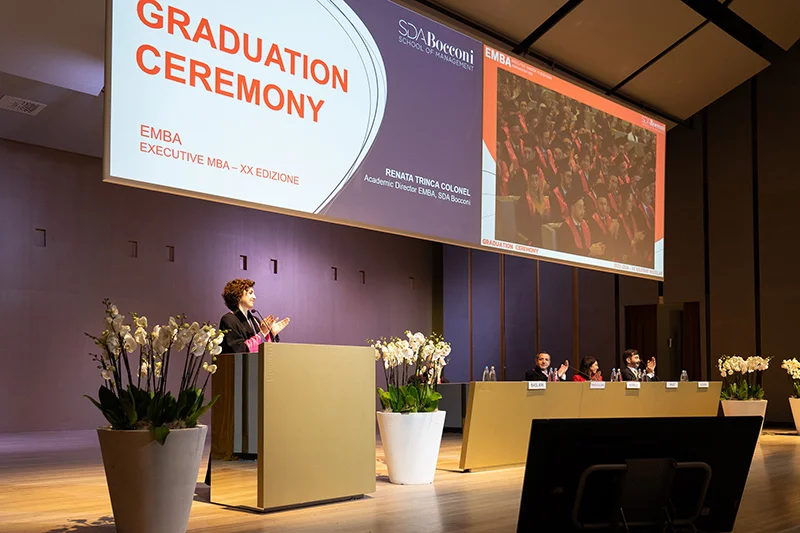
Can you share some success stories from participants who found the flexible formats pivotal in completing the program without compromising their careers?
One inspiring example is a woman with a technical executive background who went through a pregnancy while attending the program. Thanks to the flexibility of the EMBA and a personalized learning path, she was able to continue her studies seamlessly. Sponsored by her company, she successfully balanced her personal and professional commitments and was promoted to director immediately after graduation.
Another case involves an entrepreneur who applied innovative strategic frameworks and broadened his business perspectives using insights gained during the EMBA. Not only did he grow professionally, but he also created opportunities for others—offering a job position to one of his classmates. Just two years after graduating, they together launched a successful new entrepreneurial venture.
Finally, a student from the Pharma and Healthcare sector applied cost-efficiency models learned during the program directly in his company. By integrating academic insights into practical business solutions, he advanced his career significantly, reaching a global vice-president leadership role.
These stories highlight how the EMBA’s flexible formats enable students to thrive professionally while navigating their unique personal circumstances.
In light of SDA Bocconi’s high global ranking in environmental impact, have there been any movements to incorporate sustainability, ESG, or environmental impact themes further in the program?
Absolutely. At SDA Bocconi, we have been integrating sustainability and environmental impact themes into the EMBA curriculum for over five years now. Today, approximately 20 percent of the content across modules reflects sustainability-related topics and these are embedded within core business disciplines—not treated as add-ons, but as fundamental components of the program.
We also offer a mandatory course on Business Ethics, Diversity, Equity & Inclusion. It is essential for developing responsible leadership and enhancing students’ ethical decision-making capabilities.
In addition, since 2021 we have introduced a dedicated concentration week, our Business and Sustainability Week, consisting of 50 academic hours. It covers key topics such as circular economy principles, environmental risk assessment, ESG frameworks, and green investment strategies. It has consistently been one of the most in-demand sessions, fully booked each year, with around 60 EMBA students taking part annually.
What other innovations in learning approaches have been implemented recently in the EMBA to keep it cutting-edge?
We’re constantly innovating our learning approaches to ensure that the EMBA remains aligned with the evolving needs of executives and the business landscape. In recent years, we have introduced a number of new tools and methodologies that enhance both the learning experience and its practical relevance.
We’re constantly innovating our learning approaches to ensure that the EMBA remains aligned with the evolving needs of executives and the business landscape.
For example, we have integrated digital learning platforms with microlearning modules, allowing the class to engage with content in a more flexible and targeted way. We also make extensive use of advanced simulation technologies and business scenario simulations, which are crucial for applying knowledge in complex and uncertain contexts.
At the school level, we have recently introduced a Decalogue for the ethical and conscious use of AI, which provides a framework for responsible engagement with artificial intelligence, across all master programs, including the EMBA. We have also strengthened our focus on individual development through continuous performance monitoring and structured feedback systems.
As the Academic Director, how do you ensure that the program remains aligned with today’s global leadership and business challenges?
Keeping the EMBA closely aligned with today’s global leadership and business challenges means continuously evolving both content and learning formats. One of the key ways we do this is by offering students the possibility to personalize their learning path—choosing one or two concentration weeks from a portfolio of 10, which we update regularly to reflect emerging trends and business needs.
We also provide an international exchange program through partnerships with top global business schools, allowing students to gain exposure to different markets and perspectives. Each cohort also takes part in an international week abroad, selecting from three locations and topics, each hosted by a partner institution.
Toward the end of the program, students can join up to 13 optional seminars focusing on highly relevant and innovative themes, further strengthening the flexibility and relevance of the curriculum.
Guest speakers and company visits bring an additional layer of applied insight to the classroom, while the broader calendar of SDA Bocconi and Bocconi University events ensures continuous exposure to the latest ideas shaping the business world.
What kinds of career advancements do you typically see among EMBA graduates in the years following completion?
Career progression among EMBA graduates often becomes more visible in the medium term, typically within three years after graduation. At that stage, a significant percentage of students have either changed roles or moved to a different company. The majority capitalize on the degree within their current organization, taking on broader responsibilities or stepping into more strategic positions. Transitions may also include a sector change, often aligned with market trends and personal career planning.
Rather than immediate shifts, most graduates follow a step-by-step career strategy, supported by structured networking and a clearer understanding of their professional goals. While only a minority leave the corporate world entirely to pursue entrepreneurial ventures, several do initiate such projects in parallel with their main roles. These patterns of advancement are consistent across industries, reflecting the program’s broad applicability.
And finally, what can we expect to see from SDA Bocconi in the next decade?
In the next decade, SDA Bocconi will continue to strengthen its role as a truly global education player, expanding its international footprint while remaining deeply connected to its Italian and European roots. The School’s evolution will reflect the growing need for institutions that can combine global vision with local understanding, preparing professionals to navigate complexity with cultural awareness and strategic clarity.
At the same time, SDA Bocconi will remain at the forefront of innovation, embedding the responsible use of emerging technologies, including AI, into every aspect of its educational offer. This means not just adopting new tools, but helping students and organizations understand their impact, risks, and potential. The next chapter will be marked by an even stronger integration between academic rigor, technological progress, and a human-centered approach to business education.