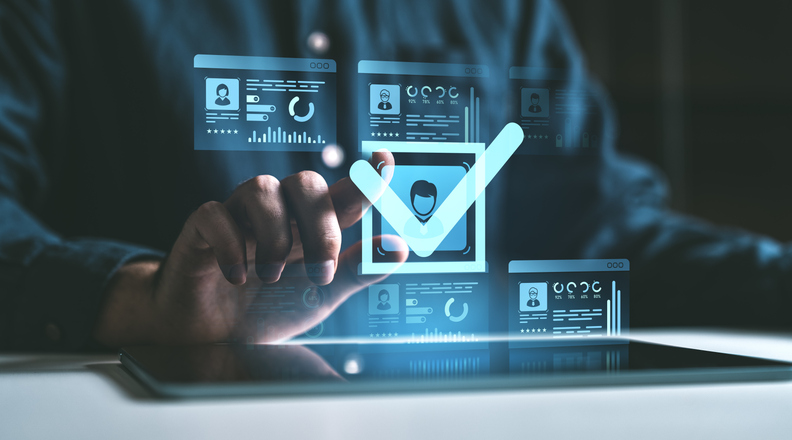
For most of the twentieth century, checking whether someone was who they claimed to be was a job for institutions. Banks verified borrowers. Employers verified candidates. Governments verified citizens. Private individuals who wanted to check up on someone hired an investigator, and paid accordingly.
That has changed remarkably fast. Verification has moved from the back office to the app store. Today a renter can screen a landlord, a seller can check a buyer, and someone about to go on a first date can confirm the person across the table exists.
This is the trust economy at the consumer level: a growing category of services that sell certainty to ordinary people. For business leaders, it’s worth understanding both as a market and as a signal of how expectations are shifting.
From institutional to personal
Three developments pushed verification into consumer hands.
- The platform economy. Marketplaces, ride-hailing, short-term rentals and dating apps all depend on strangers transacting with strangers. Each one created a need to trust someone you’ve never met.
- Cheap data and computing. Public records, image matching and identity checks that once required specialist access can now be delivered through a web form in seconds.
- A rise in impersonation. As more of life moved online, so did fraud. Generative AI has made convincing fake photos, voices and messages cheaper to produce than ever.
The result is a simple equation. More interactions with strangers, plus more convincing fakes, equals more demand for a way to check.
The cost of misplaced trust
The demand is not abstract. The US Federal Trade Commission reported that consumers lost more than $1.1 billion to romance scams in 2023, with a median reported loss of around $2,000 per person. Those figures only cover cases that were reported, and regulators have long noted that many victims never come forward.
Europe faces the same pattern, with national fraud bodies and Europol repeatedly warning about investment and romance fraud that begins on social and dating platforms.
When the potential downside of trusting the wrong person runs into thousands of euros, a service that reduces that risk for a small fee is an easy sell.
A map of the consumer verification market
The category is broader than most people assume. It breaks down roughly into five segments.
1. Identity verification inside platforms
Selfie checks, document scans and verified badges. Most large dating apps now offer some form of photo verification, and marketplaces increasingly require ID for sellers.
2. People-search and background services
Tools that compile public records such as addresses, court filings and business registrations. These are well established in the United States, where they are regulated in part by the Fair Credit Reporting Act. In Europe, the General Data Protection Regulation limits what can be offered far more tightly.
3. Reverse image and face search
Services that find where a photo appears elsewhere online. They are widely used to detect stolen profile pictures and catfishing.
4. Phone and email lookup
Caller identification and spam detection apps, which have become close to default on many smartphones.
5. Relationship verification
The newest and most debated segment: services that let a person check whether a specific individual has an active profile on a dating app. Consumer guides now compare paid tools with free ways to catch a cheater online, setting out what each method can realistically show and where it falls short. Whatever one thinks of the category, its existence says something about demand: people are willing to pay to resolve uncertainty in their private lives, just as companies pay to resolve it in commercial ones.
Why consumers buy
Understanding the motivation matters for anyone building or regulating in this space. Three drivers stand out.
- Safety. Meeting a stranger from the internet carries real risk. Confirming a name, a face and a history before meeting is increasingly treated as basic prudence, particularly by women.
- Financial protection. Deposits, online purchases and peer-to-peer payments all involve sending money to someone unknown.
- Emotional certainty. The least discussed and possibly the strongest driver. Uncertainty is uncomfortable, and people will pay to end it, whatever the answer turns out to be.
That last point has a direct business parallel. Companies spend heavily on due diligence not because they expect bad news, but because the cost of not knowing is higher than the cost of checking.
The regulatory line
The sector sits on a fault line between two legitimate interests: one person’s right to protect themselves and another person’s right to privacy. Where regulators draw that line differs sharply by region.
- European Union. GDPR requires a lawful basis for processing personal data and gives individuals rights of access and erasure. The EU AI Act adds strict limits on certain biometric uses, including the untargeted scraping of facial images to build recognition databases.
- United States. A patchwork. Federal rules cover consumer reports used for employment, credit and housing. Several states, notably Illinois with its Biometric Information Privacy Act, regulate biometric data directly.
- United Kingdom. UK GDPR broadly mirrors the EU approach, and the Online Safety Act places duties on platforms to tackle fraud and illegal content.
For operators, compliance is not a side issue. It is the product. A verification service that cannot explain where its data comes from, how long it keeps it and how a person can opt out is carrying a serious liability.
The ethical test
Law sets the minimum. The harder question is whether a given tool makes people safer or simply makes monitoring easier.
A few principles separate responsible services from the rest:
- Public information only. Checking what a profile already shows to strangers is different in kind from accessing a private account or device.
- No covert tracking. Stalkerware and hidden location tracking are illegal in many jurisdictions and widely recognized as tools of abuse.
- Clear limits on claims. A responsible provider tells customers what a result does not prove.
- A working opt-out. People must be able to have their data removed.
Services that respect these lines are likely to survive regulatory scrutiny. Those that don’t are building on sand.
What this means for business leaders
The lessons extend well beyond consumer apps.
- Trust is now a product feature. Customers have learned to expect verification. Platforms that offer visible, credible checks win users from those that don’t.
- Verification is moving left. Checks that once happened at the end of a process, such as signing a contract, now happen at first contact. B2B buyers increasingly research counterparties before the first call.
- Your employees are consumers too. Staff who verify a date or a landlord in their personal lives bring the same habits to work. That is useful for fraud prevention and worth supporting with proper tools, so that they don’t improvise with unvetted ones.
- Privacy-first design is a competitive edge. In a GDPR environment, the winners will be those who deliver certainty with the least data.
Outlook
Several trends are likely to shape the next few years.
- AI on both sides. The same technology that produces convincing fakes also powers detection. Expect an ongoing contest.
- Portable identity. The EU Digital Identity Wallet aims to let citizens prove specific facts about themselves, such as age, without handing over a full document. If adopted widely, it could reduce the need for third-party lookups.
- Platform responsibility. Regulators are steadily shifting the burden of verification from users to the platforms that connect them.
- Consolidation. A fragmented market of small tools is likely to be absorbed into larger safety and identity suites.
Conclusion
The rise of consumer verification reflects a plain fact: people now do a great deal of business, and a great deal of living, with strangers. They want what institutions have always wanted in that position, which is a way to check before they commit.
The companies that serve that need responsibly, with lawful data, honest claims and respect for the person being checked, are building something durable. Trust was always valuable. It is now also a market.