

By Scott Hutcheson
Emotional intelligence is often described in vague or idealistic terms, but its real power lies in how it shows up moment to moment in tone, timing, posture, and behavior. This article explores emotional intelligence through the lens of behavioral biology and shows what it looks like when practiced with signal clarity.
What Emotional Intelligence Really Looks Like in Action
Emotional intelligence is often described as the ability to recognize, understand, and manage one’s own emotions while also recognizing, understanding, and influencing the emotions of others. This two-part framework, popularized by Daniel Goleman, has shaped leadership development for decades. But for many leaders, the concept still feels abstract and more like a personality trait than a set of observable actions.
What’s missing from most discussions of emotional intelligence is what happens between awareness and impact. Emotion is not just a feeling. It is part of a biological sequence. Leaders who understand this sequence can manage their behavior in ways that shape performance, trust, and engagement in real time.
The Biology of Behavior and Emotional Intelligence
Emotions begin in the body. A leader sends a signal through tone, posture, language, or timing. That triggers a physiological reaction in others. The nervous system responds first, activating energy across systems like the heart, lungs, and digestive tract. This energy isn’t metaphorical. It involves real changes in breathing, heart rate, and gut tension, often directed by the autonomic nervous system.
Those physiological shifts prompt a cascade of neurochemical responses. Depending on the nature of the signal and the context, the body may release cortisol, dopamine, norepinephrine, or oxytocin. These chemicals help the brain interpret what the body is experiencing. The result is a felt emotion. Trust, anxiety, curiosity, or defensiveness, to name just a few That emotion shapes behavior, which becomes visible through actions, expressions, and engagement.
Finally, the leader can observe that behavior and adjust their signal if it is not producing the intended effect. This five-part loop forms the Biology of Behavior Cycle:
- Leadership signal
- Physiological reaction
- Emotion interpreted by the brain
- Behavior
- Leader observes behavior and adjusts signal
This is not metaphor. It is how social behavior works. The body responds before the brain constructs a feeling. And that feeling becomes behavior, setting the emotional tone of a room long before any content is processed.
Emotional Intelligence Is Observable
Leaders often talk about emotional intelligence as something to cultivate. But few describe what it actually looks like.
It looks like pacing your speech intentionally when tensions rise. It looks like adjusting your tone when you sense fatigue or confusion in the room. It shows up in how you listen without interrupting, and how you pause before speaking to let others catch up or settle in.
These are not soft or vague behaviors. They are observable, trainable, and grounded in biology. Others interpret your presence long before they evaluate your strategy. And they behave accordingly.
Signal Clarity Is the Real Skill
Most emotional intelligence models focus on internal awareness. But in behavioral terms, what matters most is signal clarity, whether the emotional message others receive is consistent with your intent.
When a leader expresses appreciation but remains visibly distracted, the signal is unclear. When someone encourages openness but communicates judgment with body language, the signal backfires. Signal clarity is not about perfection. It is about alignment between what you intend and what others perceive.
Clarity builds trust. Trust makes collaboration easier. Over time, that consistency shapes group norms and performance patterns.
How to Practice Emotional Intelligence Through Behavior
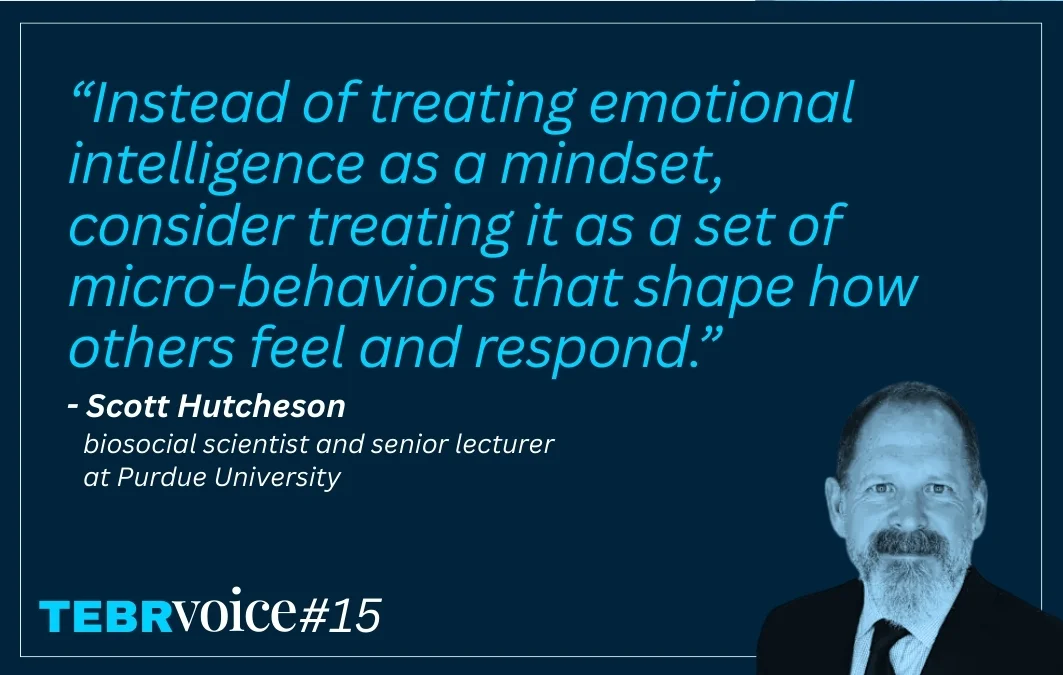
Instead of treating emotional intelligence as a mindset, consider treating it as a set of micro-behaviors that shape how others feel and respond. These practices allow you to shift from passive awareness to intentional influence.
1. Anchor your physiology
Your nervous system broadcasts signals constantly. Before important moments, take a breath. Adjust posture. Let your physical state match your desired message.
2. Set emotional intent
Ask, “What emotional tone do I want others to feel in this moment?” Use that to guide how you show up—your timing, phrasing, and level of energy.
3. Observe others’ behavior
If people become quieter, more guarded, or disengaged, consider whether your signals might be contributing. Look for nonverbal cues, not just spoken feedback.
4. Adjust in real time
When your behavior is not producing the outcome you hoped for, shift. Acknowledge it. Calibrate your next move. This responsiveness is one of the most respected forms of leadership.
Emotional Intelligence Shapes Systems
Framing emotional intelligence as a behavioral process helps explain why it matters. The signals leaders send affect how others feel, and those feelings shape how others behave. Over time, this process sets the emotional tone of the team and, eventually, the culture of the organization.
The stakes are high. When signals create uncertainty or tension, cognitive resources are drained. Teams struggle to focus or adapt. When signals create coherence and psychological safety, teams align more quickly and perform more effectively.
What distinguishes emotionally intelligent leaders is not how much empathy they feel, but how consistently they regulate the signals that shape group behavior.
 Scott Hutcheson